
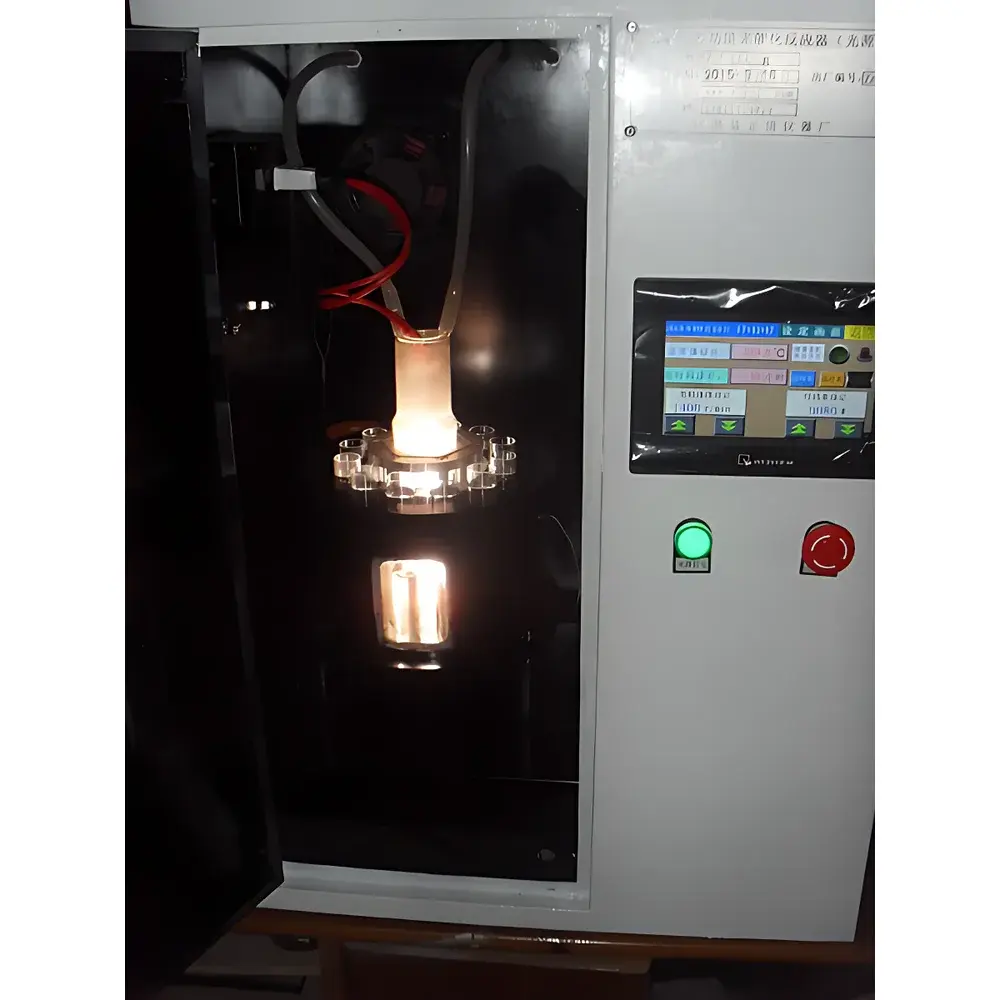
ZXF-LCA-6 Photocatalytic Reaction System by Zhengxin Instrument Factory
| Brand | Zhengxin Instrument Factory / zxyiqi |
|---|---|
| Origin | Jiangsu, China |
| Manufacturer Type | Authorized Distributor |
| Origin Category | Domestic (China) |
| Model | ZXF-LCA-6 |
| Price | USD 6,000 (approx.) |
| Temperature Range | 0–80 °C (ambient-assisted, non-integrated heating/cooling) |
| Temperature Control Accuracy | ±1 °C |
| Reaction Units | 12 parallel channels |
| Reaction Vessel Capacity | 5–10 mL per tube |
| Light Source Power Adjustment | 100–1000 W (continuous, touchscreen-controlled) |
| Light Sources Included | 1000 W Hg lamp (UV), 1000 W Xe lamp (solar-simulated), quartz reaction tubes (30 mL, 50 mL), quartz cold finger |
| Cooling Interface | Dual-port water circulation inlet/outlet with integrated fans |
| Safety Features | UV-blocking observation window, emergency stop switch, touch-screen interface (7″), temperature monitoring port, light-shielding fixture, motorized tube rotation + magnetic stirring |
| Compliance | Designed for laboratory-scale photocatalysis research under ISO/IEC 17025-aligned workflows |
Overview
The ZXF-LCA-6 Photocatalytic Reaction System is a benchtop, multi-channel photochemical reactor engineered for reproducible, scalable investigation of heterogeneous and homogeneous photocatalytic processes under controlled irradiation conditions. It operates on the principle of photon-driven redox reactions—where incident photons (UV to visible) excite semiconductor catalysts (e.g., TiO₂, g-C₃N₄, or doped metal oxides) or activate oxidants (e.g., H₂O₂, O₃, KMnO₄)—to generate reactive oxygen species (•OH, O₂•⁻, ¹O₂) or direct charge-transfer pathways. Its 12-position configuration enables statistically robust comparative studies across catalyst formulations, light spectra, dosing strategies, or solution matrices—critical for kinetic modeling, catalyst screening, and mechanistic validation in environmental remediation and synthetic photochemistry.
Key Features
- Twelve independently addressable reaction positions with simultaneous magnetic stirring and motorized orbital tube rotation—ensuring uniform photon flux distribution and minimizing boundary-layer effects.
- Integrated dual-light-source control: 1000 W mercury lamp (254 nm primary emission) and 1000 W xenon lamp (300–800 nm, AM1.5G spectral match), both dimmable from 10% to 100% output via calibrated touchscreen interface.
- Quartz cold finger assembly with dedicated water-in/water-out ports maintains stable thermal environment during high-power irradiation; compatible with external chillers for sub-ambient operation.
- Modular optical train: Interchangeable filter mounts (not included) allow spectral bandpass selection (e.g., UVC, UVB, UVA, visible cutoff); quartz reaction tubes (5–10 mL nominal volume) ensure >90% UV transmission down to 190 nm.
- Embedded safety architecture: Lead-free UV-absorbing borosilicate observation window, redundant emergency stop circuitry, real-time temperature monitoring port, and automatic lamp shutdown upon door opening or coolant flow interruption.
- Compact footprint (W×D×H ≈ 520 × 480 × 320 mm) with front-access service panel and rear-mounted ventilation fans for sustained 8-hour operation at full power.
Sample Compatibility & Compliance
The ZXF-LCA-6 accommodates liquid-phase samples in standard quartz test tubes (inner diameter 12–16 mm), supporting suspensions of powdered catalysts (e.g., P25 TiO₂), immobilized thin-film catalysts on quartz substrates, colloidal quantum dots, or dissolved photosensitizers. It is routinely deployed in studies aligned with ASTM D7613 (standard test method for photocatalytic activity of nanomaterials), ISO 22197-1 (NO removal testing), and USP extractables assessment protocols. While the system itself does not carry CE or UL certification, its electrical design conforms to IEC 61010-1:2010 safety requirements for laboratory equipment. Data acquisition—when paired with external thermocouples, pH meters, or dissolved oxygen probes—can be structured to meet FDA 21 CFR Part 11 audit-trail requirements via timestamped CSV export.
Software & Data Management
The embedded 7-inch capacitive touchscreen runs a deterministic real-time OS with no background tasks or internet connectivity—ensuring electromagnetic compatibility with sensitive analytical instrumentation. All operational parameters (lamp intensity %, runtime, stir speed, door status, emergency stop events) are logged locally to internal flash memory with microSD card backup option. Export formats include UTC-referenced .csv files containing time-stamped event markers and analog sensor inputs (e.g., thermistor voltage → °C conversion). No proprietary drivers or cloud dependencies are required; raw logs integrate seamlessly with MATLAB, Python (pandas), or LabVIEW-based analysis pipelines.
Applications
- Photocatalytic degradation kinetics of recalcitrant organics: antibiotics (ciprofloxacin, sulfamethoxazole), pesticides (diuron, atrazine), dyes (methylene blue, rhodamine B), PAHs (phenanthrene, pyrene), and halogenated compounds (chloroform, PCB-77).
- Reductive dehalogenation of Cr(VI) to Cr(III), Hg(II) to Hg⁰, or Se(IV) to elemental Se using TiO₂/Cu co-catalysts under UV–vis irradiation.
- Photo-Fenton and persulfate activation studies requiring precise control over H₂O₂/O₃/K₂S₂O₈ dosing synchronized with light pulses.
- Thin-film photocatalyst evaluation using spin-coated or dip-coated substrates mounted on custom quartz holders.
- Comparative solar-simulated vs. monochromatic UV efficacy testing for regulatory reporting (e.g., OECD TG 316 adaptation).
FAQ
Does the ZXF-LCA-6 include temperature regulation beyond ambient cooling?
No. The system provides passive thermal management via circulating water through the quartz cold finger and forced-air convection. Active heating or refrigerated temperature control requires integration with an external chiller/heater circulator connected to the inlet/outlet ports.
Can the rotation and stirring functions operate independently?
Yes. Motorized tube rotation (0–60 rpm) and magnetic stirring (0–1200 rpm) are decoupled and individually adjustable via the touchscreen interface.
Is ozone generation mitigation built into the enclosure?
The unit includes exhaust fan ventilation but does not incorporate catalytic ozone destruct modules. For high-intensity UV-C operation, external ozone scrubbing (e.g., MnO₂ filter) is recommended per OSHA PEL guidelines.
What calibration documentation is supplied?
A factory-verified irradiance map (measured at each tube position using NIST-traceable UV-A/UV-C broadband sensor) and touchscreen firmware version log are provided with shipment.
Are replacement lamps and quartz components available as spare parts?
Yes. Mercury and xenon short-arc lamps, quartz cold fingers, and standard OD2 quartz tubes (12 mm ID × 100 mm length) are stocked and shipped globally with lead times under 10 business days.



