
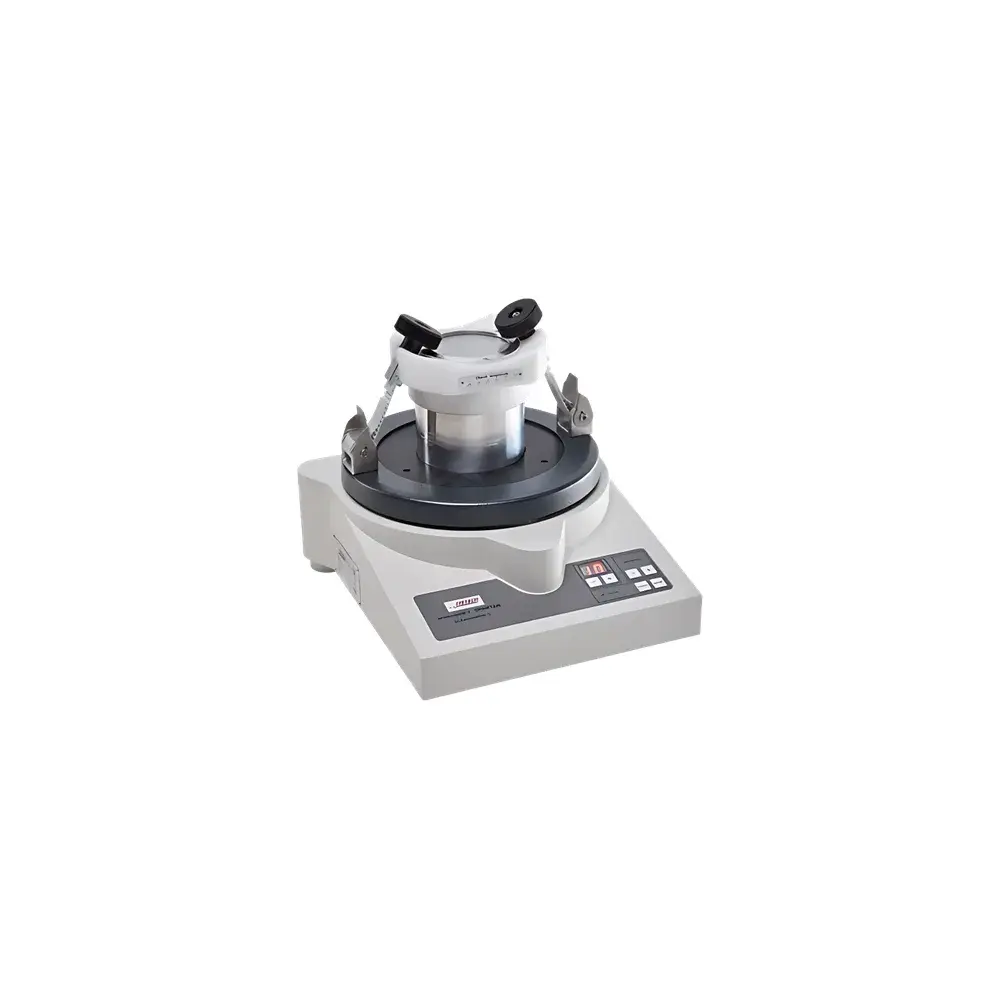
FRITSCH PULVERISETTE 0 Micro Vibratory Ball Mill
| Brand | FRITSCH |
|---|---|
| Origin | Germany |
| Model | PULVERISETTE 0 |
| Power Supply | 100–240 V, 1~ , 50–60 Hz, 50 W |
| Max. Feed Size | 5 mm |
| Max. Sample Volume | 10 mL |
| Min. Sample Volume | 0.1 mL |
| Final Particle Size | 5–10 µm |
| Grinding Modes | Dry & Wet |
| Net Weight | 21 kg |
| Gross Weight | 23 kg |
| Dimensions (L×W×H) | 37 × 40 × 20 cm |
| Optional Accessory | Cryo-Grinding Adapter |
Overview
The FRITSCH PULVERISETTE 0 Micro Vibratory Ball Mill is a precision-engineered laboratory instrument designed for the controlled size reduction of minute sample quantities—ranging from 0.1 mL to 10 mL—under reproducible, low-energy vibrational forces. Unlike planetary or centrifugal ball mills, the PULVERISETTE 0 operates on high-frequency vertical oscillation (vibratory grinding), generating kinetic energy through rapid, short-amplitude motion of grinding balls within a sealed, cylindrical grinding chamber. This principle enables efficient comminution while minimizing thermal load and mechanical stress, making it especially suitable for heat-sensitive, brittle, or heterogeneous materials such as pharmaceutical actives, catalysts, polymers, and biological tissues. Its compact footprint and low power consumption (50 W) align with modern lab sustainability requirements without compromising grinding resolution or repeatability.
Key Features
- Micro-scale processing capability: Optimized for ultra-small volumes (0.1–10 mL), eliminating material waste and enabling high-value sample handling.
- Dual-mode operation: Supports both dry grinding and wet grinding (including suspension homogenization and emulsion preparation) using standardized, interchangeable grinding vials.
- Real-time process monitoring: Integrated transparent observation window allows visual assessment of grinding dynamics, particle dispersion, and agglomeration behavior during operation.
- Precision digital timer: Programmable grinding duration from 1 second to 99 minutes with 1-second resolution, ensuring strict protocol adherence in GLP/GMP environments.
- Adjustable amplitude control: Fine-tuned vibration intensity permits optimization of energy input based on sample hardness, density, and target fineness—critical for achieving narrow particle size distribution (PSD).
- Cryo-grinding compatibility: Optional cryo-adapter enables liquid nitrogen cooling of the grinding chamber, facilitating embrittlement of elastomers, waxes, and thermolabile compounds prior to milling.
- Low-contamination architecture: Stainless steel grinding elements and PTFE- or hardened steel vial options minimize cross-contamination and metal leaching, supporting trace-level analysis workflows.
Sample Compatibility & Compliance
The PULVERISETTE 0 accommodates diverse sample matrices—including inorganic powders, organic crystals, freeze-dried biologics, ceramic precursors, and viscous pastes—without requiring pre-drying or dilution. Its closed-system design prevents aerosol release and complies with OSHA and EU Directive 2004/37/EC (carcinogens/mutagens) for operator safety. When configured with certified grinding media and vials, the system supports method validation per ISO 13320 (laser diffraction particle sizing) and ASTM E2904 (microstructural analysis). Data integrity is reinforced by time-stamped operational logs, compatible with FDA 21 CFR Part 11–compliant LIMS integration when paired with FRITSCH’s optional software interface.
Software & Data Management
While the base PULVERISETTE 0 operates via standalone digital controls, it is fully compatible with FRITSCH’s optional “ComplianceControl” software suite. This platform provides audit-trail-enabled method storage, user-access level management (admin/operator), electronic signature support, and exportable CSV/Excel reports containing timestamped parameters (duration, amplitude setting, cycle count). All data files are hashed and immutable post-generation, satisfying ALCOA+ principles (Attributable, Legible, Contemporaneous, Original, Accurate, Complete, Consistent, Enduring, Available) required under GxP-regulated quality systems.
Applications
- Pharmaceutical R&D: Pre-formulation screening of API crystallinity and polymorph stability via cryo-milling followed by XRD or DSC.
- Materials science: Homogenization of nanocomposite precursors and dispersion of carbon nanotubes in polymer melts.
- Environmental testing: Preparation of soil/sediment sub-samples for heavy metal extraction (EPA Method 3050B) and speciation analysis.
- Food & cosmetics: Particle size optimization of pigments, stabilizers, and active ingredients in emulsions and膏-like formulations.
- Academic research: Rapid sample conditioning for SEM-EDS, TEM grid preparation, and MALDI-TOF matrix co-crystallization.
FAQ
What is the maximum rotational speed or frequency of the PULVERISETTE 0?
The PULVERISETTE 0 does not rotate; it operates via vertical vibratory motion at a fixed frequency of approximately 1,800–2,200 oscillations per minute (30–37 Hz), depending on amplitude setting.
Can I use stainless steel grinding balls with corrosive samples?
For acidic or halide-containing suspensions, we recommend tungsten carbide or zirconia grinding media—stainless steel may corrode and introduce metallic contamination.
Is the instrument compliant with ISO/IEC 17025 for accredited testing labs?
Yes—the device meets mechanical and electrical safety standards per EN 61000-6-2/-6-3 and supports documented calibration of time and amplitude functions, fulfilling clause 6.4.10 (equipment verification) of ISO/IEC 17025:2017.
How often does the grinding vial require cleaning between runs?
Cleaning is mandatory between samples; FRITSCH supplies ultrasonic-compatible vials and recommends solvent rinsing followed by vacuum drying to prevent carryover—validated via blank runs monitored by FTIR or elemental analysis.



