
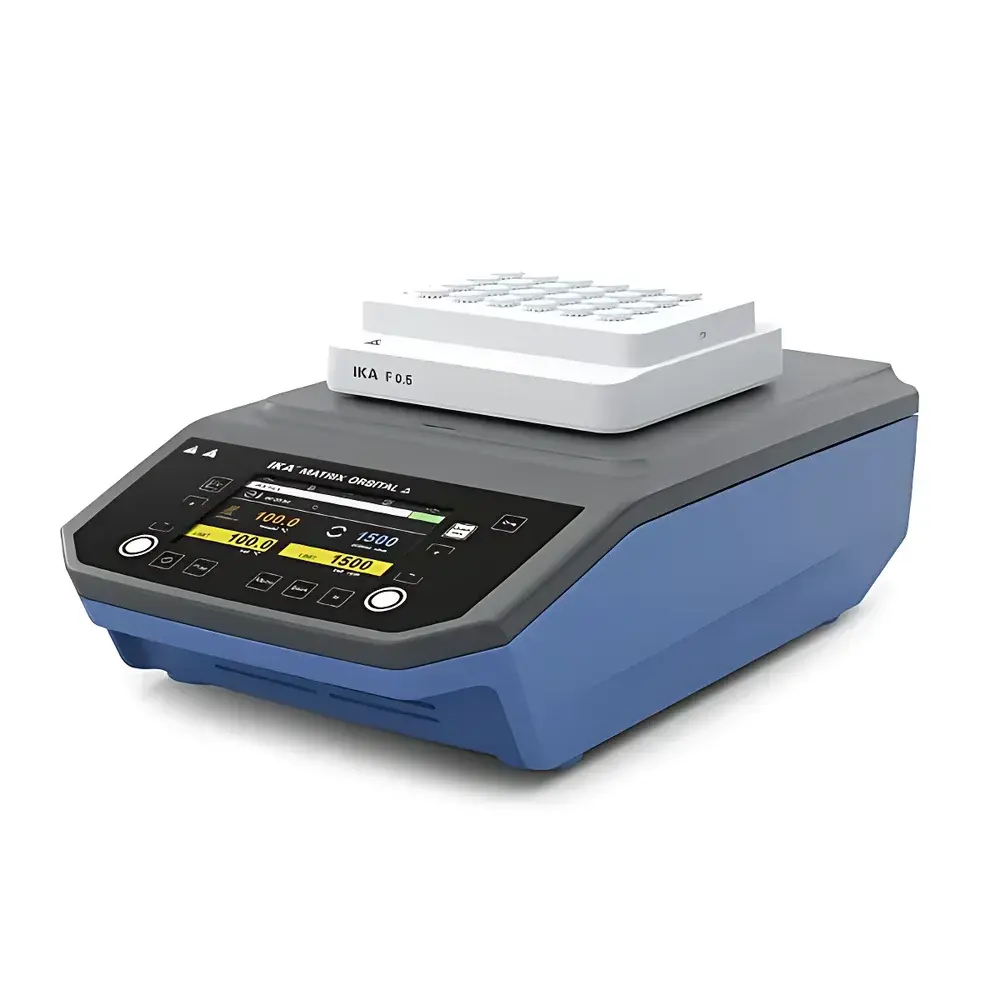
IKA MATRIX Orbital Delta F0.5 Thermostatic Orbital Shaker
| Brand | IKA |
|---|---|
| Origin | Germany |
| Model | MATRIX Orbital Delta F0.5 |
| Orbit Diameter | 3 mm |
| Max Load | 0.3 kg |
| Speed Range | 0–2000 rpm |
| Min Adjustable Speed | 300 rpm |
| Speed Accuracy | ±30 rpm |
| Speed Resolution | 10 rpm steps |
| Timer Range | 1 s – 6000 min |
| Heating Range | RT +4 °C to 100 °C |
| Heating Power | 100 W |
| Temp. Control Accuracy | ±0.5 °C |
| Temp. Uniformity | ±0.5 °C (20–45 °C), ±1.5 °C (other ranges) |
| Temp. Stability | ±0.5 °C |
| Heating Rate | 15 °C/min |
| Sample Capacity | 24 × 0.5 mL tubes |
| Dimensions (W×D×H) | 216 × 149 × 351 mm |
| Weight | 9.2 kg |
| Ambient Operating Conditions | 5–40 °C, RH ≤80% |
| Protection Class | IP21 (DIN EN 60529) |
| Interfaces | RS232, USB |
| Power Supply | 100–240 V, 50/60 Hz |
| Max Input Power | 240 W |
| Fuse | 2× T4A 250V |
Overview
The IKA MATRIX Orbital Delta F0.5 is a precision-engineered thermostatic orbital shaker designed for reproducible, contamination-free mixing and temperature-controlled incubation of low-volume biological samples. Based on orbital motion with a fixed 3 mm diameter path, the device employs Couette-type fluid dynamics to induce homogeneous vortexing in microvolume formats—particularly optimized for 24 positions of 0.5 mL reaction tubes. Its integrated Peltier-based heating system enables rapid thermal equilibration (up to 15 °C/min) and stable setpoint maintenance (±0.5 °C stability at 37 °C), making it suitable for applications requiring simultaneous thermal conditioning and mechanical agitation—such as enzymatic reactions, cell lysis, immunoassay plate preparation, and nucleic acid hybridization protocols. The instrument operates within a validated ambient envelope (5–40 °C, ≤80% RH) and conforms to IEC 61010-1 safety standards for laboratory equipment.
Key Features
- Orbital shaking platform with precisely controlled 3 mm orbit diameter ensures consistent shear profile across all 24 tube positions
- Wide speed range (0–2000 rpm) with 10 rpm resolution and real-time TFT display for accurate parameter monitoring
- Integrated Peltier heating module delivering uniform temperature distribution (±0.5 °C at 20–45 °C; ±1.5 °C across full 4–100 °C range)
- Programmable ramp-and-hold temperature profiles, enabling automated thermal transition sequences without external controllers
- Aluminum die-cast housing providing structural rigidity, vibration damping, and long-term mechanical stability under continuous operation
- Dual digital interfaces (RS232 and USB) supporting remote command execution, data logging, and integration into centralized lab automation systems
- Intuitive menu-driven TFT interface with multilingual support, timer visualization, and real-time feedback on speed, temperature, and elapsed time
Sample Compatibility & Compliance
The MATRIX Orbital Delta F0.5 is configured exclusively for standardized 0.5 mL microcentrifuge tubes, ensuring optimal tube retention and minimal cross-contamination risk during high-speed orbital motion. Its compact footprint and sealed enclosure meet IP21 ingress protection requirements per DIN EN 60529, safeguarding internal electronics from accidental splashes and particulate ingress. The device complies with EU Directive 2014/30/EU (EMC) and 2014/35/EU (LVD), and its firmware architecture supports audit-trail-capable operation when connected to compliant LIMS or ELN platforms. While not certified for GMP manufacturing environments, its temperature accuracy (±0.5 °C) and speed repeatability align with common QC validation criteria referenced in ISO/IEC 17025 and CLSI EP21-A guidelines for analytical instrument qualification.
Software & Data Management
Via RS232 or USB connection, the shaker accepts ASCII-based SCPI commands for integration into custom scripts or third-party control software (e.g., LabVIEW, Python pySerial). All operational parameters—including speed setpoint, temperature setpoint, timer duration, and active mode (continuous/timer/program)—are readable and writable in real time. The onboard memory retains up to 10 user-defined programs, each comprising up to 5 sequential steps with independent speed, temperature, and dwell time definitions. Data export functionality includes timestamped logs of actual speed and temperature values at 1-second intervals, compatible with CSV parsing for post-acquisition statistical analysis (e.g., ANOVA, control charting). No proprietary software installation is required; configuration is fully accessible via terminal emulation or manufacturer-provided configuration utility.
Applications
- Pre-analytical sample homogenization for clinical diagnostics (e.g., whole blood, serum, plasma aliquoting prior to ELISA or PCR)
- Controlled thermal activation of restriction enzymes, ligases, and reverse transcriptases in molecular biology workflows
- Optimized antigen-antibody binding kinetics studies in microvolume immunoassays
- Routine resuspension of lyophilized reagents and dried-down nucleic acid pellets
- Cell suspension maintenance during short-term incubation steps in microbiology and stem cell culture prep
- Accelerated solvent extraction protocols in small-scale metabolite profiling workflows
FAQ
Can the MATRIX Orbital Delta F0.5 accommodate tube formats other than 0.5 mL?
No—the instrument is mechanically engineered for 24-position 0.5 mL tube racks only. Adapters or alternative blocks are not available or validated by IKA.
Is the heating system capable of cooling below ambient temperature?
No. The Peltier module provides heating only; refrigeration functionality is not implemented.
What is the maximum recommended duty cycle for continuous operation?
The unit is rated for indefinite continuous operation at any combination of speed and temperature within its specified limits, provided ambient conditions remain within 5–40 °C and relative humidity does not exceed 80%.
Does the device support FDA 21 CFR Part 11-compliant electronic records?
While the hardware supports secure parameter logging and user-accessible data export, full Part 11 compliance requires deployment within a validated IT infrastructure—including role-based access control, electronic signatures, and audit trail archiving—which must be implemented externally.
How is temperature uniformity verified across the block?
IKA performs factory calibration using NIST-traceable PT100 sensors placed at geometrically distributed points (center and four corners) within the tube rack interface plane, with uniformity reported per ISO 8573-1 Annex B methodology.





