
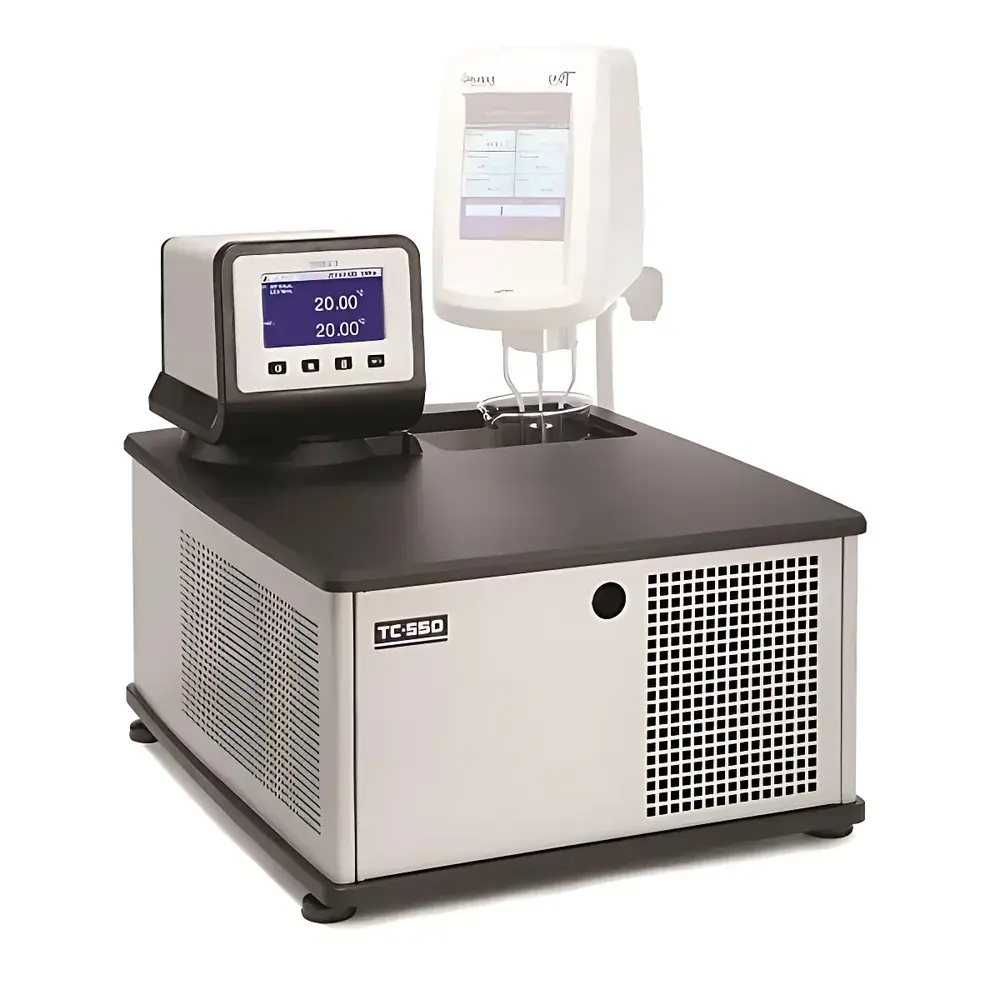
Brookfield TC-550 Precision Temperature-Controlled Circulating Water Bath
| Brand | Brookfield |
|---|---|
| Origin | USA |
| Model | TC-550 |
| Temperature Range (MX) | –20 °C to +135 °C |
| Temperature Range (AP) | –20 °C to +200 °C |
| Temperature Range (SD) | –20 °C to +170 °C |
| Temperature Stability (MX) | ±0.07 °C |
| Temperature Stability (AP) | ±0.01 °C |
| Temperature Stability (SD) | ±0.04 °C |
| Control Interface | MX — large-character LCD |
| Pump Configuration | MX — single-speed pump |
| External Circulation | Yes |
| Max Internal Bath Volume Capacity | 600 mL (standard beaker compatibility) |
| Software Integration | Compatible with RheocalcT v3.0+ for remote parameter setting, real-time monitoring, and GLP-compliant data logging |
Overview
The Brookfield TC-550 is a high-precision, circulating temperature-controlled bath engineered for laboratory environments requiring stable, reproducible thermal conditioning of samples during rheological, viscosity, density, or material property testing. Unlike passive water baths, the TC-550 integrates a closed-loop circulation system with PID-controlled heating and optional refrigeration (depending on configuration), enabling active thermal regulation across an extended range—from sub-zero cooling to high-temperature operation. Its design adheres to core principles of heat transfer thermodynamics and fluid dynamics, ensuring uniform temperature distribution within the bath chamber and consistent thermal coupling to immersed vessels. The unit serves as both a standalone thermal platform and a critical subsystem in automated viscometry workflows—particularly when paired with Brookfield DVNext or CAP2000+ viscometers via RheocalcT software.
Key Features
- Precision temperature control across three controller variants: MX (economy-grade, ±0.07 °C stability), SD (mid-tier, ±0.04 °C, full-color touchscreen, dual-speed circulation), and AP (high-end, ±0.01 °C, multi-speed programmable pump, advanced ramp/soak profiles)
- Extended operational range: –20 °C to +135 °C (MX), –20 °C to +170 °C (SD), and –20 °C to +200 °C (AP)—enabling testing under cryogenic, ambient, and elevated-temperature conditions
- Integrated circulation pump with external porting capability—supports connection to jacketed viscometer spindles, jacketed sample cells, or auxiliary heat exchangers
- No tap-water dependency: self-contained reservoir with low-evaporation design and overheat/low-fluid safety cutoffs compliant with IEC 61010-1
- Bath chamber optimized for 600 mL cylindrical glassware (e.g., ASTM D2196-compliant beakers), with center-aligned inlet/outlet ports to minimize thermal stratification
- Controller firmware supports both local setpoint adjustment (via intuitive scroll-and-select interface) and full remote orchestration via RS-232/USB or Ethernet (RheocalcT v3.0+)
Sample Compatibility & Compliance
The TC-550 accommodates standard laboratory glassware up to 600 mL without modification, making it compatible with ISO 2555, ASTM D1084, and USP viscosity test protocols. Its temperature uniformity profile (<±0.15 °C across 50 mm vertical zone at 25 °C) meets the spatial homogeneity requirements specified in ISO 17025-accredited calibration labs. All controller variants support audit-trail-enabled operation when used with RheocalcT under FDA 21 CFR Part 11-compliant configurations—including electronic signatures, user-level access controls, and immutable timestamped log files. The unit carries CE marking per Directive 2014/30/EU (EMC) and 2014/35/EU (LVD), and complies with RoHS 2011/65/EU material restrictions.
Software & Data Management
RheocalcT software (v3.0 and later) provides bidirectional communication with all TC-550 controller types, enabling synchronized temperature ramping alongside viscometer speed profiling. Users can define multi-step thermal programs—including hold times, linear ramps, and step transitions—with automatic synchronization to torque, shear rate, or viscosity acquisition triggers. Data export is supported in CSV, XML, and PDF formats, with embedded metadata (operator ID, instrument serial number, environmental timestamp, and calibration certificate traceability). For GxP-regulated environments, RheocalcT’s validation package includes IQ/OQ documentation templates and configurable electronic signature workflows aligned with ALCOA+ data integrity principles.
Applications
- Temperature-dependent viscosity measurements per ASTM D445 and ISO 3104, especially for lubricants, polymers, and pharmaceutical suspensions
- Thermal stability assessment of emulsions and colloidal dispersions under controlled isothermal or dynamic thermal cycling
- Calibration of temperature-sensitive transducers (e.g., RTDs, thermistors) against NIST-traceable references
- Pre-conditioning of samples prior to DSC, TGA, or DMA analysis to eliminate thermal history effects
- Supporting ASTM D7900 gel time testing for epoxy resins and composite precursors through precise isothermal curing control
- Integration into automated QC lines for food-grade syrups, sauces, and dairy products where batch-to-batch thermal consistency is critical
FAQ
What is the minimum recommended fluid volume for stable temperature control?
The TC-550 requires a minimum working fluid volume of 3.5 L to ensure adequate thermal mass and pump priming. Distilled or deionized water is recommended for temperatures below 90 °C; silicone oil (e.g., Dow Corning 200 Fluid) is required above 100 °C.
Can the TC-550 be operated without external software?
Yes—all models support fully autonomous operation via front-panel controls. Programming functions (ramp rates, dwell times, setpoints) are accessible without RheocalcT, though advanced data logging and multi-instrument coordination require software integration.
Is external refrigeration necessary for sub-zero operation?
The TC-550 AP and SD variants include integrated compressor-based cooling; the MX variant requires an external chiller for operation below 0 °C.
How often does the TC-550 require calibration verification?
Per ISO/IEC 17025 guidelines, periodic verification using a NIST-traceable reference thermometer is recommended every 6 months—or before critical qualification runs—and after any physical impact or firmware update.
Does the TC-550 meet GLP requirements for regulated laboratories?
When deployed with RheocalcT v3.0+ in audit-mode configuration (user authentication, electronic signatures, and tamper-evident logs), the TC-550 satisfies core GLP data integrity and instrument control requirements outlined in OECD Principles of GLP and FDA Guidance for Industry.



