
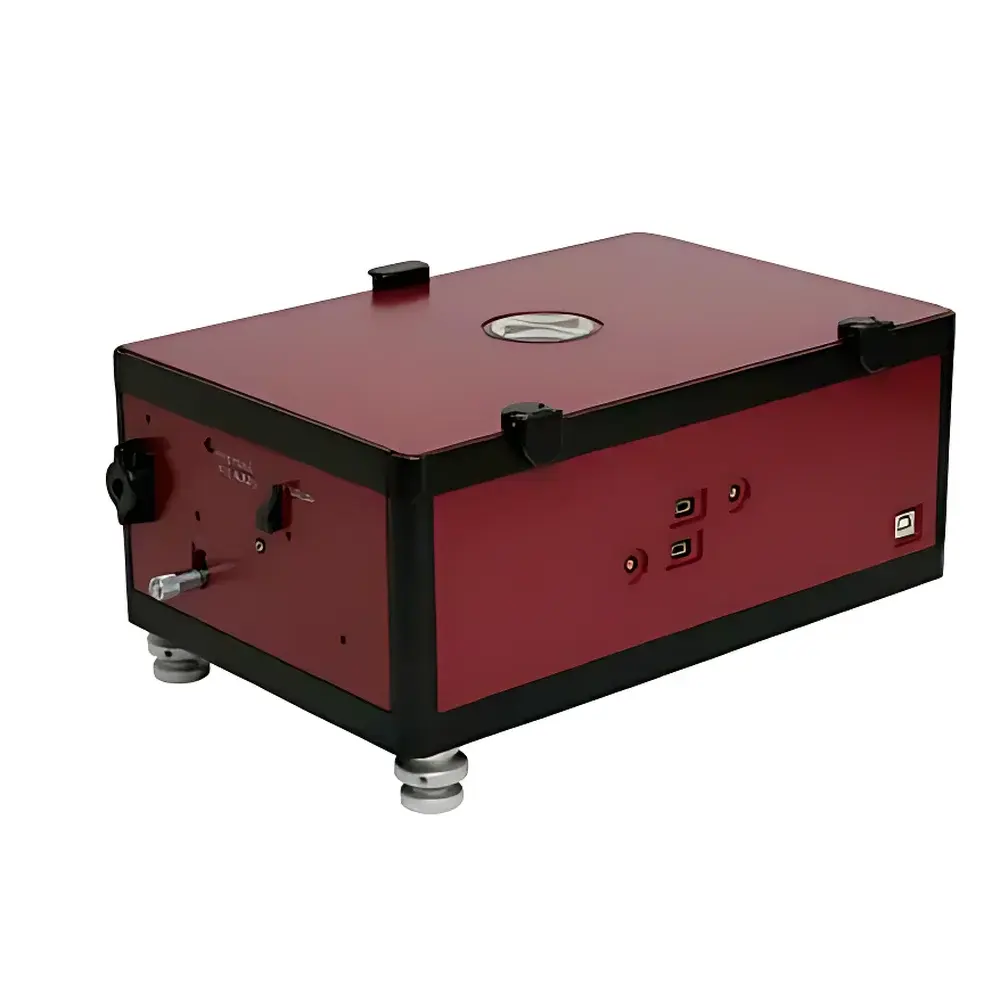
ATSEVA SPIDER Ultrafast Pulse Characterization System
| Brand | ATSEVA |
|---|---|
| Model | SP |
| Type | Spectral Phase Interferometry for Direct Electric-field Reconstruction Instrument |
| Origin | Russia |
| Import Status | Imported |
| Interface | USB 2.0 |
| Operating Mode | Single-shot & Real-time |
| Input Polarization | Linear, Horizontal |
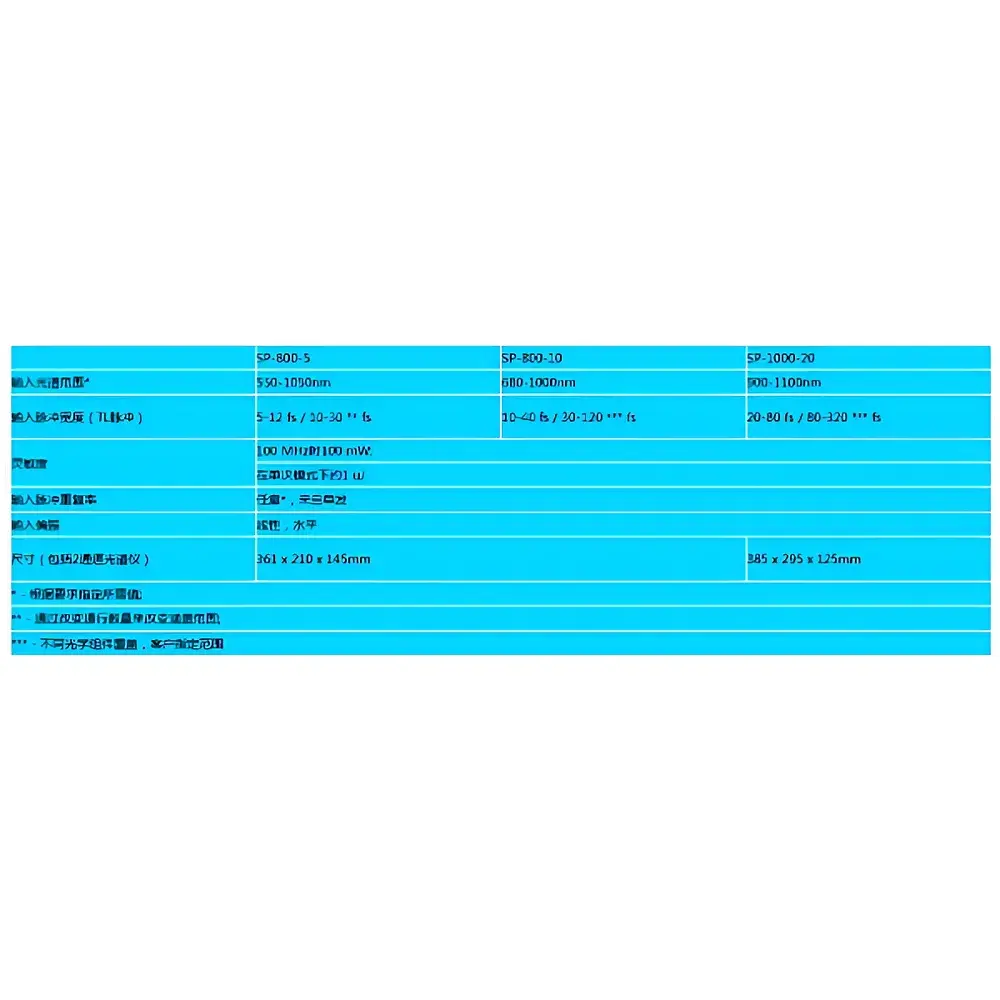
| Dimensions (w×d×h) | 361 × 210 × 145 mm (SP-800-5), 385 × 295 × 125 mm (SP-800-10 & SP-1000-20) |
| Spectral Range Options | 550–1050 nm |
| Transform-Limited Pulse Width Coverage | 5–12 fs to 80–320 fs (model-dependent) |
| Sensitivity | ≥1 µJ per pulse (single-shot mode) |
| Detection | Dual-channel CCD spectrometer integrated |
| Data Processing | Linear, non-iterative Fourier-domain reconstruction algorithm |
Overview
The ATSEVA SPIDER Ultrafast Pulse Characterization System is a precision optical instrument engineered for complete electric-field reconstruction of ultrashort laser pulses via Spectral Phase Interferometry for Direct Electric-field Reconstruction (SPIDER). Unlike intensity-only autocorrelation techniques, SPIDER provides simultaneous, single-shot measurement of spectral intensity, spectral phase, and temporal intensity profile—enabling full complex-field characterization without iterative retrieval ambiguity. The system operates on the principle of spectral shearing interferometry: an input pulse is split into two replicas with a controlled spectral shear (Δω), then recombined to generate a spectrally resolved interference pattern on a dual-channel CCD detector. A second CCD records the reference spectrum of the un-sheared pulse. Through linear Fourier analysis of the interferogram—free from convergence constraints or guess-dependent algorithms—the spectral phase is extracted directly and unambiguously. Subsequent inverse Fourier transformation yields the time-domain electric field E(t), including both amplitude and phase. This deterministic, non-iterative methodology ensures high reproducibility and traceable metrology for femtosecond and sub-10-fs pulse diagnostics in demanding R&D and industrial laser environments.
Key Features
- Integrated dual-channel CCD spectrometer with optimized dispersion optics for high-resolution spectral interferogram acquisition
- USB 2.0 interface enabling seamless integration with Windows-based control and analysis software
- Single-shot operational mode supporting low-repetition-rate and amplified laser systems (e.g., Ti:sapphire amplifiers, OPCPA outputs)
- Real-time data acquisition and on-the-fly phase reconstruction for rapid laser optimization and alignment feedback
- Modular spectral range configurations: SP-800-5 (550–1050 nm), SP-800-10 (680–1000 nm), SP-1000-20 (900–1100 nm), each optimized for specific gain media and nonlinear processes
- Compact, vibration-insensitive mechanical architecture with fixed optical path alignment—no user calibration required post-installation
- Linear polarization input requirement (horizontal orientation) ensures consistent interferometric contrast and phase fidelity
Sample Compatibility & Compliance
The ATSEVA SPIDER system is compatible with free-space collimated beams from oscillators (e.g., mode-locked Ti:sapphire, Yb-fiber, Cr:forsterite) and amplifier systems (regenerative, multipass, OPCPA) operating across visible to near-infrared wavelengths. Pulse energy sensitivity supports single-shot operation down to ~1 µJ, while average power handling extends to ≥100 mW at 100 MHz repetition rates. All models comply with IEC 61000-6-3 (EMC emission standards) and IEC 61010-1 (safety requirements for electrical equipment for measurement). While not certified under FDA 21 CFR Part 11, the accompanying software supports audit-trail-enabled data logging and timestamped export (CSV, HDF5), facilitating GLP/GMP-aligned documentation workflows in regulated photonics development labs. No hazardous materials or Class 3B/4 laser components are embedded within the instrument housing.
Software & Data Management
The proprietary SPIDER Control Suite (v4.x, Windows 10/11 compatible) provides intuitive instrument control, live interferogram visualization, and automated phase reconstruction. Key capabilities include: real-time display of spectral intensity, spectral phase, temporal intensity, and electric field modulus; batch processing of multi-pulse datasets with metadata tagging; export of fully calibrated E(ω) and E(t) arrays in standard scientific formats (CSV, MATLAB .mat, HDF5); and overlay comparison between measured and theoretical transform-limited profiles. Software architecture separates acquisition, reconstruction, and visualization layers—ensuring computational stability during extended measurement sessions. Raw interferograms and reference spectra are stored with embedded instrument configuration parameters (shear value, grating density, pixel mapping), enabling retrospective reprocessing without hardware interaction.
Applications
- Commissioning and stabilization of femtosecond oscillator-amplifier chains, including dispersion pre-compensation validation
- Quantitative assessment of spectral phase distortions induced by chirped mirrors, prism pairs, or hollow-core fiber compression stages
- In situ optimization of nonlinear frequency conversion processes (e.g., DFG, OPA, HHG) requiring precise phase-matching verification
- Characterization of carrier-envelope phase (CEP)-stable sources for attosecond science and strong-field physics experiments
- Validation of pulse shaping algorithms in 4f-zero-dispersion compressors and spatial light modulator-based pulse shapers
- Comparative benchmarking against FROG, d-scan, or XFROG measurements in metrology intercomparisons
FAQ
What is the minimum measurable pulse duration for the SP-800-5 model?
The SP-800-5 supports transform-limited pulse widths from 5 fs to 12 fs (narrow spectral shear configuration) or 10 fs to 30 fs (broad shear), depending on grating selection and spectral resolution trade-offs.
Can the SPIDER system measure pulses with arbitrary polarization states?
No—it requires linear, horizontally polarized input. Non-horizontal or elliptical polarization degrades interferometric visibility and introduces systematic phase errors.
Is external synchronization required for single-shot operation?
No. The system operates autonomously in single-shot mode; no external trigger signal is needed for data capture or reconstruction.
How is calibration maintained over time?
Spectral shear magnitude is determined optically via fixed interferometer geometry and calibrated grating dispersion. No periodic recalibration is required—only initial spectral registration using a known reference line (e.g., HeNe laser) is recommended after major optical reconfiguration.
Does the software support scripting or API access for automated testing?
Yes—COM interface and DLL-based function calls are provided for integration with LabVIEW, Python (pywin32), or MATLAB automation frameworks.



