
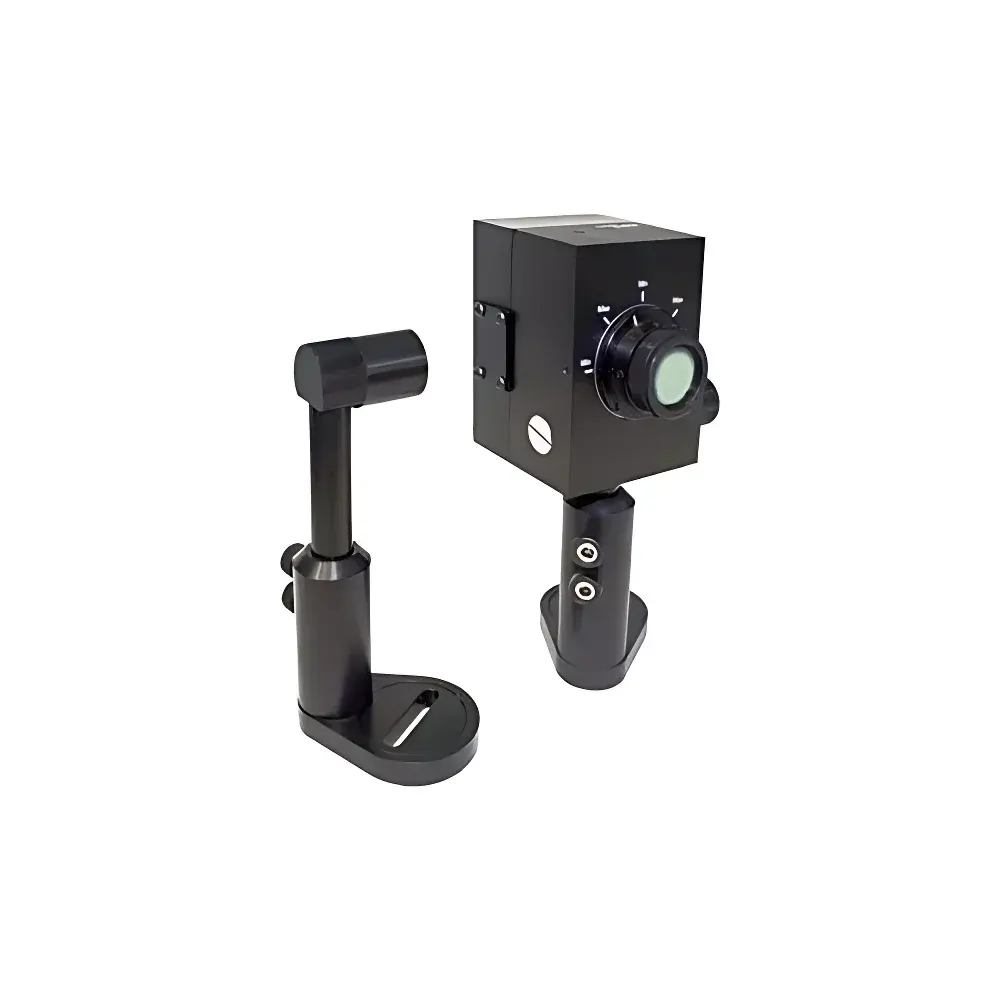
ATSEVA OA Series Femtosecond Laser Attenuator – Broadband Ultrafast Variable Beam Attenuator
| Brand | ATSEVA |
|---|---|
| Origin | Russia |
| Model | OA |
| Dynamic Attenuation Range | >10² |
| Input Pulse Duration | <50 fs (OAFP), >50 fs (OAGP), >70 fs (OABS) |
| Center Wavelength Options | 343–350 nm, 450–1600 nm (configurable), typical: 515 nm / 800 nm / 1030 nm |
| Bandwidth | 5% (OAFP), 10–12% (OAGP/OABS) of center wavelength |
| Transmission | >92% (OAFP), >90% (OAGP), >85% (OABS) |
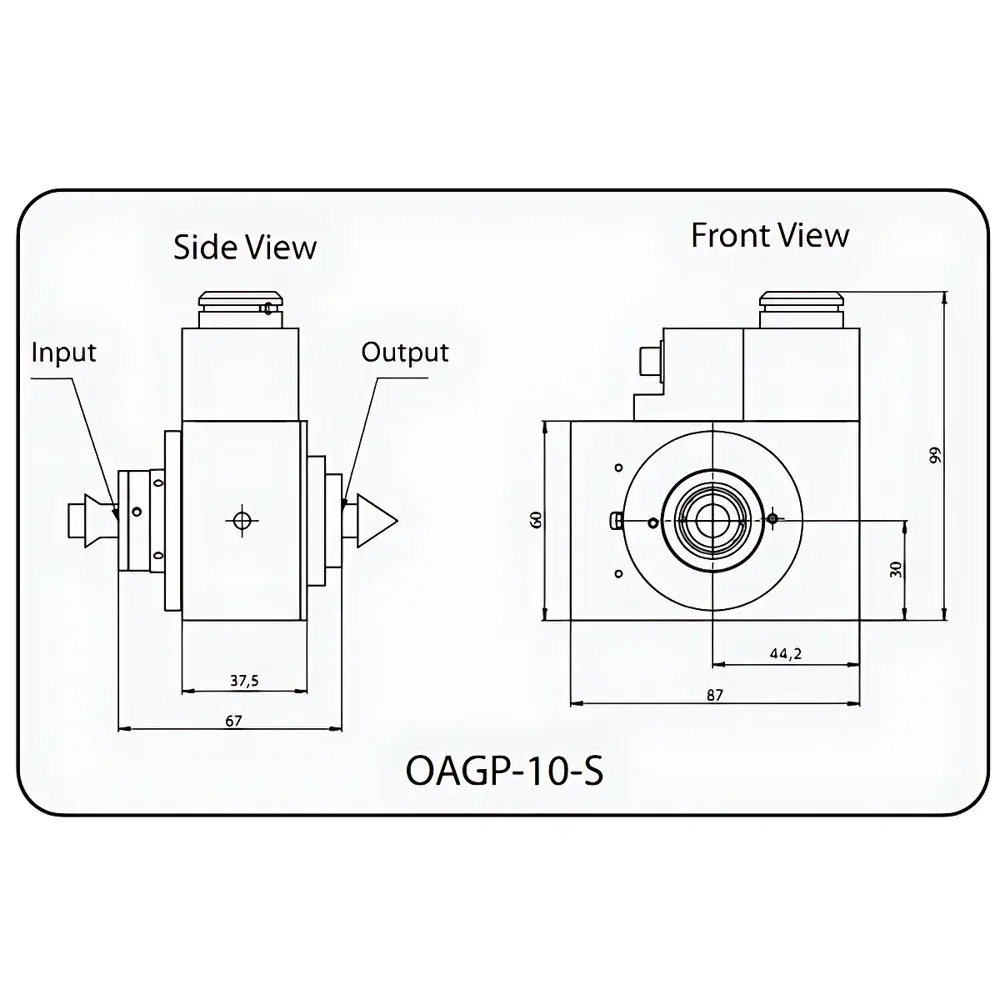
| Clear Aperture | <10 mm (OAFP/OAGP-10/OABS-9), <6 mm (OAGP-6), <15 mm (OABS-15) |
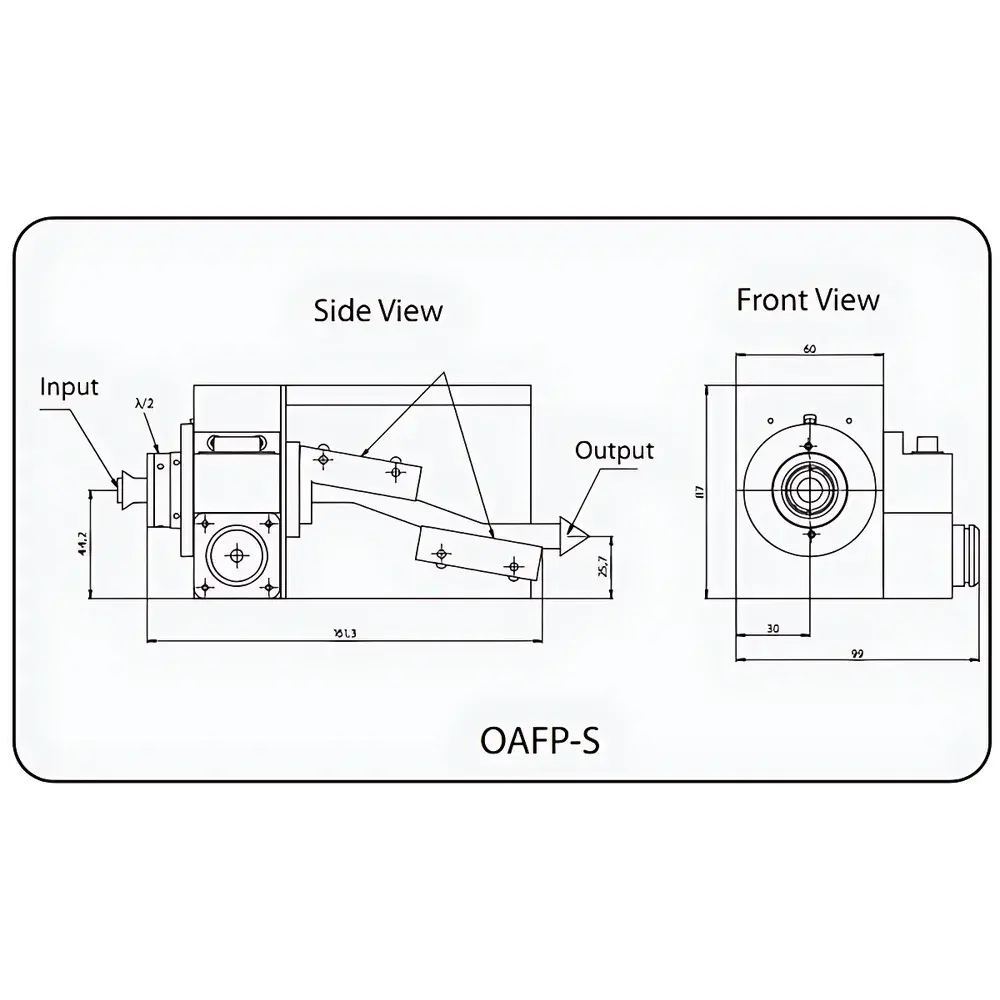
| Beam Walk-off | <40 mm (OAFP), <1 mrad (OAGP/OABS) |
| Damage Threshold | 10 J/cm² (OAFP/OAGP-10/OABS-15), 5 J/cm² (OAGP-6) |
| Drive Type | Manual (-M), Manual with Side Knob (-MK), or Stepper Motor–Driven USB-Controlled (-S), step resolution: 0.1% per step |
| Spectral Range | 250–2000 nm |
| Polarization-Based Attenuation Principle | Rotating Waveplate + Polarizer Architecture |
Overview
The ATSEVA OA Series Femtosecond Laser Attenuator is a precision polarization-based optical attenuation system engineered for high-fidelity intensity control of ultrafast laser pulses without compromising temporal pulse integrity. Unlike neutral density filters or absorptive attenuators—which introduce nonlinear effects, thermal distortion, and spectral narrowing—the OA series employs a zero-order half-wave plate (λ/2) paired with two high-damage-threshold polarizers to achieve continuous, dispersion-minimized attenuation via rotationally controlled polarization projection. This architecture ensures minimal group delay dispersion (GDD) and negligible higher-order phase distortion, making it uniquely suitable for sub-50 fs pulse regimes where even femtosecond-level chirp accumulation degrades experimental fidelity. The OAFP variant is optimized for ultrashort pulses (50 fs, the OAGP and OABS configurations integrate Glan-type polarizing prisms—offering superior transmission (>90%) and reduced walk-off—while retaining compatibility with high-repetition-rate amplified Ti:sapphire, Yb:fiber, and OPAL systems.
Key Features
- Dispersion-compensated attenuation architecture: Zero-order waveplate + dual polarizer design minimizes GDD and spectral phase distortion—critical for preserving transform-limited pulse duration.
- Broadband spectral coverage: Configurable center wavelengths from 343 nm to 1600 nm; extended range options (250–2000 nm) available via custom thin-film polarizer sets.
- High laser damage threshold: Up to 10 J/cm² (10 ns, 10 Hz, 1064 nm), validated per ISO 21254-1, enabling use with high-energy regenerative amplifiers and OPCPA systems.
- Three mechanical configurations: Manual (-M), side-knob manual (-MK) for ergonomic fine-tuning in confined optical tables, and stepper motor–driven USB-controlled (-S) version with 0.1% step resolution and bidirectional repeatability ±0.05%.
- Optimized beam handling: Clear apertures up to 15 mm (OABS-15), beam deviation <1 mrad (OAGP/OABS), and walk-off <40 mm (OAFP) ensure compatibility with multi-pass amplifier stages and vacuum-compatible beamlines.
- Modular mounting interface: Standard SM1 (1.035″-40) threading and kinematic base plates support integration into commercial optical cages (e.g., Thorlabs, Newport) and custom ultrafast laser platforms.
Sample Compatibility & Compliance
The OA series is compatible with all commercially available ultrafast laser sources operating in the UV–NIR spectrum—including Ti:sapphire oscillators (700–1000 nm), Yb-doped fiber amplifiers (1030 nm), optical parametric amplifiers (OPAs, 250–2000 nm), and frequency-doubled/ tripled systems (e.g., 266 nm, 355 nm, 515 nm). All optical substrates are fused silica or CaF₂, polished to λ/10 surface flatness and coated with ion-beam-sputtered multilayer dielectrics meeting MIL-C-48497A specifications. Each unit undergoes individual ISO 10110–7 scratch-dig inspection and is supplied with calibration certificate traceable to NIST standards for transmission uniformity and angular alignment. The USB-controlled (-S) models comply with USB 2.0 HID class protocols and support integration into LabVIEW, Python (PyUSB), and MATLAB environments. Firmware supports configurable acceleration profiles and position-hold modes for GLP-compliant long-duration experiments.
Software & Data Management
The ATSEVA OA-S series includes a cross-platform control suite supporting Windows, Linux, and macOS. The software provides real-time attenuation level readout (0.01% resolution), programmable ramp sequences, and hardware-triggered attenuation sweeps synchronized to external TTL signals (e.g., laser sync output or photodiode trigger). All actuator positions and timestamped attenuation values are logged in CSV format with optional metadata embedding (user ID, experiment ID, laser parameters). Audit trails meet FDA 21 CFR Part 11 requirements for electronic records—enabling secure user authentication, digital signatures, and immutable log archiving. Remote operation via Ethernet-to-USB bridge is supported for integration into centralized lab automation frameworks compliant with IEEE 11073-10201 (Medical Device Communication) and OPC UA industrial protocols.
Applications
- Pump–probe spectroscopy: Precise, shot-to-shot intensity balancing between pump and probe beams while maintaining identical dispersion profiles.
- High-harmonic generation (HHG): Attenuation prior to gas cell or solid-target interaction to control ionization yield without altering CEP stability.
- Time-resolved photoelectron spectroscopy: Dynamic power scaling for space-charge management in velocity-map imaging (VMI) setups.
- Optical parametric amplification seeding: Fine-tuning seed pulse energy to optimize gain saturation and spectral bandwidth in NOPA/OPCPA architectures.
- Ultrafast microscopy: Intensity normalization across multi-wavelength excitation channels in CARS, SRS, or transient absorption imaging.
- Laser-induced breakdown spectroscopy (LIBS): Pulse energy calibration for quantitative elemental analysis under variable ambient conditions.
FAQ
What is the difference between OAFP, OAGP, and OABS models?
OAFP uses thin-film waveplates and broadband polarizers for minimal dispersion—ideal for 1 mJ) pulses >70 fs with enhanced mechanical stability.
Can the OA attenuator be used in vacuum environments?
Yes—OAFP and OAGP models are vacuum-compatible (10⁻⁶ mbar) when ordered with stainless-steel housing and outgassing-certified adhesives. Optional CF-35 flange mounting kits are available.
Is wavelength recalibration required when switching center wavelengths?
No—waveplate retardance is achromatized over the specified bandwidth; however, optimal extinction ratio requires re-optimization of polarizer alignment only if changing center wavelength by >50 nm.
Does the USB-controlled version support analog voltage input for external modulation?
Not natively—but an external DAC (e.g., National Instruments USB-6211) can drive the onboard stepper controller via TTL-modulated step/direction signals using the open-command protocol documented in the SDK.
How is damage threshold tested and certified?
Per ISO 21254-1:10 ns pulse width, 10 Hz repetition rate, 1064 nm, 1 mm beam diameter, 100 shots per site; certified values include safety margin ≥2× LIDT at operational fluence.



