
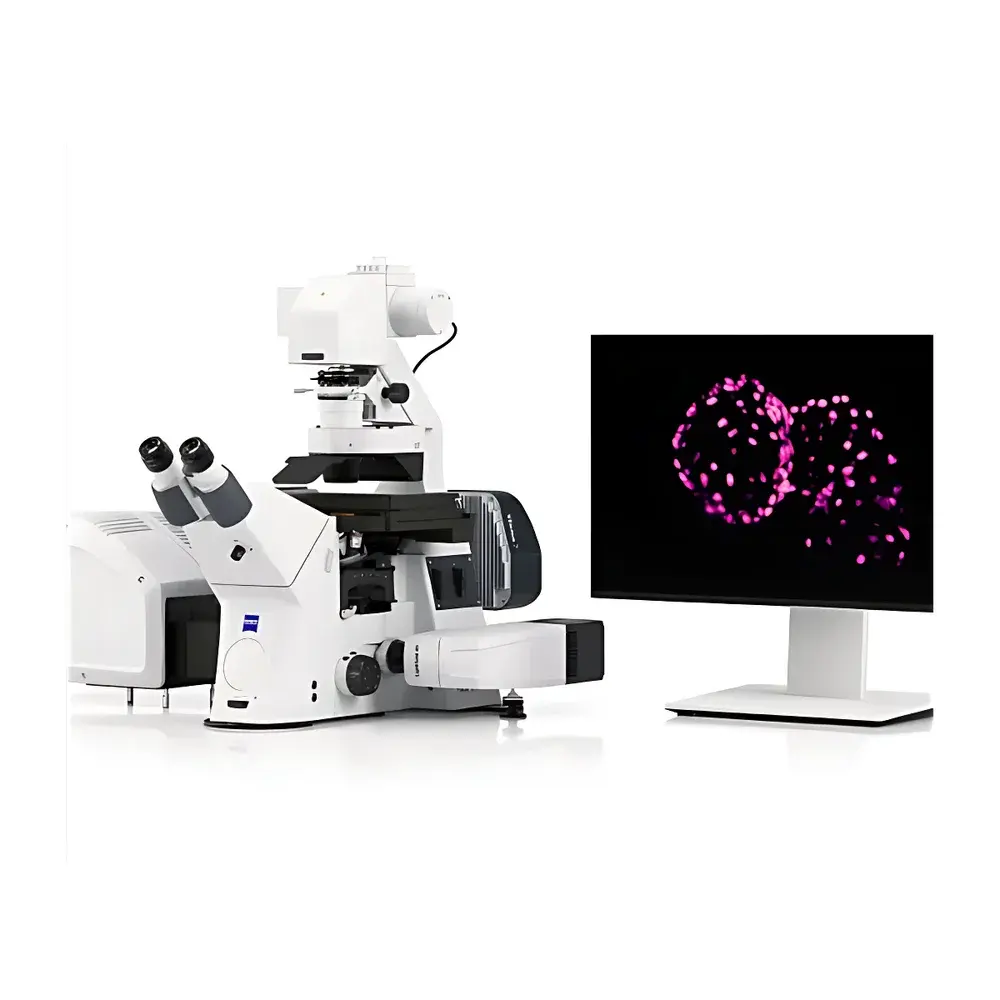
ZEISS LSM Lightfield 4D High-Speed Instantaneous Volumetric Confocal Microscopy System
| Brand | ZEISS |
|---|---|
| Origin | Germany |
| Model | LSM Lightfield 4D |
| Key Specifications | Excitation Wavelength Range: 405–740 nm |
| Max. Volumetric Acquisition Speed | 80 volumes/s |
| Spatial Resolution (X/Y) | 2.2–8.8 µm (dependent on objective & configuration) |
| Axial Resolution (Z) | 2.8–57 µm (deconvolution-optimized) |
| Voxel Size Range | 0.7×0.7×0.9 µm³ to 2.8×2.8×18 µm³ |
| Z-stack Depth Range | 109–1712 µm |
| Field of View | 20.4 mm |
| Recommended Objectives | C-Apochromat 40×/1.2 W Corr, Plan-Apochromat 40×/1.3 Oil DIC, LD LCI Plan-Apochromat 25×/0.8, Plan-Apochromat 20×/0.8, EC Plan-Neofluar 10×/0.5, among others |
| Compatible Platforms | ZEISS LSM 910 and LSM 990 mounted on Axio Observer stand |
Overview
The ZEISS LSM Lightfield 4D is a high-speed instantaneous volumetric confocal microscopy system engineered for live biological imaging without temporal compromise across the Z-dimension. Unlike conventional point-scanning or sequential slice acquisition methods—where Z-stacks are built by rastering through focal planes over time—Lightfield 4D employs a single-shot, widefield light-field optical architecture integrated with computational reconstruction. This enables simultaneous capture of full 3D volume information in one exposure, eliminating inter-slice time delays and preserving spatiotemporal fidelity during rapid physiological dynamics. The system operates on ZEISS LSM 910 and LSM 990 platforms, leveraging their high-stability laser excitation (405–740 nm), precision galvo-resonant scanning, and modular detection architecture. Its core innovation lies in the fusion of physical optics (light-field encoding via microlens array) and iterative deconvolution algorithms, delivering volumetric data at up to 80 volumes per second while maintaining subcellular spatial resolution and minimal phototoxicity.
Key Features
- Single-exposure volumetric acquisition: Captures complete Z-stacks in one camera frame—no mechanical Z-scanning or time-gated layer sequencing required.
- Ultra-low phototoxicity: Total illumination dose distributed across all Z-planes simultaneously reduces cumulative photon flux per plane, enabling hour- to day-scale time-lapse imaging of sensitive specimens including zebrafish embryos, C. elegans larvae, and primary neuronal cultures.
- High spatiotemporal fidelity: Eliminates motion-induced Z-axis shearing or phase misregistration common in sequential scanning; supports particle tracking and vector field analysis within intact volumes.
- Modular compatibility: Fully integrated into ZEISS LSM 910/990 systems on Axio Observer stands, supporting Airyscan super-resolution, spectral unmixing, FRAP/FLIP, photoactivation, and laser ablation workflows without hardware modification.
- Objective-agnostic optimization: Supports a broad range of high-NA water-, oil-, and silicone-immersion objectives—including C-Apochromat 40×/1.2 W Corr, Plan-Apochromat 40×/1.3 Oil DIC, and LD LCI Plan-Apochromat 25×/0.8—with automatic calibration of light-field parameters per magnification and refractive index.
Sample Compatibility & Compliance
The Lightfield 4D system is validated for use with live, thick, and optically heterogeneous biological samples—including whole-mount embryos, organoids, explanted tissues, and intact model organisms up to 1.7 mm in Z-depth. It complies with ISO 10993-5 (biological evaluation of medical devices) for non-invasive optical interrogation and meets GLP-aligned documentation requirements for longitudinal imaging studies. Data acquisition metadata—including timestamped excitation power, detector gain, objective ID, immersion medium, and deconvolution iteration count—is embedded in OME-TIFF format files, ensuring traceability under FDA 21 CFR Part 11-compliant environments when paired with ZEISS ZEN Blue software and secure network storage configurations. All optical components conform to DIN EN 61000-6-3 (EMC immunity) and DIN EN 60825-1 (laser safety classification).
Software & Data Management
Acquisition and reconstruction are managed through ZEISS ZEN Blue v3.6+ with dedicated Lightfield 4D modules. Raw light-field images undergo GPU-accelerated iterative deconvolution using constrained Richardson-Lucy algorithms optimized for confocal PSF models. Output volumes are saved in open-standard OME-TIFF containers with embedded XML metadata, compatible with Fiji/ImageJ, Imaris, Arivis Vision4D, and MATLAB-based custom analysis pipelines. Time-series datasets support batch processing, intensity normalization across channels and timepoints, and automated registration using rigid or elastic transformation models. Audit trails record user actions, parameter changes, and software version history—critical for GMP-regulated developmental biology or neuropharmacology studies requiring full analytical traceability.
Applications
- Real-time 3D calcium dynamics mapping across entire zebrafish brain volumes at ≤12.5 ms inter-volume intervals.
- Long-term tracking of cell migration and tissue morphogenesis in Drosophila embryogenesis over 24+ hours with <5% photobleaching per hour.
- Simultaneous multicolor volumetric monitoring of mitochondrial trafficking, lysosomal pH, and nuclear translocation events in primary cardiomyocytes during pacing-induced contraction cycles.
- Correlative structural-functional imaging: Combining Lightfield 4D volumetric activity with Airyscan SR imaging of synaptic boutons or microtubule networks in the same specimen session.
- High-throughput phenotypic screening of drug-treated C. elegans populations, where >50 individuals can be imaged and analyzed per 10-minute acquisition cycle.
FAQ
What distinguishes Lightfield 4D from traditional confocal Z-stack acquisition?
Traditional confocal Z-stacks require sequential point-by-point or line-by-line scanning across focal planes, introducing temporal gaps between slices. Lightfield 4D captures all depth information in a single exposure using light-field encoding and computational refocusing—eliminating inter-plane latency and motion artifacts.
Can Lightfield 4D be used with existing ZEISS LSM 910/990 systems?
Yes—Lightfield 4D is a field-upgradeable module requiring only optical path integration (microlens array insertion), updated ZEN Blue software, and compatible sCMOS camera firmware. No replacement of lasers, detectors, or scan units is necessary.
Is deconvolution mandatory for usable data?
Raw light-field data contains encoded depth information but requires deconvolution to reconstruct diffraction-limited 3D volumes. ZEN Blue provides both real-time preview deconvolution and offline high-fidelity reconstruction with adjustable regularization and PSF modeling.
How does Lightfield 4D handle optical aberrations in thick samples?
It incorporates adaptive spherical aberration correction via motorized correction collars on supported objectives and supports depth-dependent PSF measurement for region-specific deconvolution—particularly critical for imaging beyond 100 µm depth in cleared or live-tissue preparations.
Does Lightfield 4D support spectral unmixing or lifetime imaging?
Yes—when configured with ZEISS’s QUASAR spectral detector or FLIM modules, Lightfield 4D volumes retain full spectral and temporal photon arrival information per voxel, enabling post-hoc linear unmixing and phasor-based lifetime analysis without sacrificing volumetric speed.




