
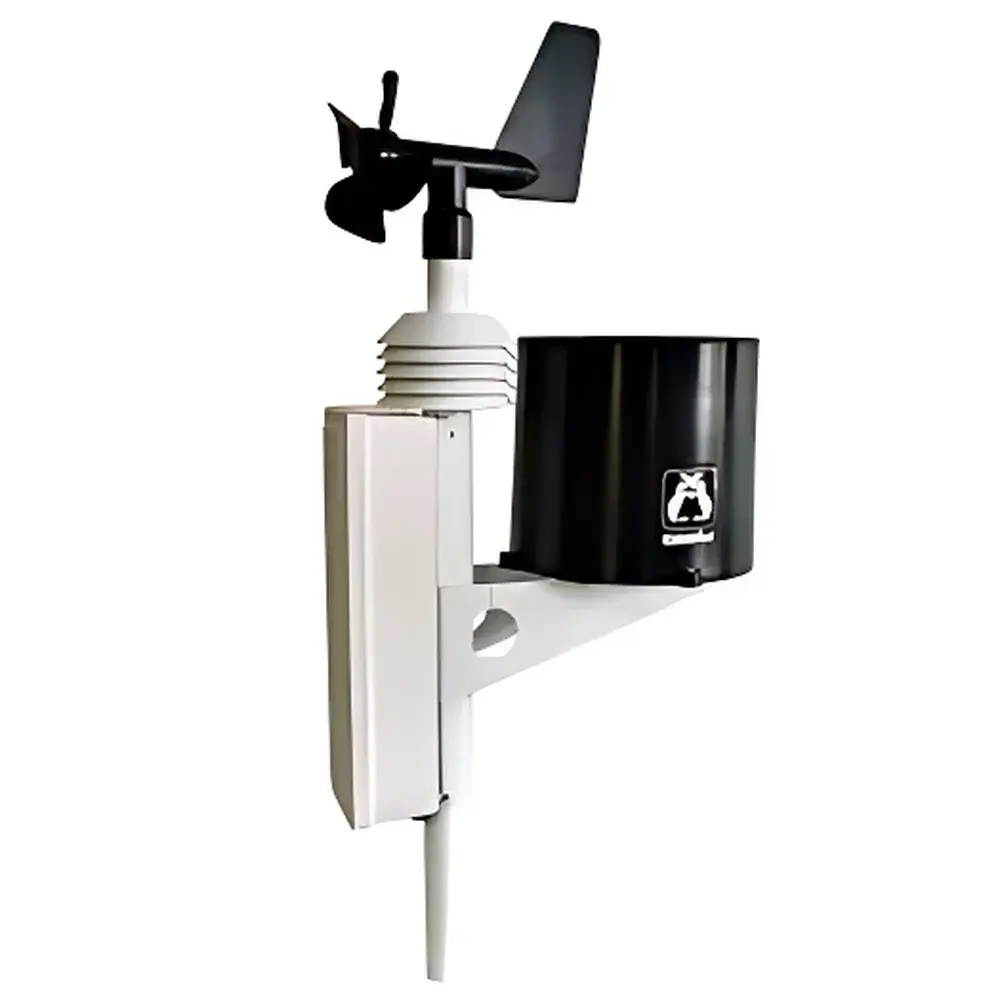
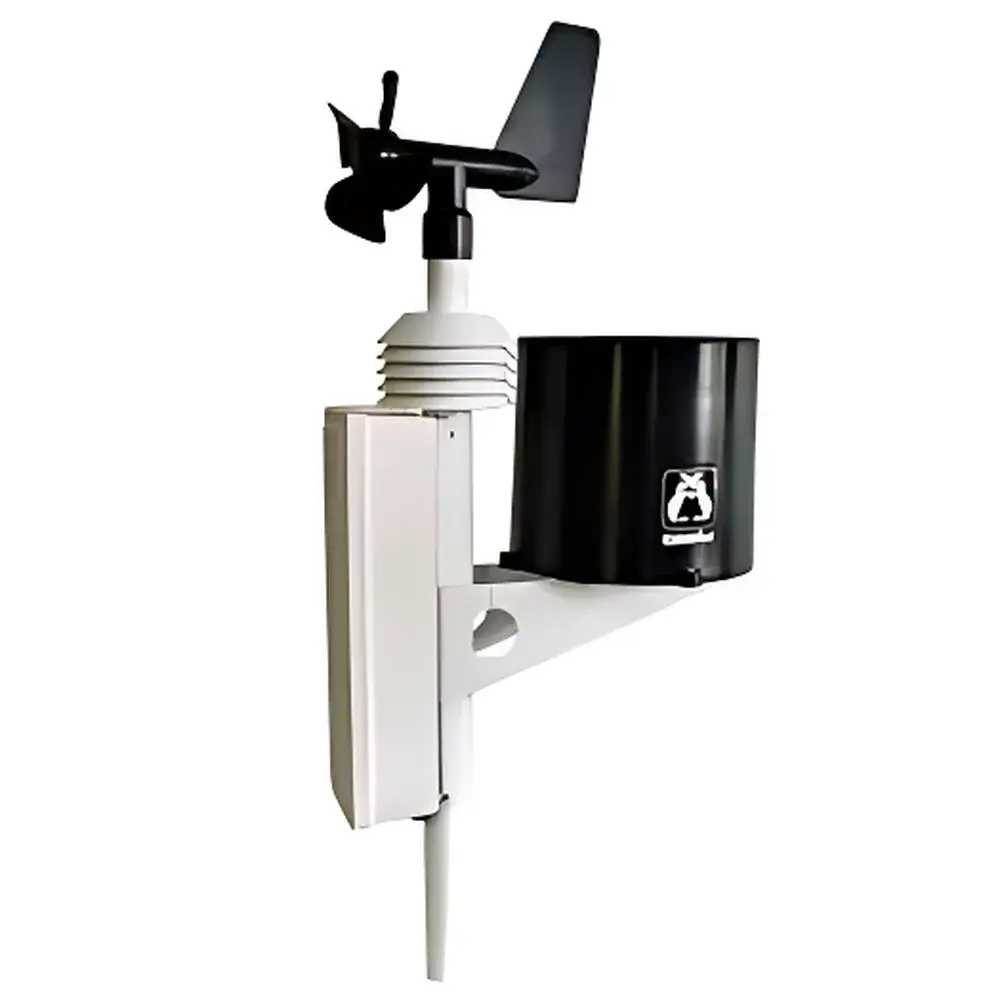
RainWise MK-III-RTI-MB Modbus Weather Station
| Brand | RainWise |
|---|---|
| Origin | USA |
| Model | MK-III-RTI-MB |
| Instrument Type | Portable Weather Station |
| Communication Interface | RS-422/RS-485 Modbus RTU (2-wire half-duplex) |
| Wind Speed Range | 0–67 m/s |
| Wind Speed Resolution | 0.045 m/s |
| Wind Speed Accuracy | ±0.45 m/s or ±5% |
| Wind Direction Range | 0–360° |
| Wind Direction Accuracy | ±11.25° |
| Temperature Range | −55 to +85 °C |
| Temperature Accuracy | ±0.2 °C @ 25 °C |
| Relative Humidity Range | 0–100 %RH |
| RH Accuracy | ±2 % (10–90 %RH @ 25 °C), ±4 % (<10 or >90 %RH @ 25 °C) |
| Barometric Pressure Range | 300–1100 hPa |
| Pressure Accuracy | ±0.5 hPa @ 25 °C |
| Rainfall Measurement Range | 0–762 mm/hr |
| Rainfall Accuracy | ±2 % @ 25.4 mm/hr |
| Operating Temperature | −55 to +85 °C |
| Power Supply | 6 V, 5 Ah AGM sealed lead-acid battery with 0.6 W solar panel |
| Enclosure Materials | PVC, ABS, stainless steel, anodized aluminum, LEXAN®, Makrolon® 2658 |
Overview
The RainWise MK-III-RTI-MB is a fully integrated, compact, and industrial-grade portable weather station engineered for reliable environmental data acquisition in demanding operational environments. Designed around the proven MK-III sensor suite, this variant features native Modbus RTU communication over RS-422/RS-485 (2-wire half-duplex), enabling seamless integration into standardized industrial control architectures. Unlike consumer-grade or web-connected weather stations, the MK-III-RTI-MB operates as a deterministic field device—delivering time-synchronized, protocol-compliant measurements of wind speed and direction, ambient temperature, relative humidity, barometric pressure, and cumulative rainfall. Its architecture adheres to IEC 61131-3 and Modbus Application Protocol (MBAP) conventions, ensuring interoperability with programmable logic controllers (PLCs), remote terminal units (RTUs), SCADA systems, distributed control systems (DCS), and building management systems (BMS). The station is factory-assembled, pre-calibrated, and rated for continuous outdoor operation across extreme thermal and humidity gradients—from −55 °C to +85 °C—with ingress protection achieved through material selection and sealed mechanical interfaces rather than IP-rated enclosures.
Key Features
- Modbus RTU interface compliant with ANSI/ISA-50.00.01 and EN 50170 standards—no proprietary drivers or middleware required
- Industrial-grade sensor assembly with optional NIST-traceable calibration documentation for audit-ready deployments
- Low-power design optimized for long-term unattended operation: 6 V, 5 Ah AGM battery supplemented by 0.6 W monocrystalline solar panel
- Robust mechanical construction using corrosion-resistant materials including anodized aluminum mast components, stainless-steel fasteners, and UV-stabilized LEXAN® and Makrolon® polymer housings
- Configurable measurement intervals (1–300 seconds) and data reporting modes (polling or unsolicited event-triggered transmission)
- Support for extended sensor options including heated rain gauge (120/240 V AC), pyranometer (solar irradiance), UV-A/B radiometer, and high-resolution wind vane (1° directional resolution)
Sample Compatibility & Compliance
The MK-III-RTI-MB meets key regulatory and industry requirements for environmental monitoring infrastructure. Its sensor outputs conform to ASTM D5096 (wind measurement), ASTM E1441 (relative humidity), and ISO 2533 (standard atmosphere reference conditions). Optional NIST-traceable calibration certificates satisfy GLP and GMP documentation needs for regulated sectors including pharmaceutical manufacturing site environmental monitoring and EPA-compliant air quality assessment. Electrical compliance includes RoHS Directive 2011/65/EU and REACH Regulation (EC) No. 1907/2006. The station’s Modbus implementation supports functional safety considerations per IEC 61508 SIL-1 when deployed within validated system boundaries. It is not intended for use in explosive atmospheres (ATEX/IECEx zones) unless housed within certified barrier enclosures.
Software & Data Management
Data acquisition occurs at the field device level without embedded OS or cloud dependency. Each Modbus register maps directly to a physical parameter (e.g., holding register 40001 = wind speed in 0.01 m/s units; 40003 = wind direction in degrees × 10). This deterministic register layout enables direct integration with historian platforms such as OSIsoft PI System, Inductive Automation Ignition, Siemens Desigo CC, or Schneider EcoStruxure Building Operation. Audit trails are maintained externally via the host SCADA or BMS, supporting FDA 21 CFR Part 11 compliance when paired with electronic signature-capable supervisory software. Firmware updates are performed via serial command-line interface (CLI) using standard terminal emulation tools—no vendor-specific utilities required. Configuration parameters—including baud rate (9600/19200 bps), parity, and slave ID—are stored non-volatilely and survive power cycling.
Applications
- Building Automation: Real-time HVAC setpoint optimization, demand-controlled ventilation, and indoor air quality (IAQ) correlation studies
- Transportation Infrastructure: Road surface condition modeling, airport crosswind advisory generation, bridge deck icing prediction, and rail signaling environmental interlocks
- Agricultural Operations: Irrigation scheduling based on evapotranspiration (ETo) calculations, pesticide drift risk assessment, and greenhouse climate feedback control
- Renewable Energy: Turbine cut-in/cut-out validation, photovoltaic yield forecasting, and micro-siting analysis for distributed wind/solar assets
- Environmental Compliance: Ambient monitoring for landfill gas migration, wastewater treatment plant odor dispersion modeling, and post-remediation site verification
FAQ
Does the MK-III-RTI-MB support Modbus TCP?
No—it implements Modbus RTU exclusively over RS-422/RS-485 physical layer. A protocol converter or gateway is required for TCP/IP network integration.
Can the station operate without solar charging?
Yes—the 6 V, 5 Ah AGM battery provides up to 12 months of autonomy under typical duty cycles (1-minute sampling interval); solar panel extends service life and stabilizes voltage during extended low-light periods.
Is the rain gauge heated version compatible with the base MK-III-RTI-MB?
Yes—the industrial aluminum rain collector (part number RG-H-AL) connects via standard 4–20 mA analog input or discrete relay interface and is electrically isolated from the main Modbus bus.
What is the maximum recommended cable length between the station and Modbus master?
For RS-485, up to 1200 meters at 9600 bps with proper termination (120 Ω) and shielded twisted-pair cabling (e.g., Belden 9841). Performance degrades above 19200 bps beyond 300 meters.
Are firmware updates field-serviceable?
Yes—updates are delivered as signed binary files and applied via serial CLI using documented Modbus function codes (FC16). No disassembly or hardware modification is required.







