
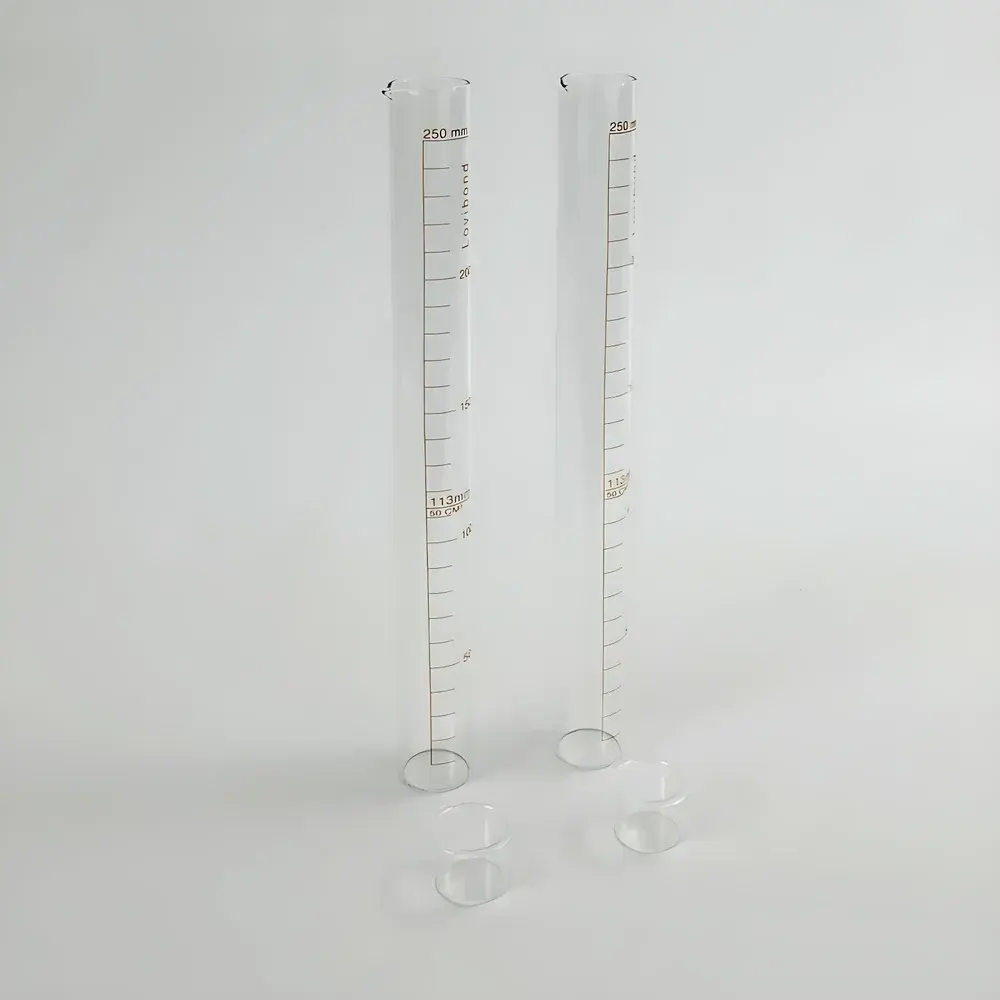
Lovibond Nessler Color Comparator Tubes
| Brand | Lovibond (Tintometer) |
|---|---|
| Origin | United Kingdom |
| Product Type | Nesslerization-Compatible Glass Color Comparator Tubes |
| Model Designations | AF228, DB420, AF262, DB421, AF306, DB423, AF306/P, DB424/13.5 |
| Tube Format | Paired Sets (Matched Optical Path Length) |
| Material | Borosilicate Glass, ASTM E2020-22 Compliant |
| Nominal Path Length | 10 mm, 13.5 mm, 20 mm, 25 mm, 50 mm (Model-Dependent) |
| Calibration Traceability | NIST-Traceable Reference Standards Available |
| Compliance | ISO 7887, ASTM D1209, ASTM D5391, USP <631>, EN ISO 7887-2 |
Overview
The Lovibond Nessler Color Comparator Tubes are precision-engineered optical components designed for visual and instrumental color comparison in water, wastewater, chemical, and pharmaceutical quality control laboratories. These tubes operate on the principle of Nesslerization—a standardized colorimetric method where ammonia reacts with Nessler’s reagent (potassium tetraiodomercurate(II) in alkaline medium) to form a yellow-brown colloidal complex proportional to ammonia concentration. Each tube is manufactured from high-purity borosilicate glass with tightly controlled wall thickness, optical clarity, and dimensional repeatability to ensure consistent light transmission and minimal scatter. Unlike generic glassware, Lovibond comparator tubes undergo rigorous batch certification for refractive index homogeneity and spectral transmittance across the visible range (400–700 nm), enabling reliable correlation between visual assessment and spectrophotometric validation.
Key Features
- Optically matched paired sets—guaranteed path length tolerance ≤ ±0.1 mm per pair—to eliminate inter-tube variability during side-by-side comparison.
- Chemically resistant borosilicate glass (Schott Duran® or equivalent), compliant with ISO 3585 and resistant to repeated exposure to strong alkalis, iodides, and mercury-containing reagents used in Nesslerization.
- Graduated volume markings etched—not printed—for permanent legibility under laboratory conditions including steam sterilization and repeated cleaning cycles.
- Standardized outer diameter (16 mm) and base geometry compatible with all major Lovibond PFXi, MD series, and legacy AF/DB comparator instruments, as well as third-party spectrophotometers equipped with 10–50 mm fixed-path cuvette holders.
- Each lot supplied with a Certificate of Conformance detailing measured average transmittance at 450 nm and 650 nm, referencing ISO 9050:2022 methodology.
Sample Compatibility & Compliance
These tubes support standard Nessler-based methods for ammonia, nitrate (after reduction), and certain heavy metal determinations (e.g., antimony, arsenic via modified protocols). They are validated for use in regulatory testing environments governed by EPA Method 350.1, ISO 7887-2:2016 (water quality — determination of colour — Part 2: Platinum-cobalt scale), ASTM D1209 (platinum-cobalt color), and USP (Color). The glass composition meets FDA 21 CFR 177.2400 requirements for indirect food contact, supporting applications in beverage and pharmaceutical excipient analysis. All tubes are suitable for GLP/GMP workflows when used with documented calibration procedures and traceable reference standards.
Software & Data Management
While the tubes themselves are passive optical components, they integrate seamlessly into digital color management ecosystems. When used with Lovibond PFXi series instruments or third-party UV-Vis spectrophotometers, raw absorbance data at 425 nm (primary Nessler peak) can be exported via USB or Ethernet to LIMS platforms compliant with ASTM E2500-22 (standard guide for specification, design, and verification of pharmaceutical and biopharmaceutical manufacturing systems). Instrument firmware supports 21 CFR Part 11 audit trails for user access, measurement timestamping, and result modification logs—ensuring full traceability when tubes are employed in regulated color quantitation workflows.
Applications
- Ammonia monitoring in municipal wastewater treatment plants (influent, effluent, digester supernatant).
- Pharmaceutical water system qualification (Purified Water, Water for Injection) per USP and EP 2.2.42.
- Quality control of industrial process chemicals including ammonium hydroxide, formaldehyde solutions, and catalyst precursors.
- Educational laboratories conducting standardized APHA color or platinum-cobalt unit (PCU) measurements per ASTM D1209.
- Environmental field labs performing rapid ammonia screening using portable comparator blocks (e.g., Lovibond 2000 series).
FAQ
Are these tubes autoclavable?
Yes—borosilicate construction allows repeated autoclaving at 121°C for 20 minutes; however, prolonged exposure to saturated steam may affect long-term surface finish. Recommended maximum cycle count: 50.
Can I substitute these for quartz cuvettes in spectrophotometry?
No—these are not intended for high-energy UV applications (<350 nm) or quantitative absorbance above 2.0 AU. Use only within visible-range Nessler-based methods (400–550 nm).
Do you provide NIST-traceable color standards with tube orders?
Traceable liquid standards (e.g., Lovibond Ammonia Standard Set, Cat. No. 205000) are available separately; each shipment includes a certificate referencing NIST SRM 2135a (Ammonia in Water) or equivalent primary reference material.
What is the shelf life of unused tubes?
Indefinite—provided stored in original packaging, protected from dust and mechanical abrasion. No degradation of optical properties occurs under ambient lab storage conditions over time.
How do I verify tube matching accuracy before critical analysis?
Use a calibrated photometer at 450 nm with deionized water blank; matched pairs must yield absorbance difference ≤ 0.003 AU. Full verification protocol is detailed in Lovibond Technical Bulletin TB-042 (Rev. 2023).



