
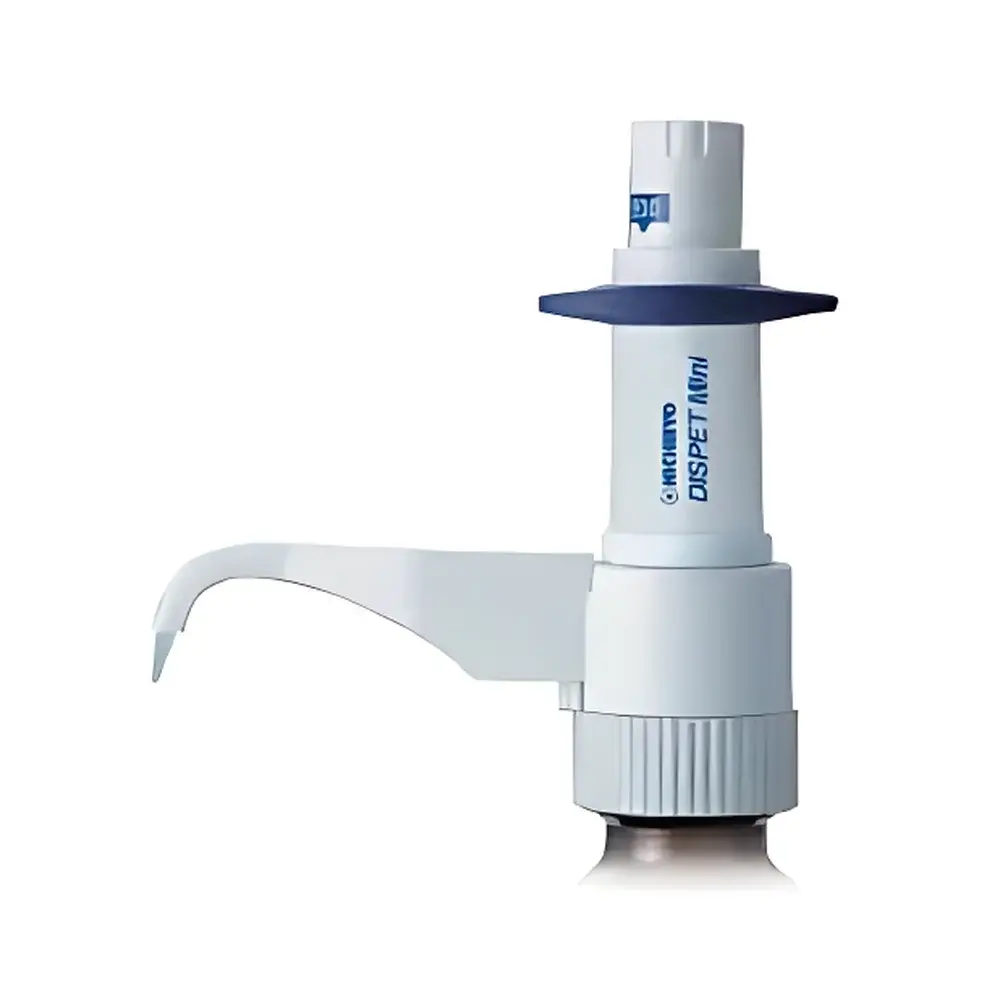
Nichiryo DISPET Mini Adjustable Bottle-Top Dispenser
| Brand | Nichiryo |
|---|---|
| Origin | Japan |
| Model | DISPET Mini |
| Dispensing Volumes | 100–250 mL (±2.0%), 500–1000 mL (±1.0%), 1000–2000 mL (±1.0%) |
| Coefficient of Variation (CV) | ≤0.4% (100–250 mL), ≤0.2% (500–2000 mL) |
| Bottle Neck Compatibility | GL-28 standard thread |
| Liquid Contact Materials | Chemically resistant PTFE, ETFE, and FEP components |
| Regulatory Compliance | Designed for ISO 8655-compliant volumetric dispensing procedures |
Overview
The Nichiryo DISPET Mini is a precision-engineered, manually operated bottle-top dispenser designed for accurate, repeatable liquid handling in analytical laboratories, quality control environments, and research settings where trace-level dispensing integrity is critical. Based on the piston-driven positive displacement principle, the DISPET Mini delivers calibrated volumes without reliance on gravity or ambient pressure—ensuring consistent performance across diverse solvents, including aggressive acids, bases, and organic media. Its compact, ergonomic form factor integrates seamlessly into fume hoods, biosafety cabinets, and benchtop workflows, supporting GLP- and GMP-aligned sample preparation protocols. Unlike fixed-volume dispensers, the DISPET Mini features continuous volume adjustment within defined ranges, enabling users to select any value between minimum and maximum limits while maintaining metrological traceability per ISO 8655-3 (2022) for piston-type dispensers.
Key Features
- Three interchangeable volume ranges: 100–250 mL (±2.0% accuracy), 500–1000 mL (±1.0%), and 1000–2000 mL (±1.0%), each certified to ISO 8655 tolerance classes;
- Ultra-low coefficient of variation (CV ≤0.4% at lower range; ≤0.2% at mid- and high-range), ensuring high reproducibility across repeated dispensing cycles;
- Liquid-contact components fabricated from fluoropolymer materials—including PTFE piston seals, ETFE body housing, and FEP-coated valves—providing broad chemical resistance to HCl, HNO₃, NaOH, acetone, chloroform, and other Class I–III solvents;
- Ergonomic, low-effort dispensing mechanism requiring ≤12 N operating force, reducing operator fatigue during extended use;
- Integrated air purge valve and self-cleaning rinse channel to minimize cross-contamination and residue carryover between samples;
- GL-28 threaded interface compatible with standard laboratory reagent bottles (e.g., HDPE, LDPE, and borosilicate glass containers); bottle not included.
Sample Compatibility & Compliance
The DISPET Mini is validated for use with aqueous solutions, polar and non-polar organic solvents, and mildly corrosive reagents. It is unsuitable for viscous liquids (>500 mPa·s), suspensions, or particulate-laden media due to potential clogging of the micro-bore dispensing orifice. All calibration data are referenced to water at 20 °C per ISO 8655-5. The device supports audit-ready documentation: individual units are supplied with a manufacturer’s certificate of conformance, traceable to JCSS (Japan Calibration Service System) standards. When deployed in regulated environments—including pharmaceutical QC labs subject to FDA 21 CFR Part 11—the DISPET Mini may be incorporated into instrument qualification protocols (IQ/OQ/PQ) as a Class A auxiliary dispensing tool, provided volume verification is performed prior to first use and at defined intervals thereafter.
Software & Data Management
As a mechanical, non-electronic dispensing system, the DISPET Mini does not incorporate embedded firmware, connectivity, or digital logging capabilities. This design eliminates software validation requirements and reduces failure modes associated with electronic components. Volume settings are adjusted manually via a calibrated dual-scale dial with vernier readout (0.1 mL resolution), and all adjustments are physically locked using a stainless-steel retention ring. For laboratories implementing electronic recordkeeping, manual entry of dispense parameters—including set volume, lot number, date, and operator ID—can be integrated into LIMS or ELN platforms using standardized templates aligned with ALCOA+ principles (Attributable, Legible, Contemporaneous, Original, Accurate, Complete, Consistent, Enduring, Available).
Applications
- Preparation of calibration standards and reference material dilutions in environmental testing (e.g., EPA Method 502.2, ISO 17025-accredited labs);
- Accurate dosing of reagents in titration workflows, spectrophotometric assays, and wet chemistry digestion procedures;
- Controlled addition of solvents during sample extraction (e.g., Soxhlet, QuEChERS) and chromatographic mobile phase preparation;
- Dispensing of hazardous or expensive reagents where containment, repeatability, and minimal waste are essential;
- Teaching laboratories requiring robust, maintenance-free equipment for undergraduate analytical chemistry instruction.
FAQ
Is the DISPET Mini suitable for use with hydrofluoric acid (HF)?
No. While fluoropolymer components resist many strong acids, HF attacks silica-based fillers in PTFE composites and compromises seal integrity. Use only with HF-compatible alternatives certified for such applications.
Can the DISPET Mini be sterilized using autoclaving?
No. Thermal cycling above 60 °C degrades fluoropolymer elasticity and dimensional stability. Cleaning is limited to solvent rinsing and air drying.
Does the device require periodic recalibration by an external lab?
Per ISO 8655-6, users must perform in-house verification using gravimetric methods at least annually—or after any impact event or suspected mechanical drift—to maintain compliance.
What bottle sizes and materials are compatible beyond GL-28?
Only GL-28 threaded bottles are supported. HDPE, LDPE, and Type I borosilicate glass bottles meeting DIN 12451 specifications are recommended; PET or polycarbonate containers are not advised due to thread deformation under torque.
Is a certificate of analysis (CoA) provided with each unit?
Each DISPET Mini ships with a Nichiryo Certificate of Conformance, including serial number, tested volume range, accuracy deviation, and CV results—traceable to JCSS-accredited mass standards.



