
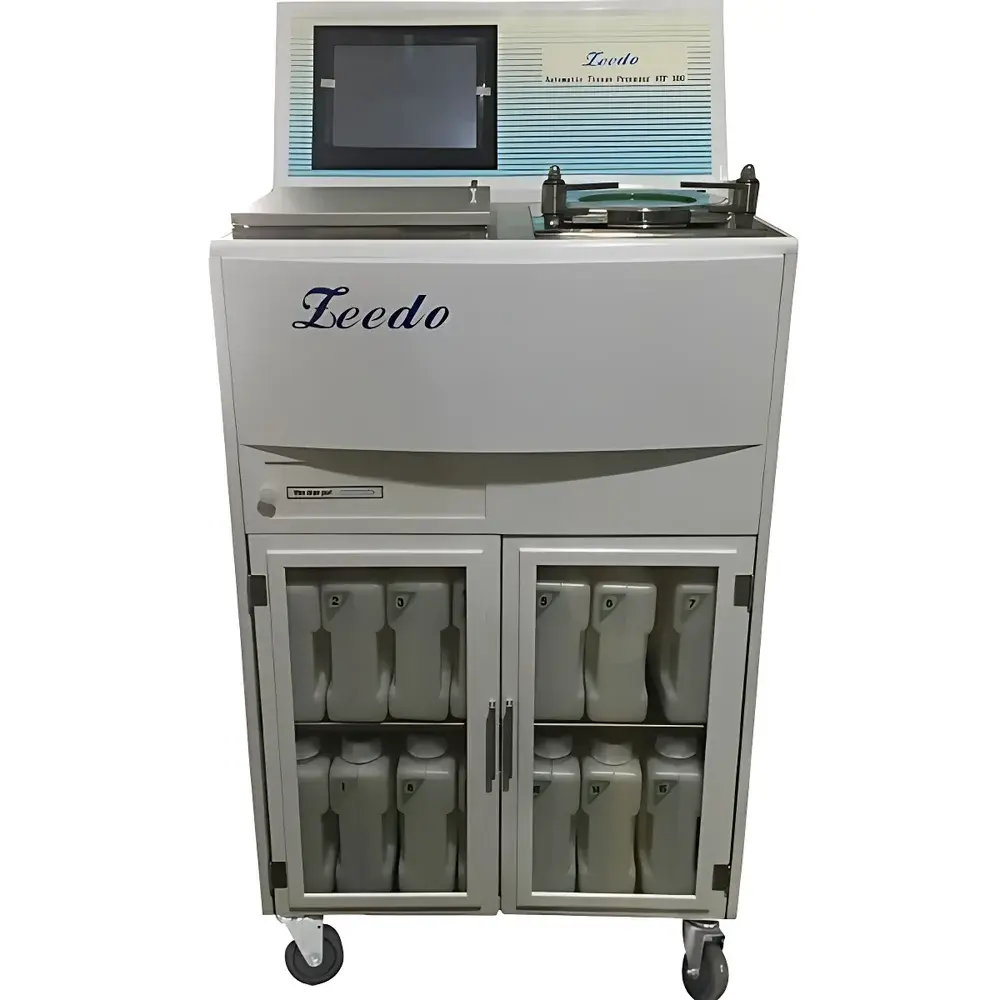
ZEEDO ATP300 Fully Enclosed Automated Tissue Dehydrator
| Origin | Zhejiang, China |
|---|---|
| Manufacturer Type | Authorized Distributor |
| Origin Category | Domestic (PRC) |
| Model | ATP300 |
| Price Range | USD 7,000 – 14,000 |
| Reagent Bottle Capacity | 2.3 L / 3.2 L (selectable) |
| Tissue Processing Chamber Volume | 3.8 L / 5.3 L (selectable) |
| Reagent Temperature Range | 30–70 °C |
| Paraffin Bath Temperature | Ambient to 80 °C ±1 °C |
| Immersion Time Setting | 0–99 h 59 min |
| Agitation Duration | 1 min |
| Agitation Interval | 10 min |
| Operating Modes | Manual & Automatic |
| Input Power | 1500 W |
| Voltage/Frequency | 220 V, 50 Hz |
| Maximum Specimen Capacity | 100 / 200 / 300 cassettes (configurable) |
| Display | Color LCD with English UI |
| User Programs | 8 pre-programmable protocols |
| Safety Features | Overtemperature protection, power-failure recovery, full liquid evacuation control, triple-stage reagent exhaust system |
| Construction | Stainless steel processing chamber and fluid pathways |
Overview
The ZEEDO ATP300 Fully Enclosed Automated Tissue Dehydrator is an engineered solution for high-throughput, reproducible histological tissue processing in clinical pathology laboratories and academic research facilities. It operates on the principle of sequential solvent exchange—replacing water in fixed biological specimens with graded alcohols (e.g., 70%, 95%, 100% ethanol), followed by xylene or xylene substitutes, and finally molten paraffin wax—enabling subsequent microtome sectioning and staining. Unlike open-basket or semi-enclosed systems, the ATP300 employs a hermetically sealed fluidic architecture: all reagent transfers, agitation cycles, and paraffin infiltration occur within a pressurized, vapor-tight chamber. This design eliminates volatile organic compound (VOC) emissions, reduces operator exposure to hazardous solvents (e.g., xylene, chloroform), and ensures consistent thermal and temporal control across all processing steps—critical for preserving tissue morphology and antigen integrity in immunohistochemistry (IHC)-ready samples.
Key Features
- Fully enclosed, vacuum-assisted fluid handling system with triple-stage exhaust and residual reagent minimization technology
- Stainless steel processing chamber (3.8 L or 5.3 L volume options) and corrosion-resistant reagent reservoirs (10 × 2.3 L / 3.2 L bottles, 2 rinse bottles, 3 paraffin baths, 2 exhaust chambers)
- Precise temperature regulation: reagent baths (30–70 °C), paraffin baths (ambient to 80 °C ±1 °C) via PID-controlled heating elements
- Programmable agitation: 1-minute mixing cycles at user-defined 10-minute intervals to ensure uniform solvent penetration without mechanical shear damage
- Intuitive color LCD interface with English-language menu navigation and real-time process monitoring
- Eight customizable processing protocols stored in non-volatile memory; supports protocol cloning, editing, and timestamped versioning
- Auto-start scheduler: programmable to initiate processing at any time up to 30 days in advance
- Comprehensive safety architecture: overtemperature cutoff, automatic power-resume after interruption, full reagent siphoning capability, and audible/visual end-of-cycle alerts
Sample Compatibility & Compliance
The ATP300 accommodates standard histology cassettes (e.g., 30 × 25 mm) in high-density configurations—up to 300 specimens per run using optional custom baskets. Its sealed operation meets occupational health requirements under OSHA 29 CFR 1910.1200 (Hazard Communication Standard) and EU Directive 2004/37/EC (Carcinogens and Mutagens). While not certified to ISO 13485 or FDA 21 CFR Part 820, the system supports GLP-compliant documentation workflows when integrated with laboratory information management systems (LIMS) via RS-232 or optional Ethernet module. All fluid pathways comply with ASTM D4291-22 for solvent compatibility testing of stainless steel components. The absence of manual bottle changes or open bath exposure aligns with CAP (College of American Pathologists) checklist ANP.42500 for automated tissue processors.
Software & Data Management
The embedded control firmware provides audit-trail-capable logging: each run records date/time stamp, selected protocol ID, actual temperatures per bath, agitation timestamps, reagent dwell times, and system fault codes. Logs are exportable via USB flash drive in CSV format for integration into QA/QC databases. The English UI supports multi-level access control (operator, supervisor, administrator) with password protection for protocol modification and calibration adjustments. Firmware updates are performed offline using signed binary files to maintain data integrity—consistent with ALCOA+ principles (Attributable, Legible, Contemporaneous, Original, Accurate, Complete, Consistent, Enduring, Available) required in regulated environments.
Applications
- Routine diagnostic histopathology: rapid dehydration of surgical biopsies, resection specimens, and cytology cell blocks
- Research-grade tissue banking: standardized processing of frozen-thawed or decalcified bone specimens requiring morphologic fidelity
- IHC and molecular pathology prep: minimized epitope degradation through controlled ethanol/xylene exposure and avoidance of overheating
- High-volume labs: parallel processing of multiple specimen types (e.g., soft tissue, lymph nodes, skin) using segmented basket loading
- Teaching laboratories: repeatable, hands-off operation ideal for training students in standardized tissue processing methodology
FAQ
Does the ATP300 support xylene-free processing protocols?
Yes—the sealed architecture and precise temperature control enable validated use of xylene substitutes (e.g., limonene, d-limonene, or isopropanol-based clearing agents) without modification.
What maintenance is required for long-term reliability?
Monthly cleaning of paraffin bath filters and quarterly inspection of O-ring seals on reagent valves are recommended; no routine lubrication of internal mechanisms is needed due to brushless motor design.
Can processing parameters be exported for regulatory submission?
Yes—full run logs (including timestamps, setpoints, deviations, and operator IDs) are exportable as CSV and may be archived alongside H&E-stained slides for CAP or ISO 15189 audits.
Is remote monitoring supported?
The base model includes RS-232 for local PC connection; optional Ethernet/Wi-Fi module enables SNMP-based status polling and SMTP alerting for unscheduled shutdowns or temperature excursions.
Related Products



