
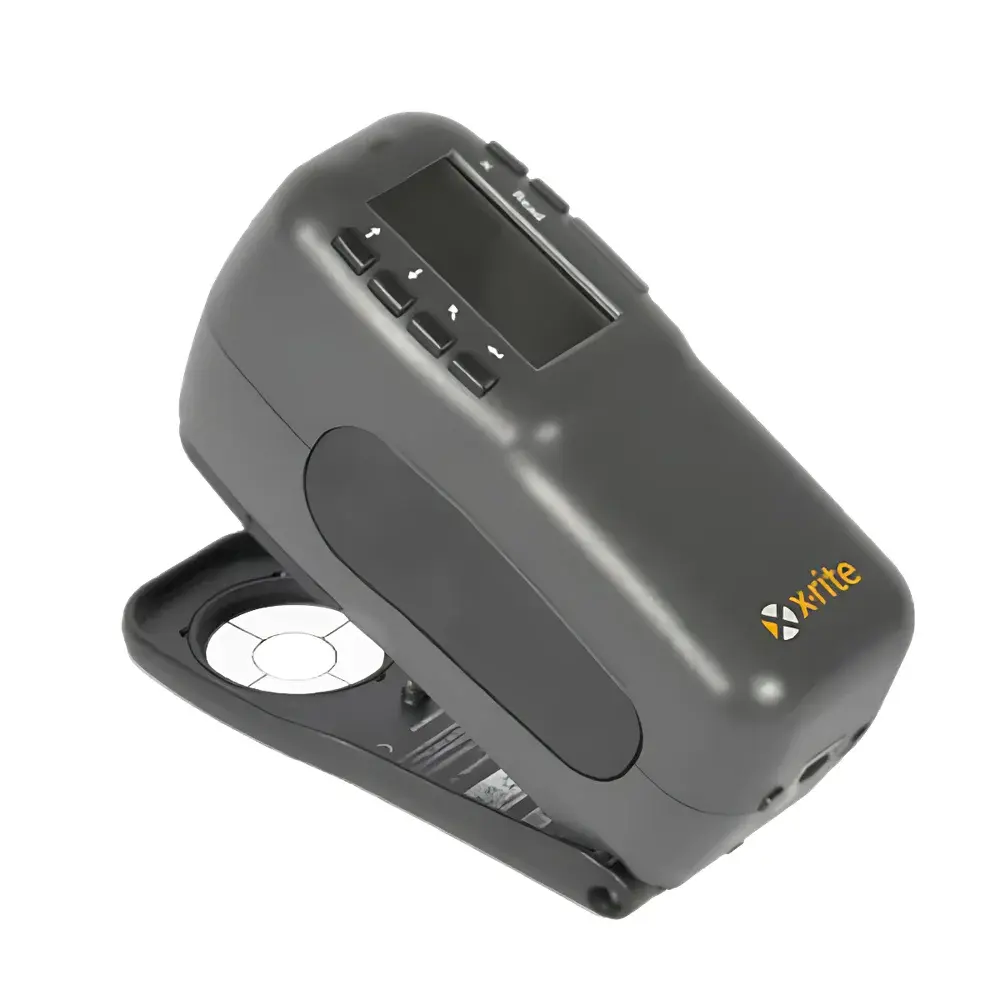
X-Rite 962 Portable 0°/45° Spectrophotometer
| Brand | X-Rite |
|---|---|
| Origin | USA |
| Model | 962 |
| Spectral Range | 400–700 nm |
| Reflectance Range | 0–200% |
| Repeatability (ΔE*ab) | ≤0.10 |
| Inter-instrument Agreement (ΔE*ab) | ≤0.20 |
| Measurement Time | ~2 s |
| Aperture Options | 15 mm, 7 mm, 4 mm |
| Dimensions | 109 × 84 × 196 mm |
| Weight | 1100 g |
| Illuminant | Pulsed Tungsten Halogen Lamp |
| Power Supply | 90–130 VAC / 100–240 VAC, 50–60 Hz |
| Storage Capacity | Up to 1,024 Pass/Fail Tolerance Sets |
| Display | Large Graphical LCD |
| Battery | Rechargeable for Field Operation |
| Geometry | 0°/45° (Fixed Illumination/Viewing Angle) |
Overview
The X-Rite 962 Portable 0°/45° Spectrophotometer is a precision-engineered color measurement instrument designed for high-fidelity spectral reflectance analysis in both laboratory and industrial production environments. Operating on the standardized 0°/45° illumination/viewing geometry—compliant with ISO 5-4, CIE 15, and ASTM E308—it eliminates specular reflection interference and delivers repeatable, geometry-consistent color data essential for quality-critical applications. Its optical architecture integrates a pulsed tungsten halogen lamp with a diffraction grating spectrometer, enabling full-spectrum acquisition across the visible range (400–700 nm) at nominal 10 nm resolution. The device calculates CIE tristimulus values (XYZ), CIELAB (L*a*b*), CIELCh, and ΔE metrics—including ΔE*ab, ΔE00, and ΔEcmc—using industry-standard observer functions (2° and 10° standard observer) and illuminants (D65, A, F2, etc.). Designed for traceability and process control, the 962 supports calibration against NIST-traceable ceramic standards and maintains stable performance across ambient temperature fluctuations (10–30 °C) and relative humidity (20–80% RH, non-condensing).
Key Features
- 0°/45° optical geometry optimized for textured, matte, and coated surfaces—ideal for automotive clearcoats, textile weaves, and molded plastics where gloss and surface structure influence perceived color.
- Interchangeable apertures (15 mm, 7 mm, and 4 mm) allow precise targeting of heterogeneous samples, small features (e.g., smartphone bezels), or patterned substrates without spatial averaging artifacts.
- Large graphical LCD display with intuitive icon-driven interface enables rapid interpretation of pass/fail results, spectral curves, and delta-E deviations—even under factory floor lighting conditions.
- Dedicated “Project Mode” organizes multiple color standards into hierarchical, searchable groups—supporting enterprise-level color specification management across R&D, sourcing, and manufacturing sites.
- Onboard storage for up to 1,024 tolerance sets facilitates offline pass/fail evaluation without PC dependency; each set includes L*a*b* targets, tolerances (ellipsoidal or rectangular), and associated metadata (operator ID, timestamp, batch code).
- Ergonomic design includes tactile side grip, swiveling target mask, and integrated wrist strap—enabling single-hand operation and consistent positioning on vertical or overhead surfaces.
- Rechargeable Li-ion battery provides ≥8 hours of continuous measurement (typical usage), certified to UL 62368-1 and compliant with IEC 61000-6-3 for electromagnetic compatibility in industrial settings.
Sample Compatibility & Compliance
The X-Rite 962 accommodates rigid, flexible, and semi-opaque materials—including painted metal panels, woven fabrics, injection-molded thermoplastics, ceramic glazes, and laminated glass substrates. Its 0°/45° configuration inherently suppresses specular contributions, making it suitable for measuring diffuse-dominant reflectance in accordance with ISO 7724-1 and ASTM D2244. Instrument-to-instrument agreement (≤0.20 ΔE*ab on BCRA II tiles) ensures metrological consistency across multi-site deployments. Data integrity meets GLP/GMP requirements through audit-trail-capable firmware (with optional software integration), and all spectral data files (.qtx) embed embedded calibration timestamps, instrument serial numbers, and measurement metadata per ISO/IEC 17025 documentation guidelines.
Software & Data Management
The 962 interfaces natively with X-Rite’s Color iQC and Color iMatch software suites via USB-C or Bluetooth 5.0. These platforms support automated report generation (PDF, CSV, XML), SPC charting (X-bar/R, Cp/Cpk), and integration into enterprise MES/QMS systems via OPC UA or RESTful API. All spectral data is stored in vendor-neutral, open-format QTX files—fully compatible with third-party color formulation engines and statistical analysis tools. Firmware updates preserve backward compatibility with legacy calibration files and maintain cryptographic signature validation for FDA 21 CFR Part 11 compliance when used in regulated environments.
Applications
- Automotive OEMs and Tier-1 suppliers for paint booth verification, interior trim matching, and headlamp lens tint consistency.
- Textile mills performing shade band control across dye lots and finishing processes (e.g., pigment printing, digital inkjet).
- Plastics compounders validating masterbatch dispersion and thermal stability of colorants during extrusion.
- Consumer electronics manufacturers auditing anodized aluminum housings, PVD-coated displays, and silicone gasket tints.
- Food packaging converters ensuring substrate-specific color fidelity on metallized PET and barrier-coated paperboard.
- Paint & coatings labs executing ASTM D313 color strength calculations and hiding power assessments using tri-stimulus ratio methods.
FAQ
What standards does the X-Rite 962 comply with for color measurement geometry?
It conforms to ISO 5-4 (0°/45° geometry), CIE Publication 15:2018, and ASTM E308 for spectral data conversion and color difference calculation.
Can the 962 measure translucent or backlit materials?
No—it is optimized for reflective mode only; transmittance or diaphragm-based transmission measurements require dedicated 0°/d or d/0 instruments such as the X-Rite Ci7800 series.
Is spectral data export supported in vendor-neutral formats?
Yes—raw spectra are saved as .qtx files containing wavelength-intensity arrays, metadata, and calibration history, fully readable by Python (via xrite-qtx-parser), MATLAB, or Excel with appropriate plugins.
How frequently must the instrument be calibrated?
Daily zero and white calibration is recommended before critical measurements; NIST-traceable recalibration every 12 months is advised for ISO/IEC 17025 accreditation.
Does the 962 support user-defined illuminants or custom observers?
Yes—up to four user-defined illuminants and two custom observer functions can be programmed via Color iQC software and deployed directly to the instrument firmware.





