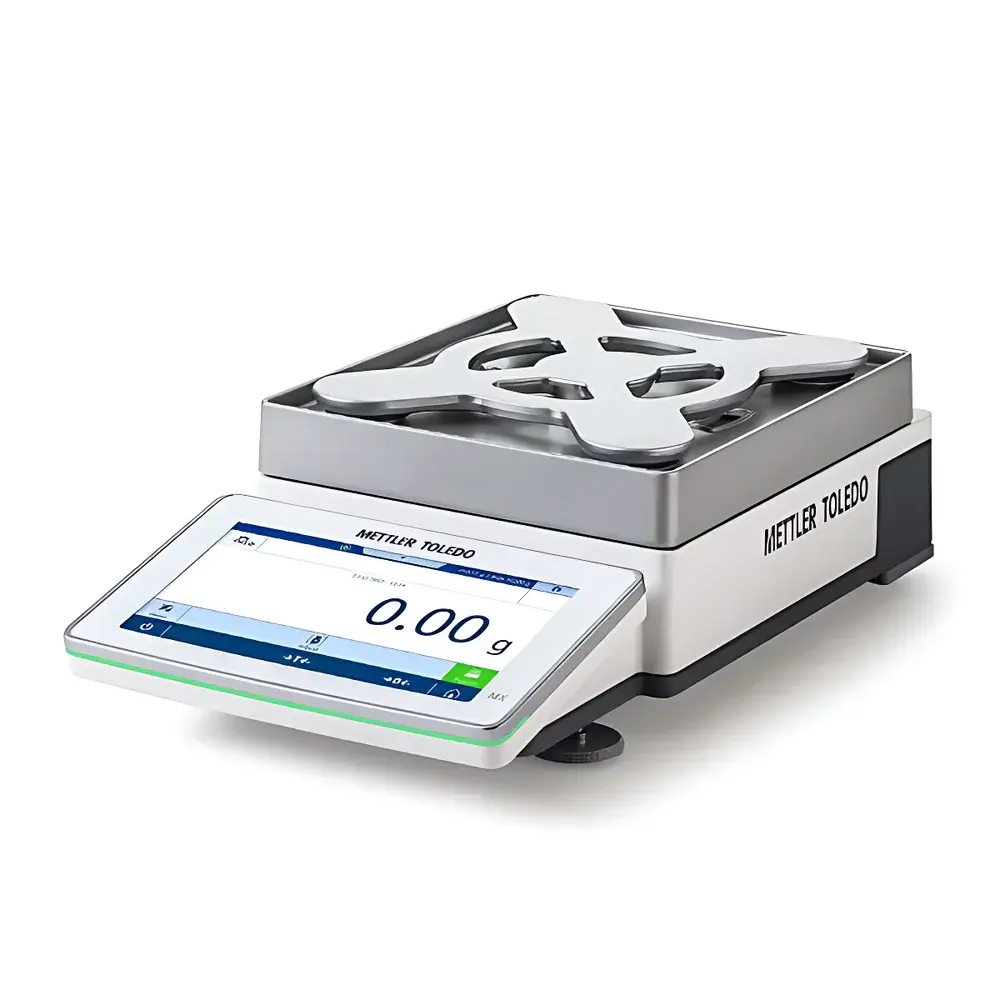
METTLER TOLEDO MX Precision Balance
| Brand | METTLER TOLEDO |
|---|---|
| Origin | Switzerland |
| Model | MX Precision |
| Readability | 0.01 mg to 1 g |
| Max Capacity | 320 g to 32.2 kg |
| Repeatability (5% load) | 0.5 mg to 400 mg |
| Linearity | 0.6 mg to 300 mg |
| Stabilization Time | 0.8 s to 1.5 s |
| Dimensions (W × D × H) | 194–354 mm × 379–380 mm × 100–353 mm |
| Pan Size | 127 × 127 mm to 352 × 246 mm |
| Certifications | OIML, NTEP, USP-compliant minimum weight validation |
| Interface | USB-A, USB-C, Ethernet, optional Bluetooth |
| Software | MT-SICS, EasyDirect™ |
| Environmental Rating | IP54 |
| Construction | Full-metal housing with QuickLock draft shield |
Overview
The METTLER TOLEDO MX Precision Balance is an advanced analytical and semi-micro weighing platform engineered for high reproducibility, regulatory compliance, and seamless integration into modern laboratory workflows. Built upon METTLER TOLEDO’s proprietary MonoBloc high-resolution electromagnetic force compensation sensor architecture, the MX series delivers exceptional stability under dynamic environmental conditions—including minor air currents, temperature fluctuations, and mechanical vibration. Its core measurement principle relies on real-time feedback-controlled current modulation to maintain zero-displacement equilibrium of the weighing pan, ensuring traceable accuracy aligned with SI mass definitions. Designed for GLP, GMP, and ISO/IEC 17025 environments, each MX model undergoes factory calibration against certified reference masses and supports internal adjustment via integrated FACT (Fully Automatic Calibration Technology) with motorized weights—eliminating manual intervention and reducing drift-related uncertainty. The balance meets OIML R76 and NTEP Class I/II requirements, and its minimum weight validation adheres strictly to USP guidelines at ±0.10% tolerance.
Key Features
- SmartPan technology: Optimized pan geometry and suspension design minimize corner-load error and improve repeatability across full weighing range.
- 7-inch capacitive touchscreen interface with intuitive icon-driven navigation and multi-language support (English, German, French, Chinese, Japanese, etc.).
- Integrated StatusLight system provides immediate visual feedback on operational status—green (ready), yellow (warning), red (error or calibration required).
- Three standard communication interfaces: USB-A (for printer or storage), USB-C (for firmware updates and direct PC connection), and 10/100 Mbps Ethernet (for networked data transfer and remote configuration).
- Optional Bluetooth 5.0 module enables wireless pairing with mobile devices and peripheral scanners for barcode-assisted sample ID entry.
- Full-metal housing with IP54-rated ingress protection ensures resistance to dust and low-pressure water jets—critical in QC labs handling solvents or powders.
- QuickLock draft shield system allows tool-free assembly/disassembly in under 10 seconds; transparent acrylic panels minimize parallax error while maintaining aerodynamic stability.
- Energy-saving mode automatically reduces display brightness and processor activity during idle periods without compromising readiness or calibration integrity.
Sample Compatibility & Compliance
The MX Precision Balance accommodates a broad spectrum of sample forms—from fine pharmaceutical powders and reference standards to bulk industrial materials and viscous liquids in tared containers. Its modular pan configurations (127 × 127 mm square pans for micro-weighing; 352 × 246 mm large-area pans for heavy-duty applications) support ASTM E899-22 volumetric dispensing protocols and USP method validation. All models are supplied with documented metrological traceability to national standards (e.g., NIST, PTB), and include a Certificate of Conformance listing uncertainty budgets per OIML R111 Annex C. Routine verification is supported by user-configurable daily tests—including repeatability checks, linearity verification, and eccentricity assessment—with pass/fail thresholds programmable per internal SOPs. Audit trails record all critical events—including calibration actions, parameter changes, and user logins—in compliance with FDA 21 CFR Part 11 requirements when used with MT-SICS software.
Software & Data Management
Data integrity and workflow automation are enabled through two complementary software ecosystems. MT-SICS (METTLER TOLEDO Standard Integration and Communication Software) provides secure, encrypted bidirectional communication with LIMS and ELN platforms using HL7, ASTM E1384, or custom XML schemas. It enforces role-based access control, electronic signatures, and immutable audit logs with timestamped metadata. EasyDirect™ software offers standalone PC-based operation for report generation, statistical process control (SPC), and trend analysis—including Cp/Cpk calculation, X-bar & R charts, and outlier detection per ISO 5725-2. Raw measurement data exports in CSV, PDF, or XML formats retain full contextual metadata (operator ID, timestamp, environmentals, calibration status). All exported reports include digital signatures compliant with EU Annex 11 and FDA Part 11 expectations.
Applications
The MX series serves as a primary weighing instrument across regulated and research-intensive domains. In pharmaceutical development, it supports API potency assays, excipient blending uniformity testing, and dissolution tablet weight variation per USP . In academic and contract research laboratories, it enables precise gravimetric preparation of standard solutions for ICP-MS and HPLC calibration. Materials science users rely on its high-resolution capability for catalyst loading quantification, polymer ash content determination (ASTM D5630), and nanomaterial dispersion dosing. Food safety labs apply MX balances for moisture loss tracking (AOAC 950.46), nutritional labeling compliance, and allergen cross-contamination threshold verification. Its robust construction and thermal compensation algorithms also make it suitable for continuous operation in production-line quality assurance stations.
FAQ
What regulatory standards does the MX Precision Balance comply with?
It conforms to OIML R76, NTEP Handbook 44, ISO/IEC 17025 clause 6.4.3, USP , and EU GMP Annex 11 when paired with validated software and documented procedures.
Can the MX balance be connected to a laboratory information management system (LIMS)?
Yes—via MT-SICS software using Ethernet or USB-C, supporting ASTM E1384, HL7, or custom API integration with full audit trail retention.
Is internal calibration performed automatically or manually?
FACT technology enables fully automatic internal calibration triggered by time schedule, temperature change (>1.5 °C), or user command—no external weights required.
How is minimum weight determined for USP compliance?
The balance calculates and displays minimum weight in real time based on current repeatability performance at 5% load (k = 2), satisfying USP ±0.10% tolerance criteria.
Does the MX series support Good Manufacturing Practice (GMP) documentation requirements?
Yes—through configurable electronic records, operator authentication, change control logs, and 21 CFR Part 11–compliant signature workflows when deployed with MT-SICS.