
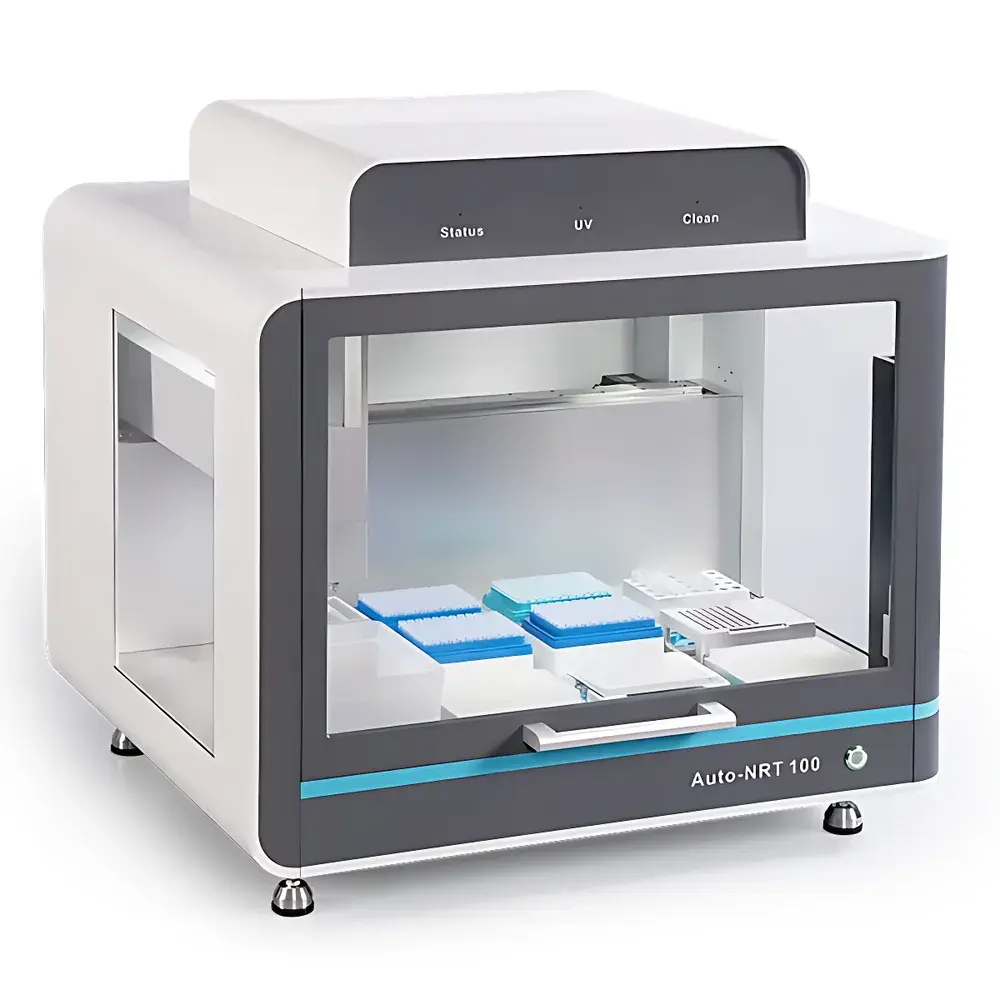
Allsheng Auto-NRT 100 Automated Sample Processing System
| Brand | Allsheng |
|---|---|
| Origin | Zhejiang, China |
| Model | Auto-NRT 100 |
| Plate Positions | 9 standard + 1 reagent reservoir + 1 waste position |
| Pipetting Principle | Air-displacement |
| Pipetting Range | 2–200 µL |
| Accuracy | ±6% at 2 µL, ±2% at 20 µL, ±1% at 100/200 µL |
| Precision | ≤6% at 2 µL, ≤2% at 20 µL, ≤1% at 100/200 µL |
| Throughput | 1–384 samples per run |
| Dimensions (W×D×H) | 740 × 630 × 670 mm |
| Temperature Control Modules | 2 units, 4–105 °C, ±0.5 °C accuracy @ 55 °C, ±0.5 °C uniformity @ 55 °C |
| Filtration | HEPA + UV sterilization |
| Compatible Vessels | SBS-standard 24-, 96-, and 384-well plates (deep/shallow), 8-tube strips, skirted/unskirted PCR plates, 1.5/2.0 mL microcentrifuge tubes, 60 mL reservoirs |
Overview
The Allsheng Auto-NRT 100 Automated Sample Processing System is a benchtop liquid handling workstation engineered for high-fidelity PCR assay setup—including conventional endpoint PCR, real-time quantitative PCR (qPCR), digital PCR (dPCR), and multiplex amplification workflows. It operates on the air-displacement pipetting principle, utilizing precision-machined syringe-driven actuators and temperature-stabilized pipette tips to deliver consistent volumetric transfer across low- and mid-range volumes (2–200 µL). Designed around SBS-compliant footprint standards, the system integrates nine programmable deck positions—eight for sample and reagent carriers plus one dedicated reservoir station and one waste disposal zone—enabling fully unattended preparation of up to 384 reactions in a single run. Its dual independent thermal modules support simultaneous heating and cooling of reaction components (e.g., master mix pre-chilling and template DNA thawing), minimizing thermal-induced variability during dispensing. The platform adheres to core principles of analytical reproducibility: traceable operation logs, user-authenticated access control, and hardware-level contamination mitigation via integrated HEPA filtration and 254 nm UV-C irradiation.
Key Features
- Eight-channel fixed-pitch pipettor with single-channel operational mode—enabling both parallel 96-well plate processing and precise single-well manipulation (e.g., serial dilution of standards or pre-mix formulation).
- Calibrated air-displacement pipetting mechanism validated per ISO 8655-2:2022, with documented accuracy and precision across the full 2–200 µL range; performance verified at critical low-volume points (2 µL and 20 µL) under controlled environmental conditions (20–25 °C, 40–60% RH).
- Dual independently controllable thermal modules (4–105 °C), each featuring ±0.5 °C temperature accuracy and uniformity at 55 °C—validated using NIST-traceable thermocouple arrays per ASTM E2251-21.
- Integrated biosafety architecture: laminar airflow supported by HEPA H14-grade filtration (≥99.995% particle capture at 0.3 µm) and pulsed UV-C irradiation (254 nm, 15 mJ/cm² dose) between runs.
- Modular deck layout accommodating SBS-standard consumables—including deep-well 96/384 plates, skirted and non-skirted PCR plates, 8-tube strips, 1.5/2.0 mL microcentrifuge tubes, and 60 mL reagent reservoirs—without mechanical adaptation.
Sample Compatibility & Compliance
The Auto-NRT 100 supports broad compatibility with common molecular biology consumables compliant with ANSI/SBS 1–2004 standards. It accommodates viscous, volatile, and surface-tension-sensitive liquids—including glycerol-containing master mixes, DMSO-diluted primers, and ethanol-precipitated nucleic acid solutions—through customizable aspiration/dispense parameters (e.g., pre-wet cycles, slow-speed dispense, tip touch-off). The system meets essential requirements for GLP- and GMP-aligned laboratories: electronic audit trails (per 21 CFR Part 11 Annex 11), role-based user authentication (three-tier permission structure), and immutable PDF-exportable run logs with timestamped operator ID, method version, and hardware status metadata. All firmware and software updates are digitally signed and version-locked to ensure configuration integrity during regulatory inspections.
Software & Data Management
The embedded Allsheng Liquid Handler Software (v3.x) provides a graphical workflow builder with drag-and-drop protocol assembly, supporting nested loops, conditional branching, and dynamic variable assignment. Each protocol includes embedded calibration metadata (tip type, liquid class, pipette offset), enabling automatic compensation for tip geometry and fluid density. Reagent management is centralized: users define and store multiple kit configurations—including volume tracking, expiration dates, and custom liquid parameters—with automated low-stock and expiry alerts triggered via front-panel LED and optional email/SNMP notification. All electronic records—including method files, execution logs, and calibration certificates—are stored in encrypted SQLite databases with SHA-256 hashing; export options include CSV for LIMS integration and PDF for SOP archiving. Audit trail entries record every action—including login/logout, parameter modification, and emergency stop activation—with cryptographic time stamping.
Applications
- High-throughput qPCR assay setup for gene expression profiling, pathogen detection, and SNP genotyping.
- Preparation of NGS library quantification standards and normalization controls (e.g., KAPA Biosystems reference standards).
- Automated serial dilution series for calibration curve generation in absolute quantification workflows.
- Reformatting of biobanked samples from storage tubes into PCR-ready plates with integrated thermal conditioning.
- Parallel processing of clinical specimens under CLIA/CAP-aligned pre-analytical protocols, including centrifugation-integrated workflows via optional robotic arm interface.
FAQ
What liquid classes are predefined in the software, and can users create custom ones?
The system ships with 12 validated liquid classes (e.g., “Water”, “Glycerol 20%”, “Ethanol 70%”, “qPCR Master Mix”) based on surface tension, density, and volatility profiles. Users may define additional classes using empirically derived parameters—contact angle, evaporation rate, and meniscus adhesion coefficient—via the Advanced Liquid Editor module.
Is the Auto-NRT 100 compatible with third-party LIMS or ELN systems?
Yes—via RESTful API endpoints and configurable ODBC drivers. Supported integrations include LabVantage, Thermo Fisher SampleManager, and Benchling; all data exchanges comply with HL7 FHIR R4 and ISA-Tab metadata standards.
How is pipette calibration maintained over time?
The system supports both factory-performed gravimetric calibration (certified per ISO/IEC 17025) and user-executed routine verification using certified weights and Class A volumetric glassware. Calibration certificates include uncertainty budgets and environmental condition logs.
Can the thermal modules be used simultaneously for heating and cooling different zones?
Yes—each module operates independently; one may be set to 4 °C for cold reagent storage while the other maintains 72 °C for hot-start enzyme activation, with real-time monitoring via onboard Pt100 sensors.
What safety certifications does the instrument hold?
CE marking (EN 61000-6-2:2019 EMC immunity; EN 61000-6-4:2019 EMC emissions; EN 61010-1:2010 safety); RoHS 2015/863/EU compliance; and IEC 61326-1:2012 for laboratory equipment electromagnetic compatibility.



