
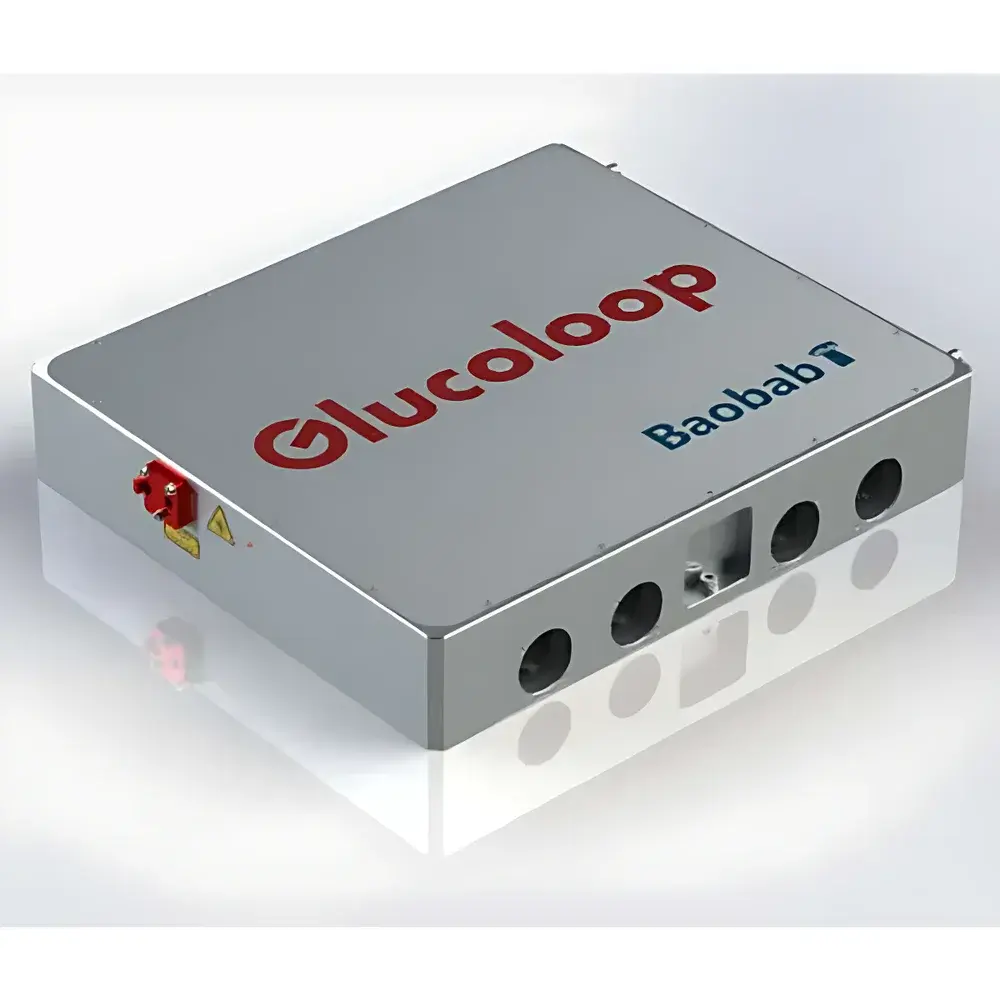
Glucoloop Baobab Compact All-in-One High-Energy Mid-Infrared (MIR) Nanosecond Laser
| Brand | Glucoloop |
|---|---|
| Origin | Switzerland |
| Model | Baobab |
| Center Wavelength | 2720 ± 10 nm |
| Pulse Duration | < 3 ns |
| Pulse Energy | > 1.3 mJ |
| Repetition Rate | < 1.5 kHz |
| Peak Power | > 500 kW |
| Average Power | > 2 W |
| Beam Quality (M²) | < 7 |
| Polarization | Unpolarized |
| Cooling | Forced Air or Water-Cooled (Optional) |
| Warm-up Time | < 15 min |
| Operating Temperature | 15–35 °C |
| Storage Temperature | −20–55 °C |
| Electrical Input | 24 VDC/12 A or 90–264 VAC, 47–63 Hz |
| Dimensions | 420 × 264 × 89 mm³ |
| Weight | 17 kg |
| Mounting | Top-entry, 3-point low-stress through-hole |
| Trigger Options | Internal Clock or External TTL |
| Amplitude Control & Gating | Integrated Fast Electronic Modulation |
| Fiber Coupling | Optional Multimode Fiber Output |
| Stability | >24 h continuous operation under ambient conditions (1 GHz detection bandwidth) |
Overview
The Glucoloop Baobab is a compact, all-in-one high-energy mid-infrared (MIR) nanosecond laser engineered for precision applications requiring strong molecular absorption in the 2.7–3.0 µm spectral window. Operating at a center wavelength of 2720 ± 10 nm—strategically aligned with the fundamental O–H and N–H vibrational absorption bands—the Baobab leverages resonant photothermal interaction to enable highly selective ablation of water-rich media. Its sub-3 ns pulse duration ensures minimal thermal diffusion beyond the target volume, making it suitable for soft-tissue procedures where collateral damage must be constrained. Unlike broadband thermal sources or longer-pulse lasers, the Baobab delivers deterministic energy deposition governed by photon–molecular bond coupling rather than bulk heating, supporting reproducible outcomes in medical, dental, and materials processing contexts.
Key Features
- Integrated architecture: Combines oscillator, amplifier, pulse picker, fast electronic gating, and amplitude modulation in a single 420 × 264 × 89 mm chassis—eliminating external alignment and reducing system footprint.
- Flexible thermal management: Selectable forced-air or water-cooling configurations ensure stable output across extended duty cycles (24/7 operation validated), with warm-up time < 15 minutes.
- Robust beam delivery: Delivers >1.3 mJ per pulse at 2 W. Beam quality (M² < 7) supports efficient coupling into multimode fibers (optional).
- Dual-trigger capability: Synchronized operation via internal clock or external TTL input enables precise timing control in time-resolved spectroscopy or gated imaging setups.
- Real-time amplitude control: On-board fast gate and analog modulation allow dynamic pulse-to-pulse energy adjustment without mechanical attenuation—critical for dose-controlled ablation and adaptive feedback loops.
- Industrial-grade reliability: Designed for laboratory and clinical environments; qualified over 24+ hours of continuous operation under ambient conditions (1 GHz bandwidth oscilloscope measurement confirms temporal stability).
Sample Compatibility & Compliance
The Baobab’s 2720 nm emission targets the hydroxyl (O–H) stretch vibration (≈3650 cm⁻¹) and amide II band (≈1550 cm⁻¹), enabling selective interaction with biological tissues, polymers, and semiconductor surfaces. It has demonstrated efficacy in ablation of hydrated soft tissue (e.g., gingiva, cornea) with negligible carbonization and rapid re-epithelialization. In materials science, it modifies bandgap properties of GaAs and InP through non-thermal lattice excitation and induces clean removal of polymeric films (e.g., PMMA, PTFE) without melt residue. The system complies with IEC 60825-1:2014 (Laser Product Safety) Class 4 requirements when operated within specified enclosure and interlock protocols. Firmware supports audit-trail logging for GLP/GMP-aligned workflows upon integration with compliant host systems.
Software & Data Management
The Baobab operates as a standalone instrument or integrates via RS-232, USB-C, or optional Ethernet interface. Glucoloop provides a vendor-agnostic SDK (C/C++, Python bindings) supporting real-time parameter readback (pulse energy, temperature, status flags) and remote configuration of repetition rate, gating window, and amplitude setpoints. All operational logs—including trigger events, thermal sensor readings, and error codes—are timestamped with microsecond resolution and exportable in CSV or HDF5 format. No proprietary runtime or license server is required; firmware updates are performed via signed binary upload with SHA-256 verification.
Applications
- Medical & Dental Surgery: Precise incision and coagulation in oral mucosa, periodontal therapy, and minimally invasive laryngeal procedures—leveraging high water absorption for shallow penetration depth (~1–3 µm).
- Aesthetic Medicine: Fractional resurfacing and scar revision with controlled dermal remodeling and reduced downtime versus Er:YAG or CO₂ platforms.
- Environmental Sensing: Pump source for quartz-enhanced photoacoustic spectroscopy (QEPAS) targeting atmospheric H₂O, NH₃, and CH₄ isotopes.
- Mass Spectrometry: Matrix-free laser desorption ionization (LDI) for thermolabile biomolecules in ambient ionization configurations.
- Semiconductor Processing: Non-contact surface modification of III–V compounds and polymer-based flexible electronics without substrate heating.
FAQ
Is the Baobab laser FDA-cleared or CE-marked?
The Baobab is supplied as a Class 4 laser subsystem. Final regulatory approval (e.g., FDA 510(k), CE-IVDR, or MDR) rests with the integrator or end-user system manufacturer, who must validate safety, performance, and clinical claims per applicable jurisdiction.
Can the pulse duration be extended beyond 3 ns?
Yes—custom pulse shaping (up to ~20 ns) is available upon request, implemented via modified cavity dumping or external pulse stretcher integration.
What fiber types are compatible with the optional fiber-coupled output?
Standard configuration supports 400–600 µm core diameter multimode fluoride or chalcogenide fibers with AR coatings optimized for 2.7–2.9 µm transmission.
Does the system support synchronization with external detectors or motion stages?
Yes—TTL-compatible trigger output (rise time < 5 ns) and input (5 V CMOS) enable sub-microsecond jitter synchronization with streak cameras, delay generators, or piezoelectric positioners.
How is long-term power stability maintained?
Thermal stabilization of gain medium and pump diodes, combined with closed-loop current regulation and real-time photodiode monitoring, ensures <±3% RMS fluctuation over 24-hour operation at constant ambient conditions.






