
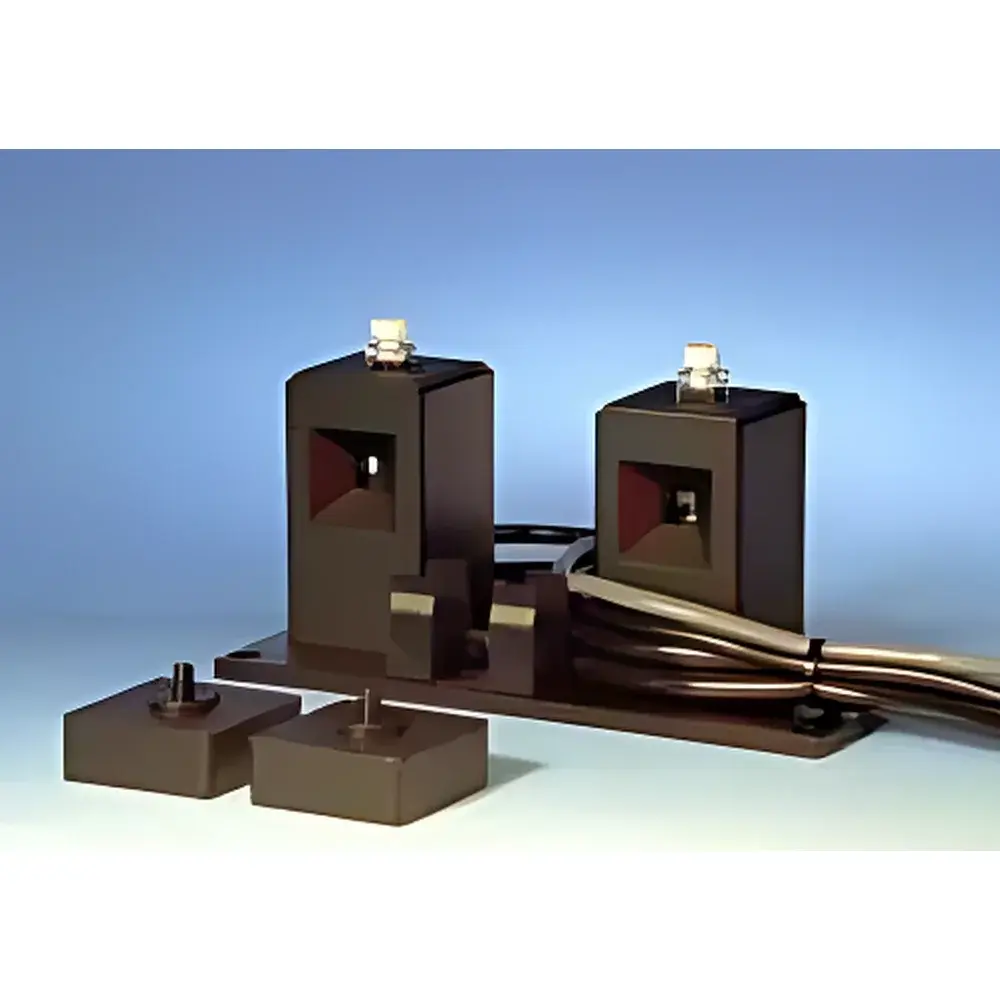
Quantum Northwest TLC42 Dual-Cell Temperature-Controlled Optical Sample Holder
| Brand | Quantum Northwest |
|---|---|
| Origin | South Korea |
| Model | TLC42 Dual-Cell Sample Holder |
| Temperature Range (Standard) | −40.00 to +105.00 °C |
| Temperature Range (Extended) | −55.00 to +150.00 °C |
| Temperature Accuracy | ±0.02 °C |
| Control Method | Peltier-based thermoelectric |
| Stirring | Magnetic, speed-adjustable per cell |
| Sensor | Integrated thermistor |
| Compliance | Designed for UV-Vis, fluorescence, CD, Raman, transient absorption, NIR, and fiber-optic spectroscopy platforms |
| Customization | Available for beam geometry, cell pathlength, optical access, and integration with specific spectrometers |
Overview
The Quantum Northwest TLC42 Dual-Cell Temperature-Controlled Optical Sample Holder is an engineered solution for high-precision, synchronized thermal management of two independent sample compartments within optical spectroscopic measurements. Based on solid-state Peltier thermoelectric technology, the TLC42 delivers rapid, bidirectional temperature control—capable of heating and cooling across a broad operational envelope—while maintaining exceptional thermal stability (±0.02 °C) and spatial uniformity. Its architecture is purpose-built for dual-beam spectrophotometric configurations, enabling simultaneous, independently regulated thermal environments for both sample and reference cells. This capability supports rigorous comparative analysis under matched or differential thermal conditions—critical for studying temperature-dependent spectral shifts, reaction kinetics, conformational transitions in biomolecules, solvent effects, and thermally induced aggregation phenomena. The system integrates seamlessly into standard cuvette-based optical paths used in UV-Vis, fluorescence, circular dichroism (CD), transient absorption, Raman, near-infrared (NIR), and fiber-coupled spectroscopy setups.
Key Features
- Peltier-driven thermoelectric control enables fast thermal response (<60 s to stabilize ±0.05 °C after step change) and precise setpoint resolution (0.01 °C increments)
- Dual independent temperature zones—each with dedicated thermistor feedback, magnetic stirring (0–1200 rpm, continuously adjustable), and real-time digital readout
- Standard operating range: −40.00 °C to +105.00 °C; extended-range variant available: −55.00 °C to +150.00 °C (requires optional cryogenic heat sink or high-temp ceramic module)
- Low-drift thermal regulation supported by active thermal isolation, low-thermal-mass cell blocks, and PID-tuned control firmware
- Magnetic stirrers ensure homogeneous sample temperature distribution—essential for viscous or sediment-prone solutions—and minimize thermal gradients across optical pathlengths
- Modular mechanical design accommodates standard 10 mm square or cylindrical cuvettes (e.g., Hellma, Starna); optical access optimized for collimated beams with minimal vignetting or stray light
- Optional vacuum-compatible and inert-gas-purged variants available for oxygen- or moisture-sensitive samples
Sample Compatibility & Compliance
The TLC42 is compatible with quartz, fused silica, sapphire, and IR-transmissive (CaF₂, BaF₂) cuvettes ranging from 0.1 mm to 10 mm pathlength. It meets mechanical and thermal interface requirements for major commercial spectrometers—including Agilent Cary, Shimadzu UV-3600iPlus, JASCO V-770, Horiba FluoroMax, and Applied Photophysics LP980 transient absorption systems. From a regulatory standpoint, its firmware supports timestamped, audit-trail-enabled temperature logging compliant with GLP and GMP documentation practices. When integrated with validated instrument control software (e.g., QNW’s TLink or third-party LabVIEW/Python APIs), it satisfies traceability requirements aligned with ISO/IEC 17025 and FDA 21 CFR Part 11 for electronic records and signatures—provided user-defined validation protocols are implemented.
Software & Data Management
Temperature control is managed via Quantum Northwest’s TLink software (Windows/Linux/macOS), which provides scripting support (TCL/Python API), multi-segment ramp-hold profiles, and real-time overlay of temperature vs. time and absorbance/fluorescence traces. All sensor data—including individual cell thermistor readings, Peltier voltage/current, and stir motor status—are logged at user-selectable intervals (10 ms to 10 s) in CSV or HDF5 format. The system supports hardware-triggered acquisition synchronization with spectrometer start signals, ensuring temporal alignment between thermal state and spectral capture. Remote operation via Ethernet or USB-C enables unattended overnight experiments and integration into automated screening workflows.
Applications
- Thermal denaturation studies of proteins and nucleic acids using CD or UV-Vis melting curves
- Temperature-dependent quantum yield determination in luminescent materials
- Reference-compensated spectroscopy where solvent or matrix thermal expansion must be isolated
- Kinetic monitoring of thermally activated photochemical reactions (e.g., photocyclization, electron transfer)
- Calibration of temperature-sensitive detectors and optical filters
- In situ monitoring of polymer phase transitions (glass transition, crystallinity onset) via NIR or Raman
- Validation of thermoregulated microfluidic spectroscopy platforms
FAQ
Can the TLC42 accommodate custom cuvette geometries or non-standard optical alignments?
Yes—Quantum Northwest offers mechanical customization including modified aperture plates, angled optical windows, and OEM mounting flanges for integration into proprietary optical benches.
Is the ±0.02 °C accuracy maintained across the full temperature range?
Accuracy is specified at steady-state conditions within the calibrated range; deviations remain within ±0.03 °C at extremes (−55 °C and +150 °C) when using extended-range modules.
Does the system support external temperature programming via LabVIEW or Python?
Yes—QNW provides documented DLLs and Python bindings for direct hardware-level control, including asynchronous temperature profiling and real-time sensor polling.
What is the maximum allowable thermal load per cell during simultaneous heating/cooling?
Each cell supports up to 1.2 W of dissipated sample heating/cooling power without compromising stability; higher loads require auxiliary heat sinking.
Are calibration certificates and IQ/OQ documentation available?
Factory calibration reports (NIST-traceable thermistor verification) are included; full IQ/OQ protocols can be supplied upon request for regulated laboratory environments.



