
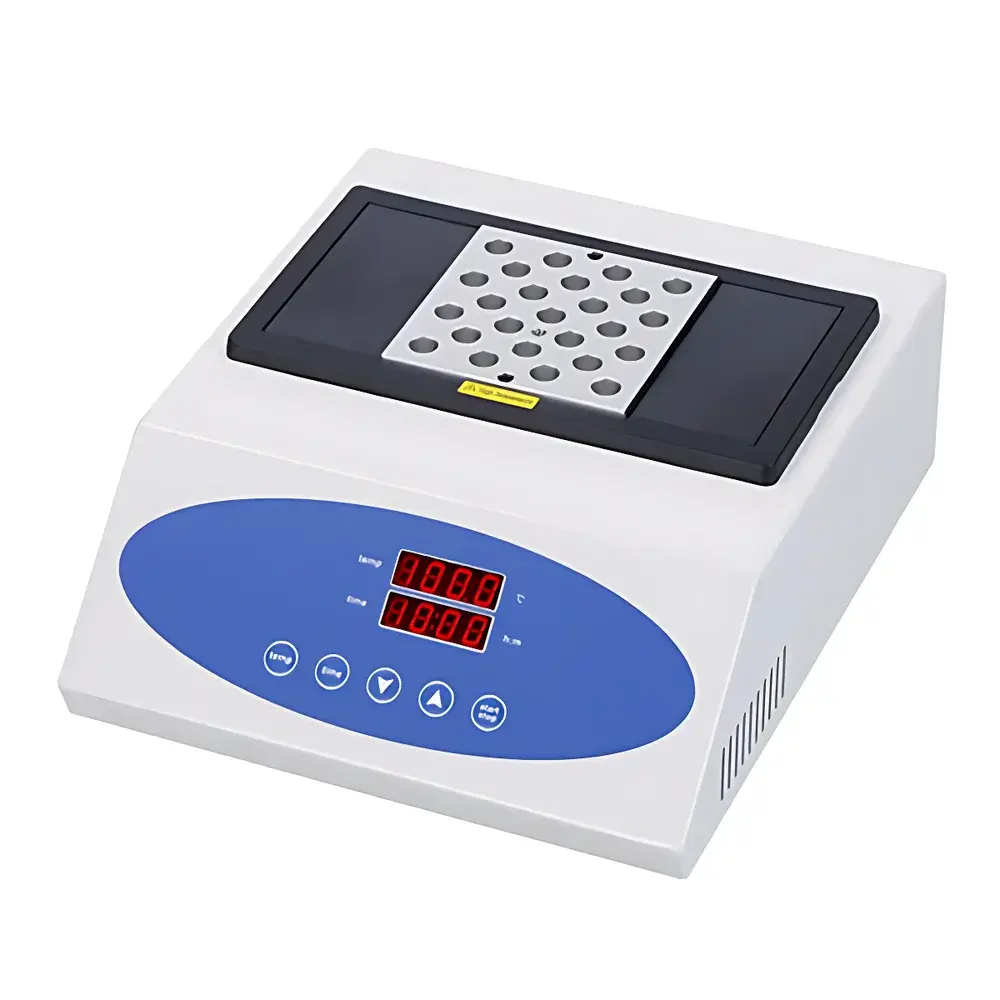
Allsheng MK200-1 High-Temperature Dry Block Heater
| Brand | Allsheng |
|---|---|
| Origin | Zhejiang, China |
| Model | MK200-1 |
| Temperature Range | Ambient +5°C to 150°C |
| Temperature Accuracy | ≤±0.5°C (at 100°C), ±0.3°C (at 40°C), ±1.0°C (at 120°C) |
| Heating Time | ≤30 min (from 25°C to 150°C) |
| Display Resolution | 0.1°C |
| Timer Range | 1 min to 99 h 59 min |
| Dimensions (W×D×H) | 280 mm × 240 mm × 110 mm |
| Net Weight | Q |
| Power Supply | AC 220 V / 120 V, 50 / 60 Hz, 200 W |
| Block Configuration | Single interchangeable aluminum block |
Overview
The Allsheng MK200-1 High-Temperature Dry Block Heater is a microprocessor-controlled thermal incubation system engineered for precise, uniform, and contamination-free temperature maintenance across life science and clinical laboratory workflows. Unlike water baths—whose evaporation, condensation, and microbial growth risks compromise sample integrity—the MK200-1 employs solid-state aluminum heating blocks with optimized thermal mass and surface geometry to deliver rapid, stable, and repeatable heat transfer directly to tubes, vials, or microplates. Its operational range spans from ambient +5°C up to 150°C, enabling applications requiring elevated thermal treatment such as enzyme inactivation, protein denaturation, serum coagulation, and pre-PCR sample preparation. The device operates on a closed-loop PID control architecture with real-time thermistor feedback, ensuring minimal thermal overshoot and high reproducibility across daily use cycles.
Key Features
- Microprocessor-based digital control with LED display showing both setpoint and real-time temperature, plus countdown timer with minute-to-hour resolution
- Dual-mode visual feedback: instantaneous temperature readout and time-remaining countdown for unambiguous process monitoring
- Integrated self-diagnostic system with audible alarm and error code indication for sensor failure, overtemperature, or power anomaly
- User-accessible temperature offset calibration function to compensate for inter-block or inter-laboratory thermal drift
- Quick-release, tool-free aluminum block design compatible with standard tube formats (e.g., 0.2 mL, 0.5 mL, 1.5 mL, 2.0 mL, and 15/50 mL conical tubes); blocks are autoclavable and chemically resistant
- Overtemperature cut-off protection circuit independent of main controller, meeting IEC 61010-1 Class II safety requirements for laboratory equipment
Sample Compatibility & Compliance
The MK200-1 supports universal sample vessel compatibility via interchangeable aluminum blocks—no custom fixtures required. Standard configurations accommodate PCR strips, individual tubes, and low-profile microcentrifuge tubes without risk of tipping or uneven contact. Each block undergoes thermal mapping validation per ISO/IEC 17025 guidelines to ensure ±0.5°C uniformity across all well positions at 100°C. The unit complies with CE marking directives (2014/30/EU EMC, 2014/35/EU LVD), RoHS 2011/65/EU, and meets electrical safety requirements under UL 61010-1 (3rd Ed.) when operated within specified voltage and frequency ranges. While not classified as a medical device, its performance characteristics align with CLIA-waived and CAP-accredited lab protocols for specimen processing where thermal consistency is critical.
Software & Data Management
The MK200-1 operates as a standalone instrument without proprietary software dependency. All configuration—including temperature setpoint, timer duration, and calibration offset—is performed locally via front-panel membrane keys. No USB, Bluetooth, or network interface is provided; this design prioritizes operational simplicity, electromagnetic immunity, and regulatory traceability in GLP/GMP environments where uncontrolled firmware updates or remote access pose audit risks. Event logs are not stored internally; however, the built-in buzzer alarm and error-code display (e.g., “E1” for sensor open-circuit, “E2” for overtemperature) support immediate troubleshooting and manual recordkeeping per laboratory SOPs. For labs requiring electronic records, integration with external environmental monitoring systems is feasible via optional analog output modules (sold separately).
Applications
- Thermal pre-treatment of clinical specimens prior to serological assays (e.g., serum clotting at 37°C or 56°C for complement inactivation)
- Denaturation steps in molecular workflows: DNA template preparation, restriction enzyme heat-inactivation, and hot-start PCR reagent activation
- Controlled drying of thin-film samples, solvent evaporation from HPLC fractions, or gentle dehydration of tissue sections
- Accelerated stability testing of reagents and standards under defined thermal stress conditions (e.g., 40°C/75% RH chamber adjunct)
- Calibration verification of thermocouples and RTDs using NIST-traceable reference blocks
FAQ
What is the maximum recommended continuous operating temperature?
The MK200-1 is rated for sustained operation up to 150°C. Prolonged use above 130°C may reduce long-term thermal element lifespan; consult the maintenance schedule for heater coil inspection intervals.
Can the unit be used with non-standard tube formats?
Yes—custom-machined aluminum blocks can be ordered separately (e.g., for 96-well plates, cryovials, or glass ampoules), subject to minimum order quantities and lead time.
Is the temperature calibration traceable to national standards?
The factory calibration uses NIST-traceable dry-well calibrators; users may perform field verification with accredited thermometers per ISO/IEC 17025 Section 6.6.
Does the device meet FDA 21 CFR Part 11 requirements?
No—this is a Class I general-purpose laboratory heater without electronic signature, audit trail, or user access controls. It may be deployed in Part 11-compliant workflows only when paired with validated external data capture systems.
How often should the heating block be cleaned and inspected?
Wipe clean after each use with 70% ethanol; inspect for surface pitting or discoloration every 200 operating hours. Replace blocks if thermal uniformity deviates beyond ±1.0°C across wells during routine verification.



