
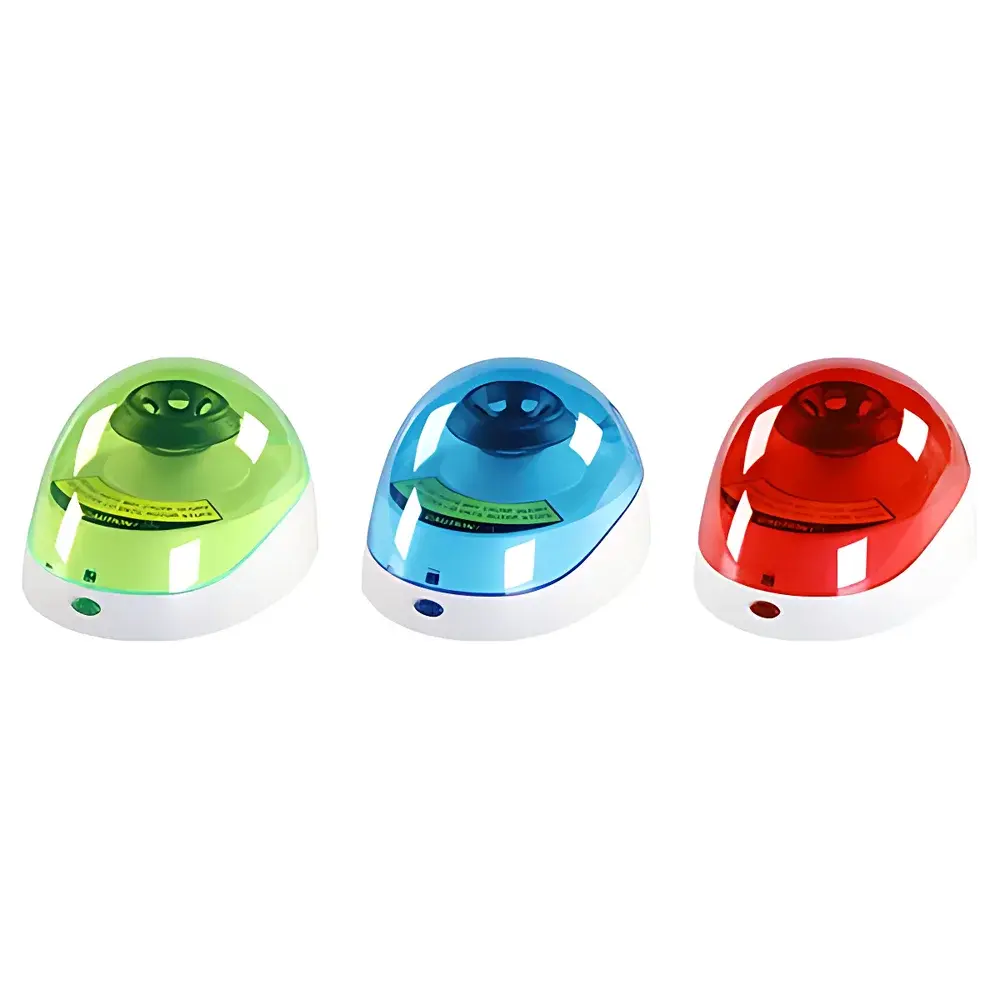
Allsheng Mini-7K Compact Benchtop Centrifuge
| Brand | Allsheng |
|---|---|
| Origin | Zhejiang, China |
| Model | Mini-7K |
| Instrument Type | Palm-Sized Centrifuge |
| Maximum Speed | 7,000 rpm |
| Maximum RCF | 2,300 × g |
| Capacity | 6 × 1.5 mL / 2.0 mL tubes or 2 × 8 × 0.2 mL PCR strips |
| Power Supply | AC 100–240 V, 50/60 Hz |
| Motor Type | Brushless DC Motor |
| Housing Material | Impact-Resistant Composite |
| Safety Features | Lid-Actuated Auto-Stop & Auto-Start, No-Coast Braking |
| Noise Level | <45 dB(A) |
| Dimensions (W × D × H) | 165 × 155 × 115 mm |
| Weight | 1.2 kg |
| Power Consumption | 30 W |
Overview
The Allsheng Mini-7K Compact Benchtop Centrifuge is an engineered solution for rapid, low-force sedimentation and pelleting of microvolume samples in resource-constrained or high-throughput laboratory environments. Designed around a brushless DC motor and precision-machined carbon-fiber rotor assembly, the Mini-7K delivers stable rotational performance up to 7,000 rpm with a maximum relative centrifugal force (RCF) of 2,300 × g—sufficient for routine pelleting of cells, precipitates, and particulates in molecular biology, clinical diagnostics, and quality control workflows. Its compact footprint (165 × 155 × 115 mm) and sub-1.2 kg mass enable deployment on crowded benchtops, inside biosafety cabinets, or in mobile lab units without compromising mechanical stability or thermal management. The device operates on universal AC input (100–240 V, 50/60 Hz), eliminating voltage compatibility concerns across global laboratory infrastructures.
Key Features
- Intelligent lid interlock system: Automatic motor stop upon lid opening and immediate restart upon secure closure—ensuring operator safety and protocol continuity.
- No-coast braking technology: Eliminates post-run rotor spin-down delay, reducing cycle time by up to 40% compared to passive deceleration systems.
- Ultra-low acoustic signature: Optimized airflow path and vibration-damped housing maintain noise levels below 45 dB(A) at rated speed—compatible with quiet-zone laboratories and shared core facilities.
- Dual-capacity rotor configuration: Supports both standard 1.5/2.0 mL microcentrifuge tubes (6-position angular rotor) and 0.2 mL PCR strip formats (2 × 8-position strip carrier), enabling parallel processing of diverse sample types.
- Robust composite enclosure: Reinforced polymer housing resists impact, chemical splashes, and repeated mechanical stress—validated per IEC 61010-1 for laboratory equipment safety compliance.
- Energy-efficient operation: 30 W nominal power draw minimizes thermal load and supports continuous duty cycling in unventilated enclosures.
Sample Compatibility & Compliance
The Mini-7K accommodates standard polypropylene and polyethylene microtubes (1.5 mL and 2.0 mL) as well as thin-walled 0.2 mL PCR strips, with optional adapters available for 0.5 mL and 0.2 mL tube formats. Rotor balance tolerance is ±0.1 g per position, supporting accurate loading without precision weighing. The instrument conforms to IEC 61010-1 (Safety Requirements for Electrical Equipment for Measurement, Control, and Laboratory Use) and meets EMC standards per IEC 61326-1. While not certified for GLP/GMP production environments, its repeatable speed control (±50 rpm accuracy), consistent RCF delivery, and audit-ready mechanical interlocks support documentation requirements for ISO/IEC 17025-accredited testing laboratories performing routine sample preparation.
Software & Data Management
The Mini-7K operates via a tactile, single-knob interface with LED status indicators—no embedded software, firmware updates, or connectivity protocols. This design eliminates cybersecurity exposure, reduces validation overhead, and ensures deterministic behavior under regulatory scrutiny (e.g., FDA 21 CFR Part 11 does not apply to non-data-logging devices). All operational parameters—including run time (0–99 seconds, incremental), speed setpoint, and lid status—are directly observable and manually adjustable without dependency on external computers or proprietary drivers. Maintenance logs and usage records may be maintained externally per institutional SOPs.
Applications
- Routine microcentrifugation prior to nucleic acid extraction, protein precipitation, or column-based purification.
- Quick-spinning of condensation in PCR tube lids before thermal cycling.
- Pelleting of bacterial cultures, yeast cells, or mammalian cell suspensions in teaching labs and field-deployable diagnostics units.
- Centrifugal separation of immiscible phases in small-volume solvent extractions (e.g., phenol-chloroform).
- Preparatory spinning of capillary blood collection tubes in point-of-care hematology screening.
- Stabilization of reagent mixes prior to dispensing in automated liquid handling workflows.
FAQ
What is the maximum recommended operating time per run?
The Mini-7K is rated for continuous operation up to 99 seconds per cycle. For extended protocols, users should allow ≥30 seconds between consecutive runs to maintain optimal motor temperature.
Can the Mini-7K accommodate 0.5 mL tubes?
Yes—using the optional AS-08061-05 adapter, which inserts into the 1.5/2.0 mL angular rotor positions.
Is rotor imbalance detection built into the device?
No. Users must manually verify symmetrical tube loading per the ±0.1 g balance specification outlined in the operator manual.
Does the Mini-7K support variable acceleration/deceleration profiles?
No. It employs fixed-rate ramp-up and no-coast braking only—optimized for speed, simplicity, and reproducibility in standardized microcentrifugation tasks.
What maintenance is required for long-term reliability?
Routine cleaning of the rotor chamber with 70% ethanol; annual visual inspection of rotor threads and lid latch mechanism; no lubrication or calibration required.



