
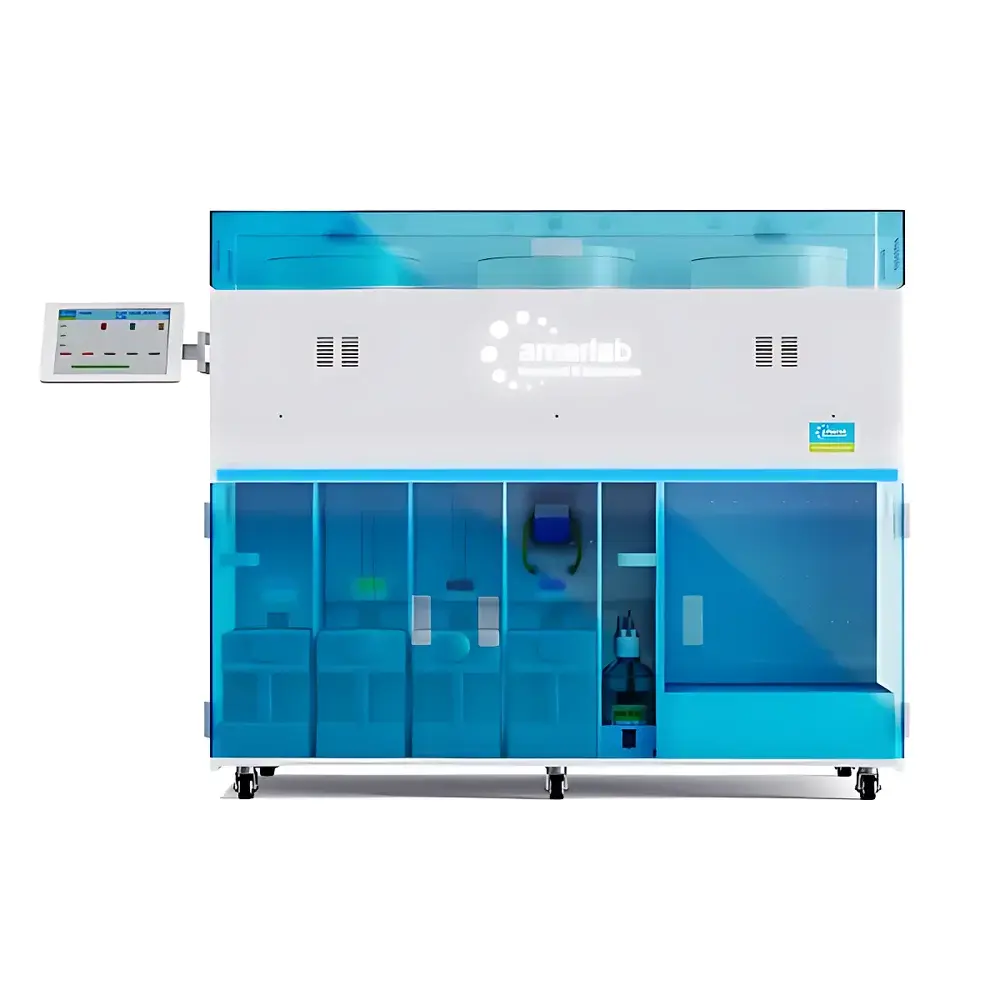
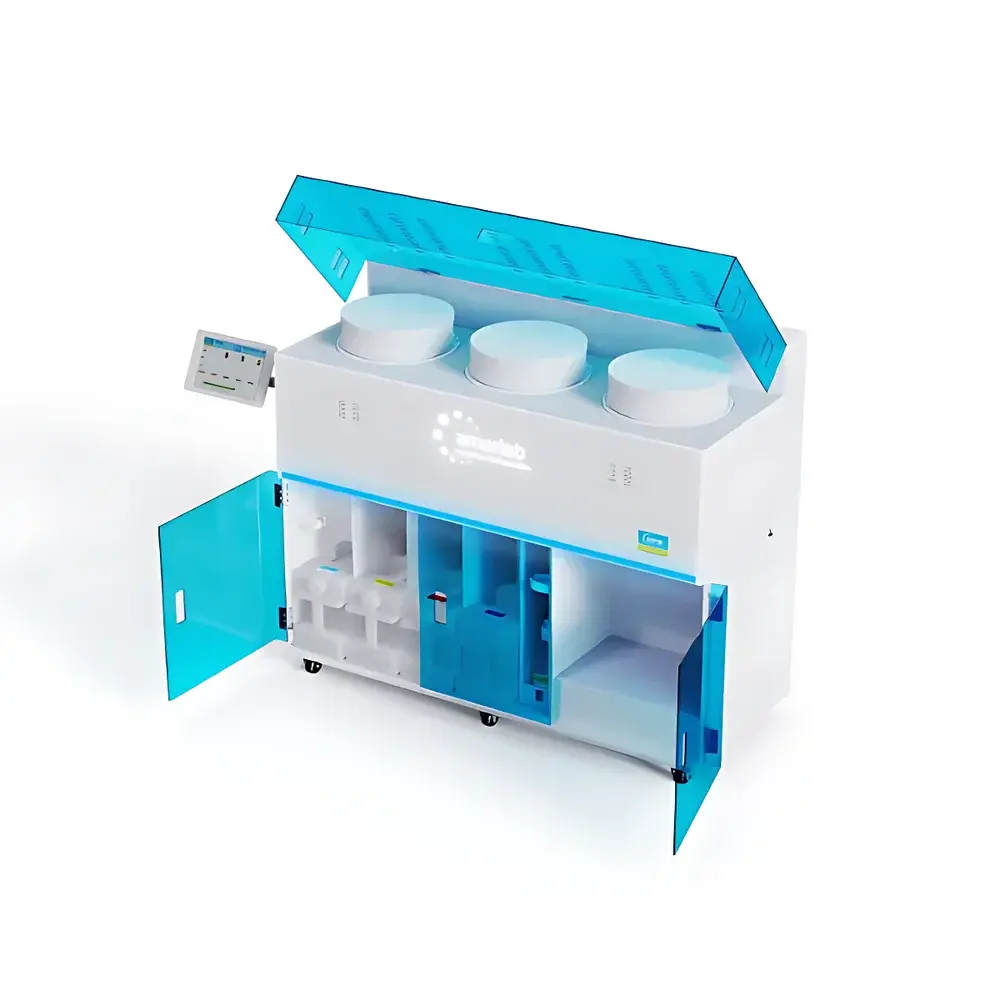
Amerlab AC XXXL Ultra-High-Throughput Sub-Boiling Acid Vapor & Counterflow Cleaner
| Brand | Amerlab |
|---|---|
| Origin | Guangdong, China |
| Manufacturer Type | Manufacturer |
| Model | AC XXXL |
| Automation Level | Fully Automatic |
| Cleanliness Level | ppt-level residue |
| Cycle Time | < 8 hours |
| Material Compatibility | PTFE/PFA-wetted path, PP chassis |
| Max Capacity | 252 digestion tubes per full cycle (3 × 84-tube channels) |
| Safety Interlocks | Temperature, pressure, liquid level, pH monitoring |
Overview
The Amerlab AC XXXL is the seventh-generation ultra-high-throughput sub-boiling acid vapor and counterflow cleaner engineered for trace-metal and ultra-trace analytical laboratories. It employs a dual-mode cleaning architecture—combining controlled sub-boiling acid vapor generation with precisely regulated acid counterflow rinsing—to achieve ppt-level contamination removal from quartz, fluoropolymer, and borosilicate labware. Unlike conventional hotplate-based acid baths or single-mode vapor cleaners, the AC XXXL integrates thermally stable sub-boiling evaporation (typically at 110–120 °C for HNO₃/HCl mixtures) with gravity-driven, low-turbulence counterflow circulation. This ensures uniform acid exposure across all vessel surfaces while minimizing aerosol generation, thermal stress, and cross-contamination risk. Designed for ISO/IEC 17025-accredited labs and compliant with ASTM D5686, USP , and EPA Method 1638 requirements for trace metal analysis, the system eliminates manual handling of aggressive acids and supports rigorous documentation for GLP/GMP audits.
Key Features
- Fully automated 3-channel modular design: Each channel processes up to 84 digestion tubes (e.g., Milestone ETHOS, CEM Mars Xpress, SCP Science UltraClean), enabling scalable throughput from 84 to 252 tubes per cycle.
- Sub-boiling acid vapor generation: Precise temperature control (±0.5 °C) maintains acid vapor below boiling point to suppress volatile loss and maximize condensate purity—critical for ICP-MS and HR-ICP-OES sample introduction systems.
- Acid counterflow rinse mode: Programmable flow rate (0.5–3.0 mL/min) and dwell time ensure complete displacement of residual contaminants without turbulent mixing or splashing.
- Full-wetted-path construction: All fluid-contact components—including reservoirs, manifolds, spray nozzles, and condensers—are fabricated from high-purity PTFE or PFA; chassis is molded PP for chemical inertness and structural stability.
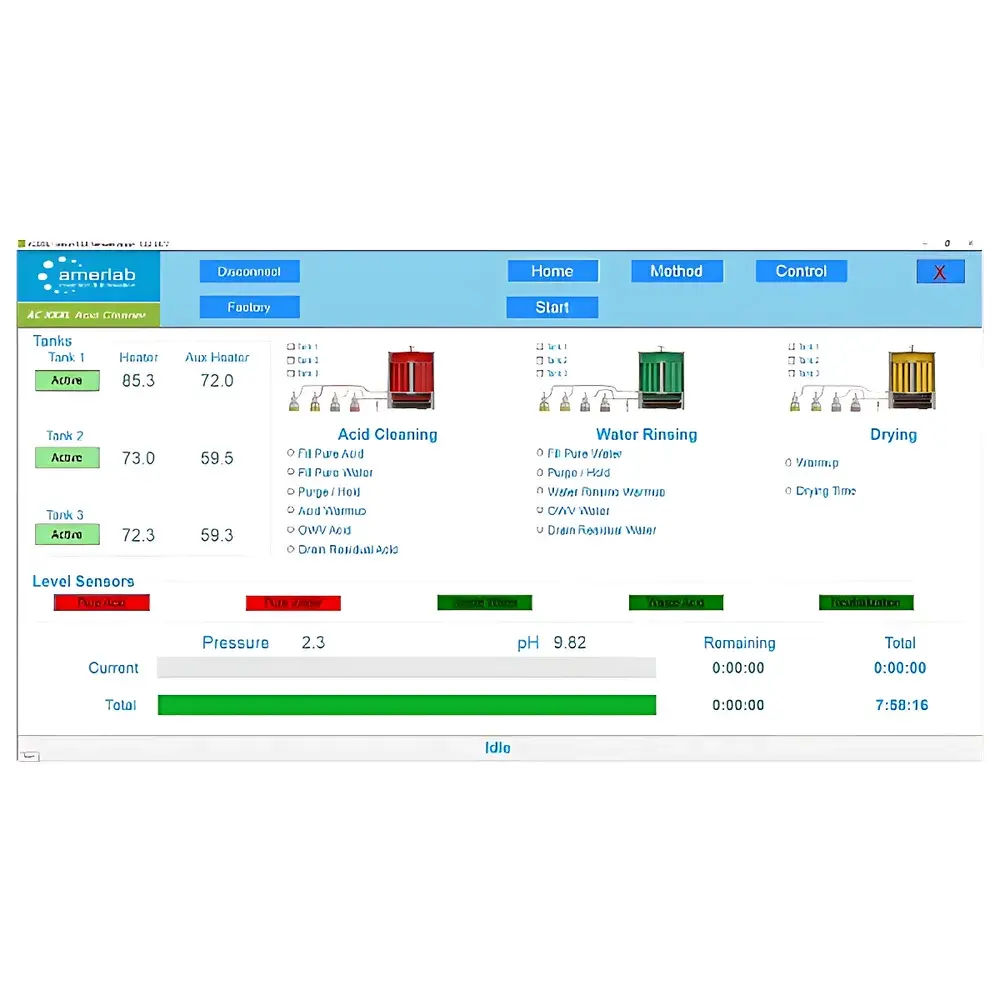
- Integrated safety architecture: Real-time monitoring of chamber temperature, internal pressure, liquid level, and rinse solution pH triggers automatic shutdown and alarm logging in accordance with IEC 61000-6-2 EMC and IEC 61010-1 safety standards.
- No fume hood required: Closed-loop vapor condensation and sealed acid recovery minimize airborne emissions—validated per OSHA 1910.1200 and EU Directive 2004/37/EC for occupational exposure limits.
Sample Compatibility & Compliance
The AC XXXL accommodates standard and custom digestion vessels (15–100 mL capacity), including closed-vessel microwave digestion tubes, open-vessel hot-block digestion jars, volumetric flasks (10–1000 mL), centrifuge tubes, and quartz cuvettes. Its universal rack interface accepts OEM and third-party fixtures—no adapter kits required. System validation protocols support IQ/OQ/PQ documentation aligned with FDA 21 CFR Part 11 (electronic records/signatures), EU Annex 11, and ISO 9001:2015 quality management requirements. Cleaning efficacy is verified using certified reference materials (CRMs) such as NIST SRM 3100 series and spiked recovery tests per ISO 17025 Clause 5.4.4.
Software & Data Management
Controlled via a 10.1″ industrial touchscreen HMI running embedded Linux, the AC XXXL firmware provides full audit trail functionality—including user login, parameter changes, cycle start/stop timestamps, sensor readings, and alarm events—with encrypted local storage (2 GB SD card) and optional Ethernet/Wi-Fi export to LIMS or ELN platforms. All logs are timestamped, digitally signed, and exportable in CSV or PDF format. Optional software module enables remote monitoring, predictive maintenance alerts (based on acid consumption trends and pump duty cycles), and integration with laboratory asset management systems via RESTful API.
Applications
- Preparation of trace-metal-free labware for ICP-MS, ICP-OES, GF-AAS, and TXRF analysis in environmental, clinical, and geochemical laboratories.
- Routine cleaning of microwave digestion vessels following EPA Methods 3050B, 3051A, and 3052 to prevent memory effects and spectral interferences.
- Decontamination of glassware used in ultrapure water production facilities (ASTM D1193 Type I) and semiconductor wafer testing environments.
- Supporting ISO 14644-1 Class 5 cleanroom workflows where particle and ionic contamination must remain below 10⁴ particles/m³ and ≤1 ppt total dissolved solids.
- Acid recycling capability (optional): Integrated distillation module recovers >92% of spent HNO₃/HF/HCl for reuse—reducing hazardous waste disposal costs by up to 70% annually.
FAQ
What acid types are compatible with the AC XXXL?
Concentrated nitric acid (69%), hydrochloric acid (37%), hydrofluoric acid (49%), and aqua regia (3:1 HCl:HNO₃) are validated. Sulfuric and perchloric acids are not supported due to thermal decomposition risks.
Does the system require external ventilation or ducting?
No. The closed-loop condensation and PFA-lined exhaust filtration meet OSHA permissible exposure limits (PELs) without connection to a fume hood.
How is cleaning validation performed?
Users may run blank cycles with certified reference solutions (e.g., NIST SRM 3100) and quantify residual metals via ICP-MS; system-generated log files include all operational parameters for traceability.
Can the AC XXXL be integrated into an existing LIMS?
Yes—via optional Ethernet module and configurable CSV/XML export templates supporting ASTM E1578 and HL7 standards.
What maintenance intervals are recommended?
PTFE gaskets and PFA tubing should be inspected every 500 cycles; acid reservoirs require quarterly calibration against certified pH and conductivity standards.



