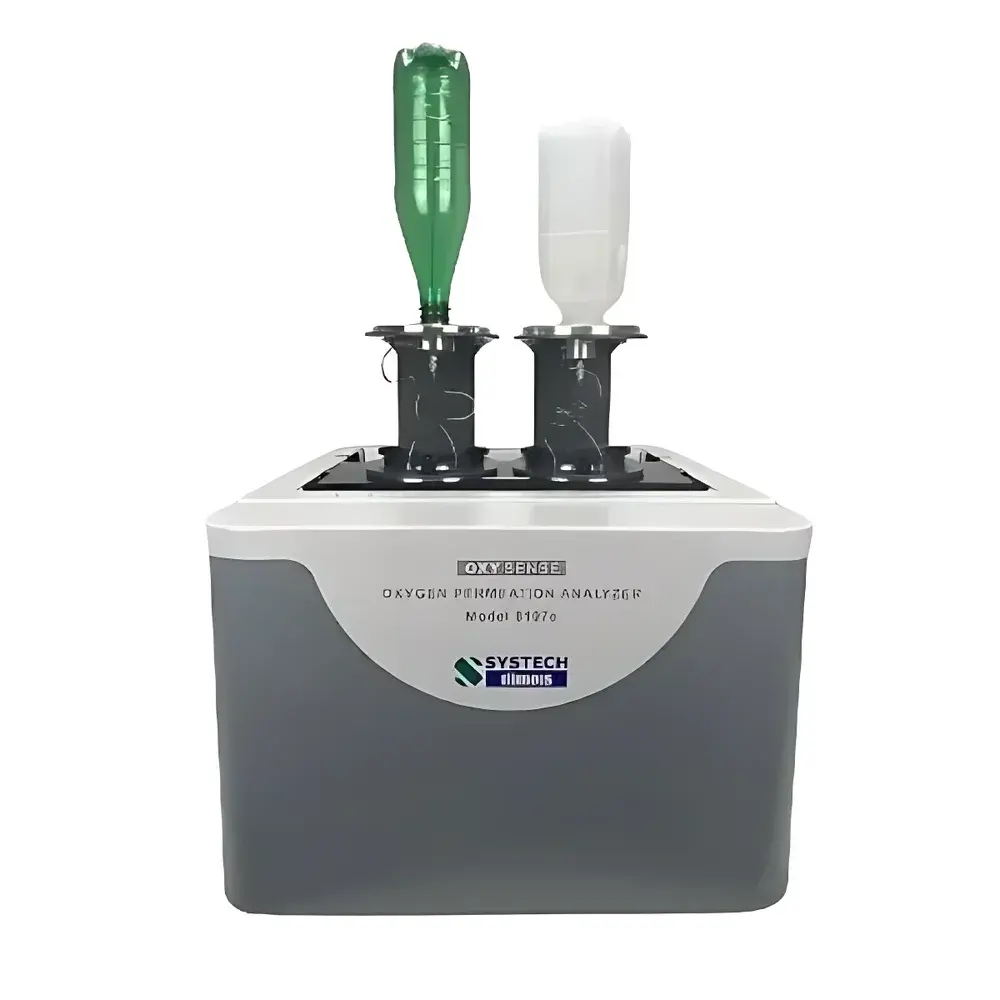
Systech Illinois 8107 Oxygen Transmission Rate Analyzer
| Brand | Systech Illinois |
|---|---|
| Origin | United Kingdom |
| Model | 8107 |
| Measurement Principle | Coulometric Sensor (ASTM F1307) |
| Test Range | 0.00025–2000 cm³/(pkg·day) |
| Resolution | 0.00001 cm³/(pkg·day) |
| Repeatability | ±0.00001 cm³/(pkg·day) or ±2% |
| Sensor Technology | Long-life E-metric Coulometric Cell |
| Protection | Anti-Surge™ Over-O₂ Compensation |
| Gas Requirement | Ambient air only (no N₂/H₂ mix required) |
Overview
The Systech Illinois 8107 Oxygen Transmission Rate (OTR) Analyzer is a benchtop, coulometric-based instrumentation system engineered for precise, trace-level quantification of oxygen permeation through flexible and semi-rigid packaging materials under controlled environmental conditions. Operating on the fundamental principle of coulometric titration—where oxygen diffusing through a test specimen is electrochemically reduced at a proprietary E-metric sensor—the instrument measures the resulting electrical charge proportional to O₂ flux. This method delivers direct, absolute measurement without calibration drift or reliance on reference gases. Designed specifically for compliance with ASTM F1307 (“Standard Test Method for Oxygen Gas Transmission Rate Through Plastic Film and Sheeting Using a Coulometric Sensor”), the 8107 supports both ambient laboratory testing and regulated conditioning environments (e.g., temperature- and humidity-controlled chambers), enabling reproducible evaluation of barrier performance across diverse packaging formats including pouches, blister packs, sachets, and laminated foils.
Key Features
- Proprietary E-metric coulometric sensor architecture delivering >2× operational lifetime versus conventional coulometric cells—reducing long-term cost of ownership and minimizing downtime for sensor replacement.
- Anti-Surge™ protection circuitry actively monitors and compensates for transient high-oxygen excursions (e.g., during chamber purging or seal failure), preventing irreversible sensor saturation and extending functional longevity.
- No external carrier gas required: operates exclusively on ambient air, eliminating dependency on costly and logistically complex nitrogen/hydrogen gas mixtures common in paramagnetic or electrochemical alternatives.
- Ultra-high resolution of 0.00001 cm³/(pkg·day) and repeatability of ±0.00001 cm³/(pkg·day) or ±2%, supporting validation of ultra-high-barrier packaging used in pharmaceutical blistering, sterile medical device packaging, and extended-shelf-life food applications.
- Modular test cell design accommodates standard ASTM-compliant sample sizes (typically 100 cm²) and integrates seamlessly with optional temperature/humidity control enclosures for ISO 15105-2 or ASTM F1927 preconditioned testing.
Sample Compatibility & Compliance
The 8107 accepts flat, non-porous, and multi-layer flexible packaging specimens—including aluminum foil laminates, SiOₓ- and AlOₓ-coated films, ethylene vinyl alcohol (EVOH) structures, and polymer blends—provided they maintain mechanical integrity under test conditions. It does not support rigid containers (e.g., glass vials, PET bottles) or porous substrates (e.g., paperboard without full barrier coating) without custom fixturing. The analyzer is fully compliant with ASTM F1307 and aligns with the metrological framework of ISO 15105-2 for comparative OTR assessment. Its coulometric methodology satisfies regulatory expectations for traceable, first-principle-based measurement in GLP- and GMP-regulated environments; audit trails, user access controls, and electronic signature readiness can be enabled via optional software modules compliant with FDA 21 CFR Part 11 requirements.
Software & Data Management
Instrument control, data acquisition, and report generation are managed through Systech’s Windows-based OTRSoft™ application. The software provides real-time OTR curve visualization, automatic calculation of steady-state transmission rates, statistical analysis (mean, SD, CV%), and customizable reporting templates aligned with internal SOPs or regulatory submission formats (e.g., ICH M4). All raw sensor output, environmental metadata (T/RH timestamps), and operator annotations are stored in encrypted, tamper-evident binary files. Optional database integration supports LIMS connectivity via ODBC, while version-controlled method files ensure consistent test execution across multiple instruments and shifts.
Applications
- Pharmaceutical packaging qualification: verification of OTR for blister cavities, cold-form foil, and child-resistant push-through packaging per USP and EP 2.6.20.
- Medical device sterilization packaging validation: monitoring barrier integrity of Tyvek®/PET-foil pouches exposed to ethylene oxide or gamma irradiation.
- Food & beverage shelf-life modeling: correlation of measured OTR values with accelerated aging studies to predict oxidative rancidity onset in nuts, coffee, and dairy powders.
- Material development R&D: comparative screening of novel barrier coatings, nanocomposite films, and bio-based laminates under standardized climatic profiles (e.g., 23°C/0% RH, 38°C/90% RH).
- QC release testing: routine batch acceptance of incoming packaging roll stock or finished pouches against pre-established OTR specifications.
FAQ
Does the 8107 require daily calibration with certified reference standards?
No. The coulometric sensor operates on a fundamental physical principle (Faraday’s law), making it inherently absolute and drift-free. Periodic verification using traceable OTR reference films (e.g., NIST-traceable polyester standards) is recommended quarterly or per internal SOP.
Can the 8107 measure OTR at elevated temperatures such as 40°C or 60°C?
Yes—when paired with an externally controlled environmental chamber meeting ASTM F1307 Annex A1 requirements. The instrument itself does not regulate temperature but synchronizes data acquisition with chamber telemetry inputs.
Is the E-metric sensor compatible with aggressive sterilants like hydrogen peroxide vapor (H₂O₂)?
The sensor is not designed for direct exposure to H₂O₂ vapor or plasma sterilization environments. It must be used downstream of sterilization, on post-sterilized packaging samples conditioned to ambient or specified T/RH.
What maintenance is required beyond sensor replacement?
Routine cleaning of test cell gaskets and O-rings with isopropyl alcohol; annual verification of pressure integrity and zero-drift performance by authorized service personnel.
How is data integrity ensured for regulatory submissions?
With optional 21 CFR Part 11-compliant firmware and software, the system enforces role-based access, electronic signatures, immutable audit logs, and secure export of PDF/A-2 or CSV reports with embedded metadata.
Related Products