
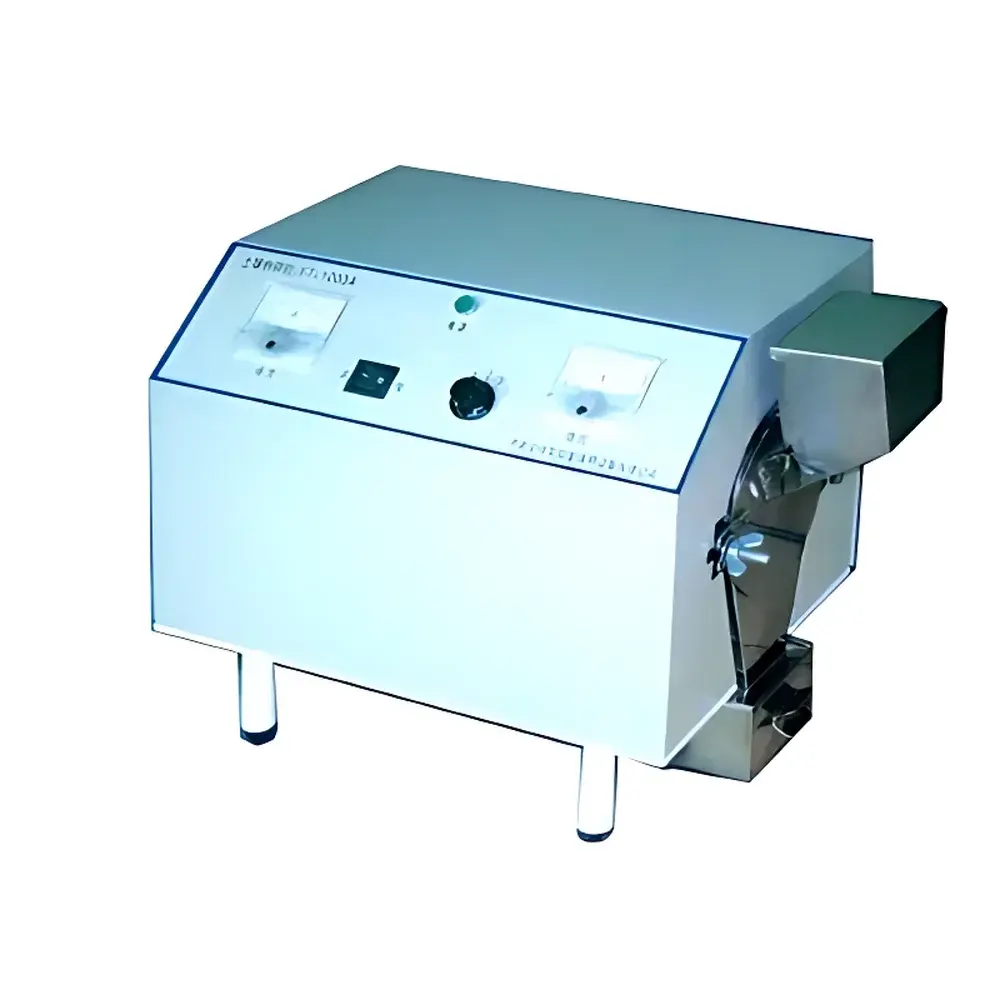
Soil Pulverizer Model 1000
| Origin | Beijing, China |
|---|---|
| Manufacturer Type | Authorized Distributor |
| Origin Classification | Domestic (China) |
| Model | 1000 |
| Pricing | Available Upon Request |
| Construction | Stainless Steel Housing & Rotor |
| Door Configuration | Side-Access Hinged Door |
| Speed Control | 3-Position Mechanical Selector |
| Motor Power | 370 W |
| Rated Voltage | 220 V AC, 50 Hz |
| Maximum Rotational Speed | 1400 rpm |
| Sample Throughput | ≥60 soil samples per hour |
| Feed Hopper Capacity | 600 g |
| Collection Drawer Capacity | 700 g |
| Rotor Design | Smooth-Frame Hammer-Type |
| Dust Containment | Sealed Drawer-Type Collection System |
| Dimensions (W×D×H) | 513 × 290 × 366 mm |
Overview
The Soil Pulverizer Model 1000 is a laboratory-grade mechanical sample preparation instrument engineered for consistent, contamination-free size reduction of heterogeneous soil matrices. It operates on the principle of high-speed hammer impact within a controlled stainless-steel chamber, where rotational kinetic energy is transferred from a precision-balanced smooth-frame rotor to hardened steel hammers. This mechanism enables rapid disintegration of aggregated soil particles—including clay-rich, gravelly, or organic-matter-laden specimens—without thermal degradation or compositional bias. Designed specifically for pre-analytical processing in regulated environments, the Model 1000 supports standardized protocols required by ISO 11277 (soil particle-size analysis), ASTM D422 (particle-size distribution of soils), and GB/T 22105 (Chinese national standard for soil testing). Its sealed drawer-based collection system minimizes airborne particulate release, aligning with OSHA permissible exposure limits (PELs) for respirable dust and supporting institutional compliance with laboratory safety management systems (e.g., ANSI Z10).
Key Features
- Stainless steel construction throughout the grinding chamber, rotor assembly, and feed hopper—ensuring zero metallic leaching and eliminating cross-contamination between samples.
- Three-position mechanical speed selector enabling operator-defined control over impact energy: low (≈800 rpm), medium (≈1100 rpm), and high (1400 rpm), optimized for varying soil cohesion and moisture content.
- Smooth-frame hammer rotor design—reducing material adhesion and facilitating complete discharge of fine fractions while maintaining structural integrity under repeated load cycles.
- Side-hinged access door with positive-latch sealing—allowing unobstructed visual inspection, rapid cleaning, and maintenance of internal surfaces without tooling.
- Digital front-panel indicators for real-time monitoring of input voltage (220 V ±10%) and operating current—supporting preventive diagnostics and power stability verification prior to batch processing.
- Integrated sealed drawer-type collection unit (700 g capacity) with silicone gasket interface—preventing fugitive dust emission during loading/unloading and ensuring full sample recovery for subsequent gravimetric or elemental analysis.
Sample Compatibility & Compliance
The Model 1000 accepts air-dried, oven-dried, or freeze-dried soil specimens ranging from sandy loam to heavy clay, including those containing up to 15% organic matter or ≤5 mm gravel fragments (pre-sieved). It is not intended for use with wet, saturated, or highly fibrous substrates. All contact surfaces comply with FDA 21 CFR §178.3570 (indirect food additives: adjuvants, production aids, and sanitizers) and meet ISO 8573-1 Class 4 purity requirements for compressed-air–free mechanical processing. The unit conforms to IEC 61000-6-3 (EMC emission standards) and IEC 61000-6-2 (immunity), and carries CE marking under the Machinery Directive 2006/42/EC. Documentation includes factory calibration records traceable to NIM (National Institute of Metrology, China) and a Declaration of Conformity.
Software & Data Management
As a standalone electromechanical instrument, the Model 1000 does not incorporate embedded firmware or digital connectivity. However, its operational parameters—including speed setting, run duration, and sample batch ID—are fully compatible with external laboratory information management systems (LIMS) via manual entry or barcode-scanned log sheets. The unit supports GLP-compliant recordkeeping: each pulverization cycle can be documented with timestamp, operator ID, soil source code, moisture content (pre-run), and post-processing sieve fraction weights. Optional accessories include a calibrated digital timer (±0.1 s resolution) and a certified reference soil standard set (NIST SRM 2710a-compatible matrix) for routine performance verification.
Applications
- Preparation of homogenized subsamples for XRF, ICP-OES, and AAS elemental analysis—ensuring representative particle-size distribution below 2 mm as specified in EPA Method 6010D.
- Routine processing of field-collected cores for pH, EC, CEC, and nutrient extraction assays (e.g., Mehlich-3, Olsen P) per AOAC Official Methods of Analysis.
- Standardized grinding of contaminated site soils prior to TCLP (Toxicity Characteristic Leaching Procedure) testing under 40 CFR Part 261.
- High-throughput sample conditioning in agricultural extension labs conducting soil health assessments (e.g., aggregate stability, permanganate oxidizable carbon).
- Geotechnical specimen preparation for Atterberg limits and Proctor compaction testing in civil engineering QA/QC workflows.
FAQ
Is the Model 1000 suitable for grinding moist or frozen soil samples?
No. The instrument requires air-dried or oven-dried material with moisture content ≤15% w/w to prevent clogging, rotor imbalance, and inconsistent particle-size output.
What maintenance intervals are recommended for sustained performance?
Inspect hammer wear and rotor balance every 200 operating hours; replace hammers when edge thickness falls below 3 mm. Clean stainless surfaces with 70% ethanol after each batch; perform full chamber decontamination weekly using ultrasonic-assisted detergent immersion.
Can the unit be integrated into an automated sample prep line?
Not natively—but it may be positioned downstream of robotic sample dispensers with gravity-fed transfer chutes, provided vibration isolation and interlocked safety guarding are implemented per ISO 13857.
Does the manufacturer provide validation documentation for GMP environments?
Yes. IQ/OQ protocols, blank run reports, and repeatability studies (n=6 per soil type, RSD ≤4.2% for d50) are available upon request for qualified users in pharmaceutical or agrochemical regulatory settings.
Related Products



