
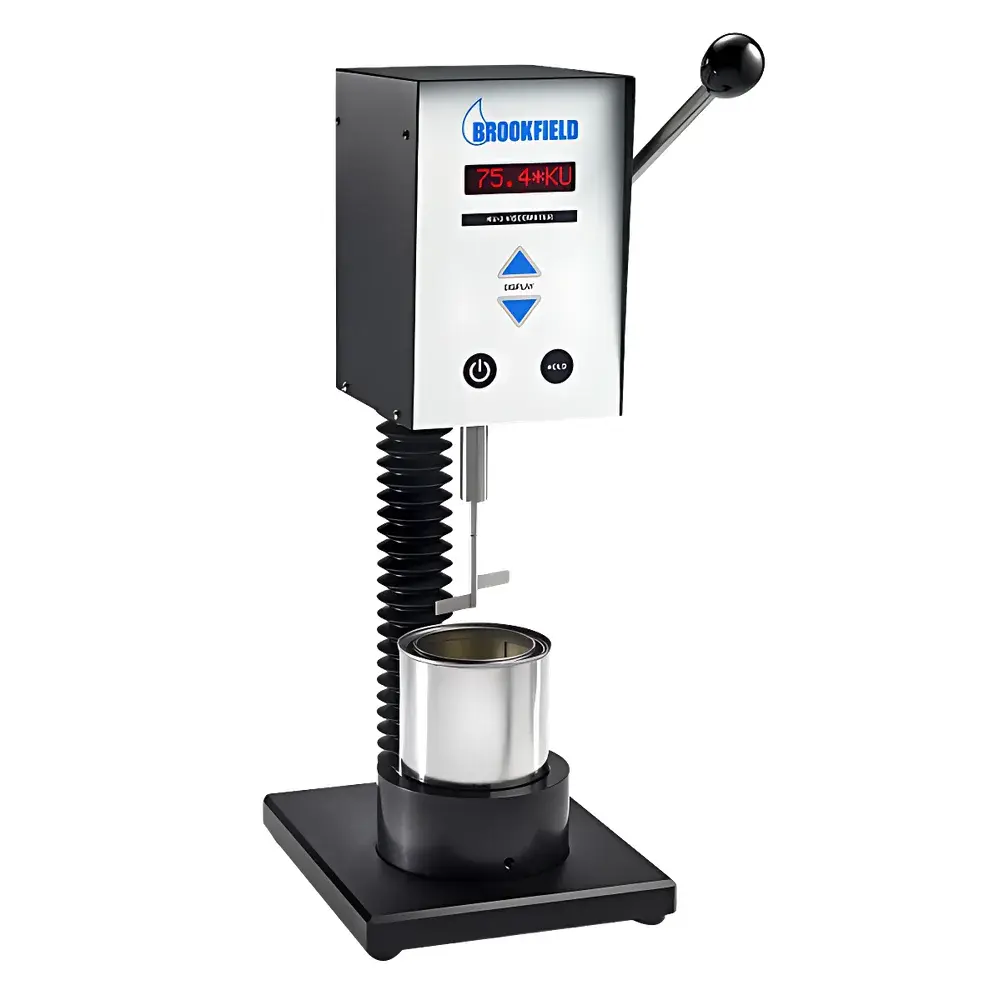
Brookfield KU-3 Krebs Unit Viscometer
| Brand | Brookfield |
|---|---|
| Origin | USA |
| Instrument Type | Rotational Viscometer |
| Model | KU-3 |
| Measurement Principle | ASTM D562-compliant Krebs Unit (KU) viscosity measurement via rotational drag on standardized paddle-type spindle |
| Standard Spindle | KU-1030 |
| Sample Vessel Compatibility | 1-pint (473 mL) and ½-pint (237 mL) cans (ASTM D562 compliant) |
| Optional | Quart (946 mL) can fixture |
| Measurement Range | 40–141 KU |
| Equivalent Units | 32–1099 g (load), 27–5274 mPa·s (cP) |
| Accuracy | ±1.0% of full-scale reading |
| Repeatability | ±0.5% |
| Display | LED with selectable units (KU, g, cP) |
| Hold Function | Yes |
| Interface | Magnetic spindle coupling |
| Compliance | ASTM D562, ISO 2555 (indirectly applicable), GLP-ready operation |
Overview
The Brookfield KU-3 Krebs Unit Viscometer is a purpose-engineered rotational viscometer designed exclusively for quality control testing of architectural paints, industrial coatings, adhesives, inks, and semi-solid dispersions according to ASTM D562. Unlike general-purpose rotational viscometers, the KU-3 implements a fixed-speed, fixed-geometry measurement principle based on the Krebs unit (KU) — a standardized empirical viscosity scale defined by the torque required to rotate a specific paddle-type spindle (KU-1030) at 200 rpm through a defined volume of material in a standard 1-pint or ½-pint container. This method correlates strongly with application properties such as brushability, sag resistance, and spatter control, making it indispensable in R&D labs and production QC environments where rapid, repeatable, and specification-bound assessment is required.
Key Features
- ASTM D562–compliant measurement architecture: Fixed 200 rpm motor speed, calibrated magnetic coupling, and geometrically precise KU-1030 spindle ensure strict adherence to the standard’s mechanical requirements.
- Dual-unit LED display: Simultaneous or toggle-enabled readout in Krebs Units (KU), gram load (g), and centipoise (cP), with automatic conversion using ASTM D562–defined polynomial relationships.
- No-weight, no-balance operation: Eliminates manual calibration weights and lever-arm adjustments — all torque sensing is internal and factory-traceable.
- Magnetic spindle coupling: Enables quick, tool-free attachment/detachment of the KU-1030 spindle; prevents slippage and ensures consistent rotational alignment.
- Dedicated sample fixtures: Precision-machined holders for both 1-pint (473 mL) and ½-pint (237 mL) standard paint cans — each fixture positions the can to exact vertical and radial tolerances specified in ASTM D562.
- HOLD function: Freezes displayed values post-test for documentation and data entry without drift or decay.
- Robust industrial housing: Cast aluminum base and sealed electronics provide long-term stability in factory-floor or lab environments subject to temperature fluctuation and incidental solvent exposure.
Sample Compatibility & Compliance
The KU-3 is validated for use with Newtonian and mildly non-Newtonian fluids exhibiting yield stress behavior typical of latex paints, alkyd enamels, acrylic dispersions, and thickened adhesives. Its fixed-geometry design inherently limits applicability to materials that fill the prescribed can volume to the ASTM-specified meniscus level (±1 mm). The instrument complies fully with ASTM D562 “Standard Test Method for Viscosity of Paints, Varnishes, Lacquers, and Related Products by Krebs-Unit (KU) Viscometer” and supports audit readiness under GLP and GMP frameworks. While not directly certified to ISO/IEC 17025, its traceable calibration procedure and documented uncertainty budget (±1.0% FS) meet foundational metrological requirements for accredited testing laboratories. Optional quart-can fixtures extend compatibility to larger-volume formulations used in industrial maintenance coatings.
Software & Data Management
The KU-3 operates as a standalone benchtop instrument with no embedded software or PC connectivity. All measurement logic, unit conversion, and display control are implemented in hardened firmware. For laboratories requiring electronic records, analog output (0–5 V DC) is available via optional interface module, enabling connection to PLCs, chart recorders, or SCADA systems. When integrated into regulated environments (e.g., FDA-regulated paint manufacturing), users may implement external electronic lab notebooks (ELN) or LIMS platforms to capture timestamped HOLD-value entries, operator ID, batch number, and environmental conditions — satisfying 21 CFR Part 11 requirements for audit trails when paired with appropriate access controls and electronic signatures.
Applications
- Architectural paint formulation QC: Rapid verification of KU targets prior to canning and shipment.
- Raw material acceptance testing: Evaluation of thickeners, rheology modifiers, and pigment pastes against incoming spec limits.
- Batch-to-batch consistency monitoring: Trend analysis of KU, g-load, and cP across production runs.
- Process troubleshooting: Correlation of KU shifts with dispersion time, milling energy, or additive dosage changes.
- Technical service support: On-site viscosity validation during customer audits or field trials.
- Regulatory submission support: Generation of ASTM D562–compliant data packages for product registration dossiers (e.g., EPA, EU CE marking).
FAQ
What is the difference between Krebs Units (KU) and centipoise (cP)?
Krebs Units are an empirical scale defined by ASTM D562 and represent the torque required to rotate a specific paddle spindle at 200 rpm in a standard can. Centipoise is an absolute SI-derived unit (mPa·s) for dynamic viscosity. The KU-3 applies ASTM-defined polynomial conversions to estimate cP — these are approximations, not direct physical measurements.
Can the KU-3 measure non-paint materials?
Yes — provided the material fills the standard can to the correct depth, exhibits sufficient structural integrity to resist splashing, and falls within the 40–141 KU range.膏状物 (pastes), gels, and high-solids adhesives have been successfully tested, but highly thixotropic or particle-laden systems may require protocol validation.
Is calibration traceable to NIST?
Brookfield provides factory calibration certificates traceable to NIST standards for torque and rotational speed. End-users should perform periodic verification using certified reference oils or KU calibration standards per ASTM D562 Annex A1.
Does the KU-3 support GLP or GMP compliance?
As a stand-alone instrument, it supports GLP/GMP workflows when operated with documented procedures, operator training records, and controlled calibration logs. Electronic data capture requires external systems to fulfill 21 CFR Part 11 audit trail requirements.



