
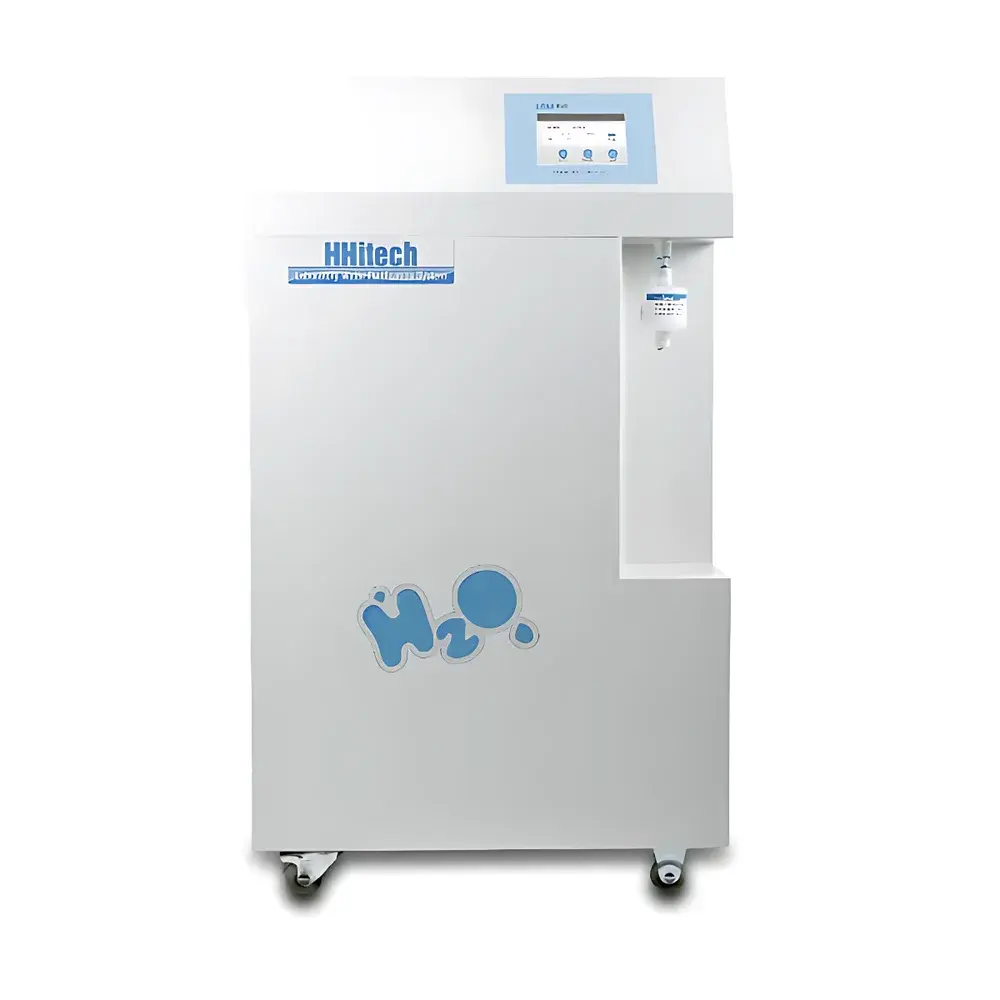
HHitech Pilot-S Ultra Pure Water System (Standard Version)
| Brand | HHitech |
|---|---|
| Origin | Shanghai, China |
| Model | Pilot-S |
| Production Capacity (Pure Water) | 45–180 L/h (varies by series) |
| Deionized Water Output | 2.0–3.0 L/min (tank-fed) |
| UP Water Resistivity | 18.2 MΩ·cm @ 25°C |
| Heavy Metals | <0.01 ppb |
| TOC | ≤10 ppb (Standard), ≤3 ppb (UV/UF variants) |
| Bacteria | <0.01 CFU/mL |
| Particles (>0.2 µm) | <1/mL |
| Endotoxins | <0.001 EU/mL (UVF variant) |
| RNases | <1 pg/mL (UVF variant) |
| DNases | <5 pg/mL (UVF variant) |
| RO Salt Rejection | 97–99% (new membrane) |
| Organic Rejection (>200 Da) | >99% |
| Input Water | Municipal tap water, 5–45°C, 1.0–4.0 kgf/cm² |
| Dimensions (L×W×H) | 640×540×1110 mm |
| Weight | ~70 kg |
| Power | 120–300 W (model-dependent) |
| Compliance | GLP-compliant architecture, NSF-certified fluid path components, DOW RO membranes, dual-wavelength UV (185/254 nm), 5000 Da MWCO UF module (UVF), 0.2 µm PES final filter |
Overview
The HHitech Pilot-S Ultra Pure Water System (Standard Version) is an engineered laboratory-grade water purification platform designed to deliver consistent, trace-contaminant-free Type I ultrapure water per ISO 3696:1987 and ASTM D1193-06 specifications. It employs a multi-stage purification architecture centered on dual-stage reverse osmosis (RO), followed by electrodeionization (EDI) or mixed-bed ion exchange, UV photooxidation, ultrafiltration (in UVF configurations), and terminal 0.2 µm polyethersulfone (PES) filtration. The system operates on the principle of sequential contaminant removal: RO membranes reject >97% of dissolved ions and >99% of organic molecules above 200 Da; UV irradiation at 185 nm generates hydroxyl radicals that mineralize residual organics, while 254 nm UV inactivates microorganisms; ultrafiltration removes endotoxins and nucleases via size-exclusion; and final submicron filtration ensures sterility. This architecture ensures reproducible production of water meeting stringent requirements for molecular biology, HPLC, LC-MS, cell culture, and semiconductor rinsing applications.
Key Features
- Dual-pump, dual-membrane RO configuration with intermediate storage tank—enhances rejection stability, reduces wastewater ratio, and lowers energy consumption versus single-stage systems.
- Automated RO membrane antiscalant flush cycle—executed daily or on demand—to inhibit carbonate/silica scaling and extend membrane service life beyond 24 months under typical municipal feed conditions.
- GLP-aligned system architecture: password-protected configuration (dual-tier factory/user access), audit-trail-capable event logging, and optional RS232/USB data export supporting 12-month continuous水质 parameter recording (resistivity, TOC, flow rate, pressure).
- NSF/ANSI Standard 61-certified fluid path: all tubing, fittings, and housings comply with material leachability limits—minimizing post-purification TOC contribution (<1 ppb background).
- Factory-integrated DOW FilmTec™ RO elements—guaranteeing >99% salt rejection consistency across pH 4–11 and enabling stable operation with feed TDS up to 1000 ppm.
- Modular cartridge design: pre-filtration (sediment + activated carbon), RO stage, and polishing modules (ion exchange, UV, UF, final filter) are physically and hydraulically isolated—enabling targeted maintenance without system shutdown.
Sample Compatibility & Compliance
The Pilot-S is validated for compatibility with critical life science and analytical workflows requiring ISO Class 5 cleanroom-grade water quality. Its UVF configuration meets USP purified water monograph criteria for endotoxin (<0.001 EU/mL) and nuclease content (RNase <1 pg/mL, DNase <5 pg/mL), making it suitable for primary neuronal culture, IVF media preparation, and CRISPR reagent formulation. All wetted materials—including PES final filters, DOW ion exchange resins, and UV quartz sleeves—carry full chemical compatibility documentation per FDA CFR 21 Part 177. The system’s firmware architecture supports 21 CFR Part 11-compliant electronic records when paired with validated third-party LIMS integration (via RS232/USB). Electrical safety complies with IEC 61010-1:2010; mechanical design conforms to IP20 enclosure rating for indoor laboratory environments.
Software & Data Management
While the Standard Version does not include embedded touchscreen HMI, it provides robust analog/digital signal outputs (4–20 mA resistivity, pulse-based flow meter) and serial communication interfaces (RS232 standard, USB optional) for integration into centralized facility monitoring systems. Internal non-volatile memory logs timestamped events—including RO inlet/outlet pressures, UV lamp operational hours, cartridge replacement alerts, and real-time resistivity/TOC trends—for up to 12 months. Exported CSV files contain ISO 8601 timestamps, sensor IDs, and calibrated measurement units—enabling direct ingestion into ELN platforms compliant with ALCOA+ data integrity principles. Audit trail functionality records user ID, action type (e.g., “cartridge reset”), and timestamp for all configuration changes, satisfying GLP requirement §58.130(a)(4).
Applications
- HPLC and UHPLC mobile phase preparation—where TOC <10 ppb prevents column fouling and baseline drift.
- Cell culture media formulation—requiring endotoxin-free water to avoid TLR4-mediated inflammatory responses in macrophage and stem cell models.
- Next-generation sequencing library prep—dependent on nuclease-free water to prevent RNA/DNA degradation during adapter ligation.
- Atomic absorption spectroscopy (AAS) and ICP-MS calibration—demanding heavy metal content <0.01 ppb to avoid spectral interference.
- Pharmaceutical QC testing per USP TOC methodology—validated using certified reference standards traceable to NIST SRM 1099a.
FAQ
What is the expected service life of the DOW RO membranes under typical municipal feed water?
With automated daily antiscalant flushing and feed water hardness 15% decline in salt rejection or >20% increase in differential pressure.
Does the Standard Version support 21 CFR Part 11 compliance out-of-the-box?
No—electronic signature, role-based access control, and audit trail encryption require integration with validated third-party software. However, the system’s hardware-level logging and dual-password architecture provide foundational controls required for Part 11 readiness.
Can the Pilot-S be connected to an external water distribution loop?
Yes—equipped with 1/4″ OD quick-connect ports and configurable pump output pressure (up to 0.4 MPa), it integrates with recirculating loops using sanitary tri-clamp fittings and 316L stainless steel piping.
Is TOC monitoring performed inline or via periodic grab sampling?
The Standard Version does not include integrated TOC analyzer; TOC values listed in specifications are derived from validated offline measurements using GE Sievers 900-series instrumentation per USP . Optional TOC modules are available as field-upgrade kits.
How frequently must the ultrafiltration (UF) module be replaced in UVF configurations?
Under continuous operation with endotoxin-laden feed water (e.g., distilled water storage tanks), the 5000 Da MWCO UF cartridge requires replacement every 6–12 months—monitored via differential pressure rise (>0.1 MPa) or validated endotoxin breakthrough testing.



