
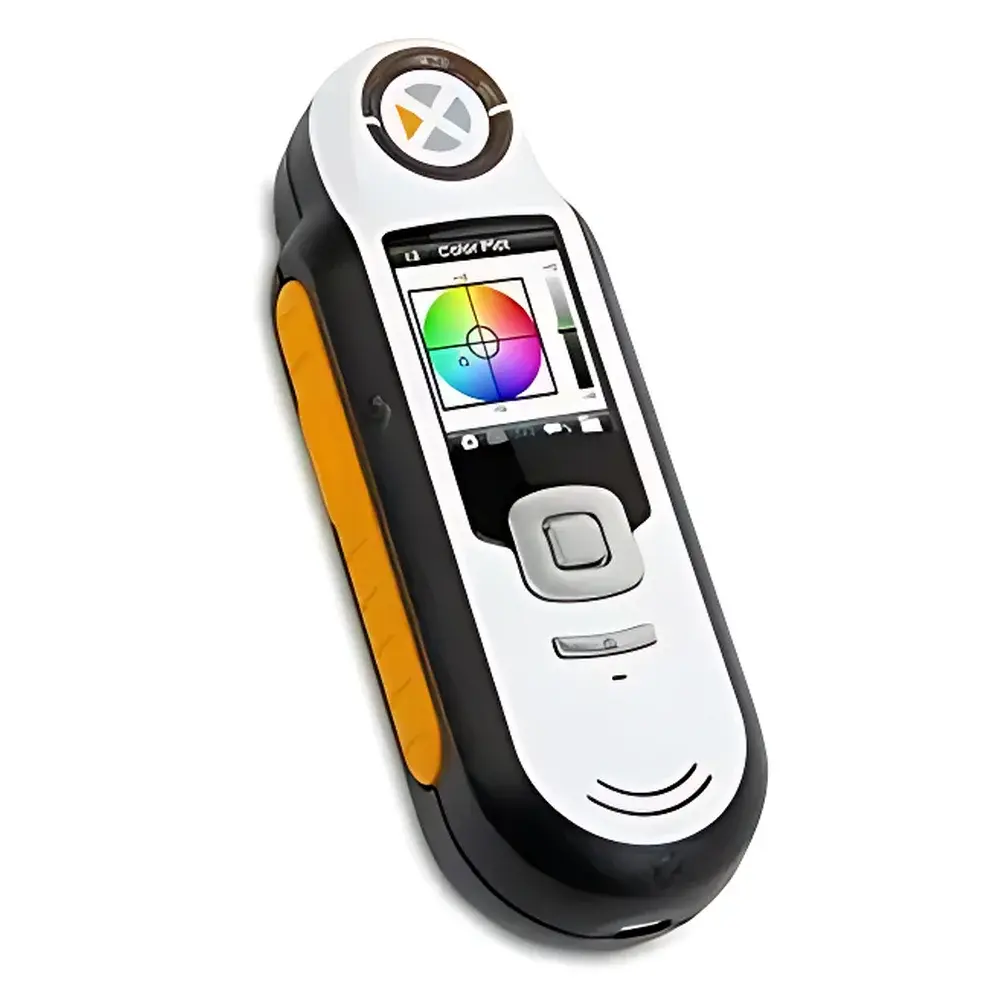
X-Rite RM200QC Portable Imaging Spectrophotometer
| Brand | X-Rite |
|---|---|
| Origin | USA |
| Model | RM200QC |
| Instrument Type | Portable |
| Optical Geometry | d/8° integrating sphere (with 45/0 imaging mode) |
| Light Source | Tungsten-halogen lamp + UV LEDs (Ci4200UV) |
| Spectral Range | 400–700 nm |
| Repeatability | 0.05 ΔE*ab (typical, white tile, D65/10°) |
| Measurement Apertures | 4 mm and 8 mm |
| Measurement Time | 1.8 s |
| Standard Memory | 20 |
| Sample Memory | 350 |
| Display | 4.5 cm color TFT LCD |
| Interface | USB Mass Storage Class |
| Operating Temperature | 0–40 °C |
| Storage Temperature | −20–60 °C |
| Relative Humidity | 20–80 % RH (non-condensing) |
| Altitude Limit | 2000 m |
| Pollution Degree | 2 |
| Overvoltage Category | II |
Overview
The X-Rite RM200QC Portable Imaging Spectrophotometer is an industrial-grade color measurement instrument engineered for high-accuracy, on-site quality control in manufacturing, packaging, paint, plastics, and textile environments. Unlike conventional tristimulus colorimeters, the RM200QC combines full-spectrum reflectance acquisition (400–700 nm) with high-resolution spatial imaging—leveraging a dual-mode optical architecture that integrates both d/8° integrating sphere spectroscopy and 45/0° multi-angle image capture. This hybrid design enables simultaneous spectral data collection and geometrically registered color imaging, ensuring metrological traceability while preserving visual context. The device employs a stabilized tungsten-halogen lamp for visible illumination and a dedicated UV LED (Ci4200UV) to assess fluorescent whitening agents (FWAs), supporting compliance with ISO 13655:2017 (M0/M1/M2/M3 measurement modes). Its 0.05 ΔE*ab repeatability (measured on ceramic white tile under D65/10°) meets stringent intra-instrument stability requirements for process-critical applications.
Key Features
- Dual optical geometry: d/8° integrating sphere for CIE-compliant spectral reflectance measurements, plus 45/0° imaging optics for spatially resolved color evaluation and surface texture correlation
- 25-LED illumination system: 24 visible-wavelength LEDs arranged in three independent directional arrays (8 per axis) + 1 UV LED—enabling uniform, shadow-free illumination across curved or textured surfaces
- Real-time imaging capability: Captures 27 synchronized color images in <1 second; reconstructs 3D surface color maps aligned with spectral data points
- Variable aperture selection: Switchable 4 mm and 8 mm measurement areas accommodate fine-detail components (e.g., cosmetic caps) and large-area substrates (e.g., automotive trim)
- On-device pass/fail decision logic: Configurable single-tolerance limits applied directly on instrument; results displayed as intuitive color-coded indicators (green/red) without PC dependency
- Integrated 4.5 cm high-brightness TFT display: Supports CIELAB, CIELCH, and ΔE*ab vector visualization; includes simulated color patches and interactive chromaticity diagrams for rapid operator interpretation
- Firmware-level Chinese language support: Fully localized UI—including menus, error prompts, and report templates—for streamlined deployment in APAC production facilities
Sample Compatibility & Compliance
The RM200QC accommodates opaque, translucent, and semi-gloss substrates—including injection-molded plastics, coated metals, printed films, and fabric swatches—without requiring sample preparation or external calibration tiles. Its 45/0° imaging mode mitigates directional reflectance artifacts common in structured surfaces (e.g., brushed aluminum or embossed leather), while the d/8° sphere mode ensures compliance with ASTM D2244, ISO 11664-4, and CIE Publication 15:2018 for spectrophotometric color difference reporting. UV-enabled M1 mode supports regulatory assessment of optical brighteners per ISO 11475 and TAPPI T485. Device firmware adheres to IEC 61000-4 electromagnetic compatibility standards and carries CE, UKCA, and FCC certifications. No external software is required to satisfy internal audit requirements for GLP or GMP environments—measurement history, timestamps, operator IDs (via optional PIN), and tolerance configurations are stored onboard with write-protected integrity.
Software & Data Management
Data export occurs via USB mass storage class interface—no drivers required—allowing direct drag-and-drop transfer of CSV-formatted spectral data, image thumbnails, and summary reports (.txt/.pdf) to any host system. All measurements include embedded metadata: date/time stamp (RTC-backed), illuminant/viewing angle, aperture size, UV status, and operator ID. While standalone operation is fully functional, optional integration with X-Rite Color iMatch QC software enables advanced statistical process control (SPC), trend analysis, and automated report generation compliant with FDA 21 CFR Part 11 (audit trail, electronic signatures, data integrity controls). Firmware updates are delivered via signed .bin files validated against X-Rite’s secure OTA signing chain.
Applications
- Automotive interior trim verification: Detect batch-to-batch hue shifts in polypropylene dashboards under varying lighting conditions
- Pharmaceutical blister pack inspection: Quantify color consistency of PVC/PVDC laminates and confirm absence of UV-induced degradation
- Consumer electronics housing QC: Validate anodized aluminum color match across multiple suppliers using spatial averaging over 8 mm aperture
- Textile dye lot approval: Compare spectral curves of dyed cotton samples against master standards under M1 (D65+UV) to detect fluorescent additive drift
- Food packaging print verification: Assess CMYK ink density uniformity on flexible laminates using image-based delta-E mapping
- Paint formulation validation: Rapidly screen tinted basecoats against digital standards without lab spectrophotometer dependency
FAQ
Does the RM200QC require annual recalibration by an accredited laboratory?
No—its solid-state optical path and factory-traceable NIST-calibrated reference tile enable stable performance for 12 months under normal use. Optional annual verification services are available through X-Rite Service Centers.
Can measurement data be exported in industry-standard formats for LIMS integration?
Yes—CSV exports include full spectral data (10 nm intervals), CIE XYZ, L*a*b*, and ΔE*ab values; custom field mapping is supported via X-Rite’s open API documentation.
Is the device suitable for outdoor use under ambient daylight?
It is rated for indoor use only (IP20 enclosure); direct sunlight exposure may compromise UV LED stability and thermal sensor accuracy.
How does the 45/0° imaging mode improve correlation with visual assessment?
By capturing spatial color variation across the measurement area—and rendering it as a perceptually uniform CIELAB heatmap—it replicates human observer sensitivity to local heterogeneity, unlike point-spectrophotometers.
What security protocols govern onboard data storage?
All stored measurements are timestamped and immutable; firmware prevents deletion of historical records unless initiated via authenticated service mode with physical button sequence.




