
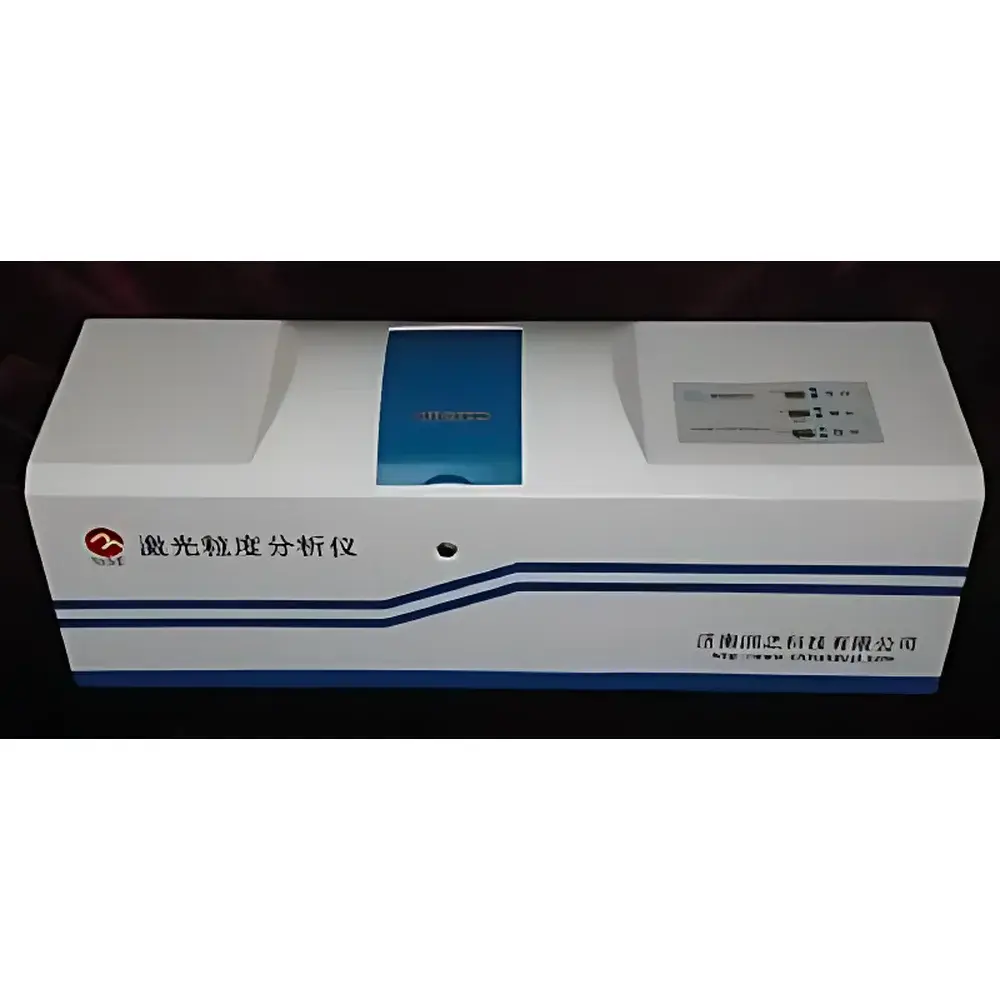
Rise-2006 Laser Particle Size Analyzer
| Origin | Beijing, China |
|---|---|
| Manufacturer Type | Authorized Distributor |
| Origin Category | Domestic (PRC) |
| Model | Rise-2006 |
| Pricing | Available Upon Request |
| Measurement Range | 0.05–800 µm |
| Accuracy Error | < ±1% (D50, certified reference materials per GB/T 19077–2016) |
| Repeatability | < ±1% (D50, same standard) |
| Electrical Supply | AC 220 V ±10%, 50 Hz, 200 W |
| Dimensions | 1000 × 330 × 320 mm |
| Weight | 38 kg |
Overview
The Rise-2006 Laser Particle Size Analyzer is a high-precision, wet-dispersion instrument engineered for reliable and traceable particle size distribution (PSD) measurement across industrial R&D, quality control, and regulatory laboratories. It operates on the principle of Mie scattering theory—fully incorporating complex refractive indices of both particles and dispersion medium—to invert angular light intensity patterns into volumetric PSD data. Unlike simplified Fraunhofer-based systems, the Rise-2006 implements full-range Mie inversion without prior assumptions about distribution shape (i.e., non-parametric, unconstrained fitting), ensuring fidelity to actual sample morphology. This computational rigor demands optimal optical design: a He–Ne laser (λ = 632.8 nm) delivers exceptional wavelength stability (25,000-hour operational lifetime, while its monochromatic coherence enables high signal-to-noise ratio detection across a wide angular range (up to 105°). The instrument’s single-optical-path Fourier configuration eliminates alignment sensitivity and lens stacking, enhancing long-term reproducibility and reducing maintenance overhead.
Key Features
- Stable Light Source: Integrated helium–neon laser with narrow spectral linewidth, low power drift (<0.5% over 8 hours), and thermal stabilization ensures consistent illumination critical for inter-day repeatability.
- Advanced Detector Array: Non-uniform, cross-three-dimensional扇形 (sectoral) photodiode matrix with 1 primary and multiple auxiliary detectors; optimized spatial resolution across forward and backward scattering angles.
- Integrated Dispersion System: 100 W ultrasonic generator co-located with main unit; digitally controlled sonication time (0–9 min 50 sec, 1-sec increments); electromagnetic shielding prevents interference during concurrent measurement and dispersion.
- Modular Fluid Handling: 400 mL stainless-steel circular dispersion cell with rapid drain port; compatible with water, deionized water, ethanol, and other low-viscosity, non-corrosive dispersants.
- Dynamic Homogenization: Independent, touch-controlled stirring (0–3000 rpm) and circulation (0–5000 rpm) systems—both continuously adjustable and digitally displayed—minimize sedimentation and bubble formation while maintaining suspension uniformity throughout analysis.
- Alignment-Free Optics: Fixed convergent optical path with no user-serviceable mirrors or lenses; factory-calibrated detector geometry ensures zero-field adjustment across service life.
Sample Compatibility & Compliance
The Rise-2006 supports routine analysis of powders, suspensions, emulsions, and slurries exhibiting moderate to high agglomeration tendency—including metal oxides, pharmaceutical actives, ceramic precursors, pigments, and battery cathode materials. Its dispersion architecture accommodates samples with densities up to 7.8 g/cm³ and hardness values ≤ Mohs 6. While not intrinsically explosion-proof or ATEX-rated, the system complies with IEC 61010-1:2010 for laboratory electrical safety. Data acquisition and reporting align with GLP/GMP documentation expectations: raw scattering patterns, instrument metadata (laser power, temperature, date/time stamp), and operator ID are embedded in each .DAT file. Though not pre-certified to ISO 13320:2020 or ASTM E2412–22, its Mie-based inversion engine and traceable calibration protocol (using NIST-traceable SRM 1963 and GBW(E)120012 standards) enable validation per internal SOPs required by FDA 21 CFR Part 11–governed environments.
Software & Data Management
The PADMAS (Particle Diameter Measure & Analysis System) software provides ISO/IEC 17025–aligned data handling. It computes D10, D50, D90, span, specific surface area (volume- and mass-normalized), and lognormal/Rosin–Rammler parameters. Default classification comprises 130 size bins from 0.02–2000 µm; users may define custom binning schemes (1–130 bins) or export binned data to CSV/Excel for external statistical modeling. Reports include interactive histograms, cumulative curves, and tabular summaries—with configurable headers, footers, and bilingual (English/Chinese) output. All graphical outputs render as vector-based PDF or raster PNG for integration into LIMS or electronic lab notebooks. Audit trail functionality logs user actions, parameter changes, and calibration events—supporting 21 CFR Part 11 compliance when deployed on validated Windows OS platforms with domain authentication.
Applications
- Pharmaceutical solid dosage development: API crystallinity assessment, excipient blending uniformity, and inhaler aerosol characterization.
- Cement and concrete admixture QC: fineness verification per ASTM C204 and EN 196-6.
- Advanced ceramics manufacturing: sintering feedstock consistency monitoring and green-body density prediction.
- Electrochemical material qualification: cathode/anode powder sizing for Li-ion battery slurry rheology and electrode porosity modeling.
- Environmental particulate analysis: soil sediment fractionation, airborne PM characterization (after liquid suspension), and wastewater floc size tracking.
- Food & beverage ingredient control: starch granule distribution, dairy protein aggregate sizing, and spice milling endpoint determination.
FAQ
What refractive index inputs does the Rise-2006 require for Mie calculation?
Users must specify real and imaginary components of both particle and dispersant refractive indices. Default libraries include common materials (e.g., SiO₂, TiO₂, lactose, water, ethanol); custom values may be entered manually or imported via CSV.
Can the system measure dry powders directly?
No—the Rise-2006 is configured exclusively for wet dispersion. Dry powder measurement requires optional add-on modules (not included with base configuration).
Is the ultrasonic transducer replaceable in-field?
Yes; the 100 W piezoelectric transducer is a modular component with standardized mounting and cabling—replacement can be performed by trained personnel using supplied torque tools and alignment jig.
Does the software support automated batch reporting for production lots?
Yes—PADMAS includes scriptable report templates and folder-watch automation that triggers sequential analysis and PDF export upon file drop, enabling unattended multi-sample throughput.
How often is recalibration recommended?
Annual verification against certified reference materials (e.g., NIST SRM 1963) is advised; daily system suitability checks using secondary standards are recommended prior to critical measurements.
Related Products



