
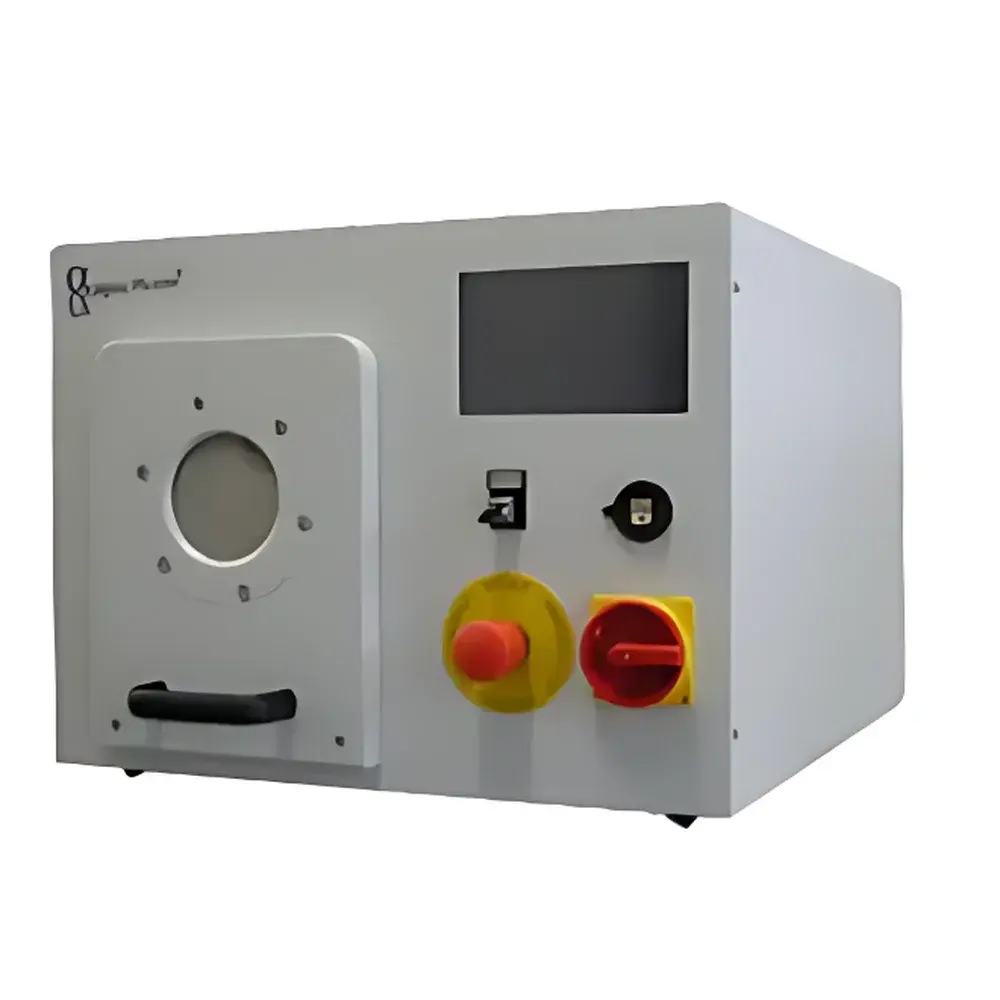
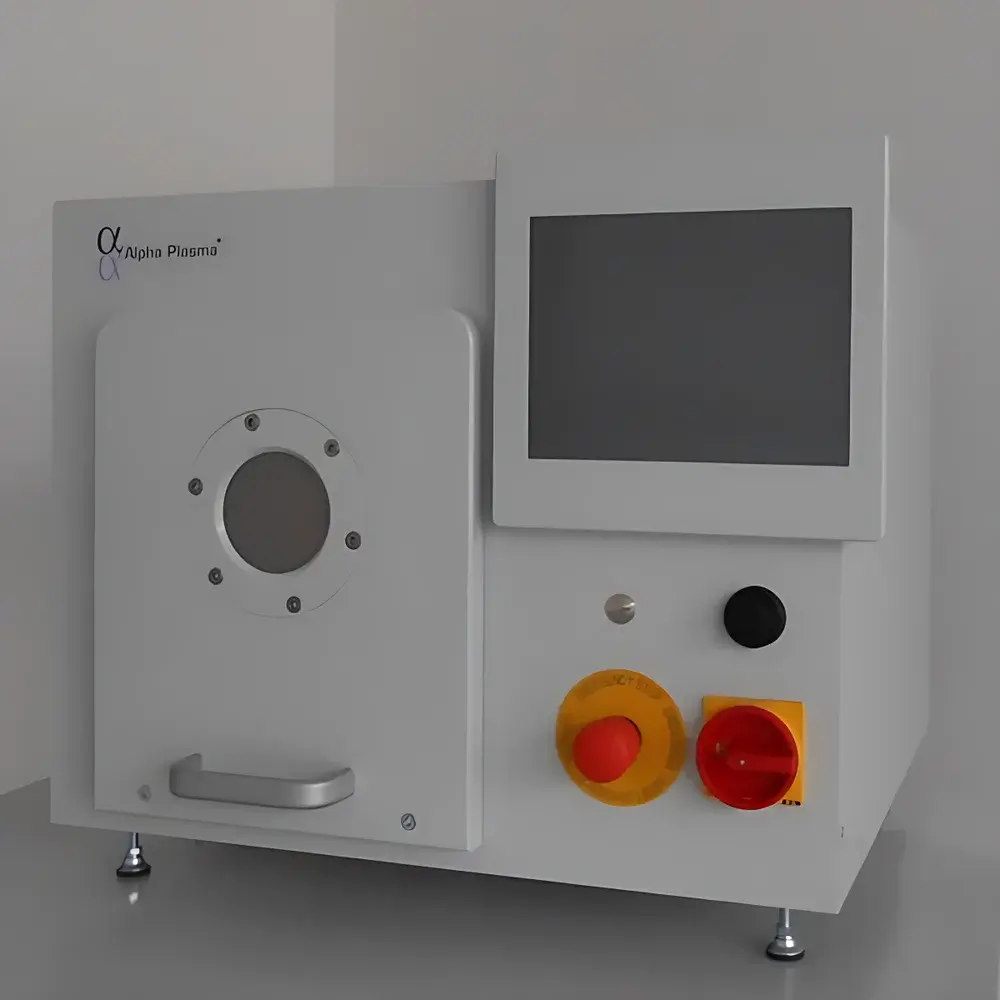
Alpha Q-Series Microwave Plasma Asher
| Brand | Alpha |
|---|---|
| Origin | Germany |
| Model | Q-Series |
| Frequency | 2.45 GHz |
| Power Range | 50–1200 W (model-dependent) |
| Chamber Material | Quartz or Borosilicate Glass |
| Max Wafer Size | 8-inch |
| Working Pressure | ≤100 Pa |
| Vacuum System | Integrated dry pump (oil pump optional) |
| Gas Control | Up to 6 MFC channels (2–3 standard) |
| Vacuum Gauges | Pirani (1–1×10⁵ Pa) and/or Baratron (1–1000 Pa) |
| Control Interface | 7"–10.4" TFT touchscreen |
| Operating System | Windows Embedded Compact 2013 |
| Compliance | CE, RoHS, SEMI S2/S8 compatible |
| Dimensions (W×H×D) | 500×370×550 mm to 760×775×775 mm |
| Weight | 40–95 kg |
| Utilities | 3/N/PE AC 240/400 V, 50/60 Hz, 16 A |
Overview
The Alpha Q-Series Microwave Plasma Asher is an engineered solution for high-precision, low-damage photoresist stripping and descum in semiconductor front-end and back-end processes. Utilizing 2.45 GHz microwave energy coupled into a low-pressure reactive gas environment (typically O₂, CF₄, or O₂/CF₄ mixtures), the system generates a high-density, uniform plasma without internal electrodes—eliminating arcing, particle generation, and electrode erosion common in RF-based plasma tools. This electrodeless design ensures exceptional process stability and reproducibility across batch and single-wafer configurations. The Q-Series operates at pressures ≤100 Pa, enabling efficient radical-dominated chemistry ideal for gentle yet rapid organic residue removal—critical for advanced lithography nodes where pattern integrity, sidewall profile preservation, and underlying layer protection (e.g., low-k dielectrics, Cu interconnects) are paramount.
Key Features
- Electrodeless 2.45 GHz microwave plasma source with power output continuously adjustable from 50 W to 1200 W (Q240 model), enabling precise control over plasma density and ion energy.
- Quartz or borosilicate glass process chamber options—chemically inert, ultra-clean, and transparent for real-time optical monitoring of plasma ignition and uniformity.
- Modular vacuum architecture integrating a dry scroll pump (standard) or oil-sealed rotary vane pump (optional), paired with dual-range vacuum gauging (Pirani + Baratron) for accurate pressure control across 1 Pa–1×10⁵ Pa.
- Multi-channel mass flow controller (MFC) gas delivery—2 or 3 MFCs standard, expandable to 6—supporting complex gas sequences for multi-step ash/etch/descum protocols.
- Industrial-grade human-machine interface (HMI) featuring a 7″ to 10.4″ resistive touchscreen, running Windows Embedded Compact 2013 with full graphical recipe editor, parameter logging, and user-level access control (admin/operator/maintenance).
- Comprehensive safety architecture: hardware interlocked chamber door with microwave shielding window, emergency stop circuitry, real-time fault diagnostics, and automatic power cutoff on vacuum loss or temperature anomaly.
Sample Compatibility & Compliance
The Q-Series accommodates wafers up to 200 mm (8-inch) diameter in batch mode (Q240) or single-wafer configuration with optional heated or temperature-controlled chucks (HT/TC Chuck). It supports silicon, SiC, GaN, compound semiconductors, MEMS substrates, and flexible polymer carriers. Process compatibility extends beyond photoresist ashing to include SU-8, polyimide (PI), BCB, and spin-on carbon removal—provided substrate thermal limits (≤200 °C standard; up to 300 °C with HT chuck) are observed. The system complies with CE Directive 2014/30/EU (EMC), 2014/35/EU (LVD), and RoHS 2011/65/EU. Vacuum and gas handling meet SEMI S2-0215 (safety) and S8-0703 (ergonomics) guidelines. Optional audit-trail-enabled software modules support GLP/GMP environments requiring FDA 21 CFR Part 11-compliant electronic records.
Software & Data Management
Control firmware implements deterministic real-time process sequencing with sub-second timing resolution. All operational parameters—including power ramp profiles, gas flow transitions, pressure setpoints, and dwell times—are stored as editable XML-based recipes. System logs capture timestamped event data: run history, alarm triggers (e.g., “Chamber pressure out of spec”, “Microwave reflection >15%”), error codes, and manual operator actions. Data export supports .csv and .xlsx formats directly compatible with Microsoft Excel and statistical process control (SPC) platforms. Remote monitoring via Ethernet enables integration into factory automation systems (SECS/GEM compliant upon request). USB and RS-232 ports facilitate firmware updates and legacy tool connectivity.
Applications
- Post-lithography descum: removal of residual photoresist scum at trench/via bases without undercutting or mask erosion.
- Hard-bake residue cleaning prior to etch or deposition steps.
- Surface activation and hydrophilization of SiO₂, SiNₓ, and polymer surfaces for improved adhesion in bonding or coating processes.
- Low-damage removal of thick SU-8 layers (>50 µm) and polyimide films used in MEMS packaging and flexible electronics.
- Pre-metal clean for Cu/Al sputtering or electroplating—eliminating organic contaminants while preserving native oxide integrity.
- Research-scale plasma functionalization of 2D materials (graphene, MoS₂) and nanowire arrays.
FAQ
What plasma gases are supported, and how are they controlled?
Standard configurations support O₂, CF₄, N₂, Ar, and custom mixtures via MFC-controlled inlet lines. Gas selection and flow rates are defined per recipe step; up to six independent MFCs can be installed for advanced multi-gas protocols.
Is the system suitable for R&D labs with limited cleanroom space?
Yes—the Q150 model measures only 500 × 370 × 550 mm and weighs 40 kg, making it compatible with Class 1000–10,000 cleanrooms and benchtop installation with appropriate exhaust ducting.
Can process data be exported for quality audits?
All runtime logs, alarm histories, and parameter traces are exportable in .csv format with ISO 8601 timestamps. Optional software modules provide electronic signature capability and audit trail generation aligned with ISO 9001 and IATF 16949 requirements.
What maintenance is required for long-term reliability?
Routine maintenance includes quarterly quartz chamber inspection, annual MFC calibration, and biannual vacuum pump oil change (if oil pump option selected). No consumable electrodes or RF matching networks require replacement.
Does Alpha provide application support for process development?
Yes—Alpha Plasma offers remote and on-site application engineering services, including plasma parameter optimization, wafer mapping studies, and DOE-based process qualification reports tailored to customer-specific device architectures.
Related Products



