
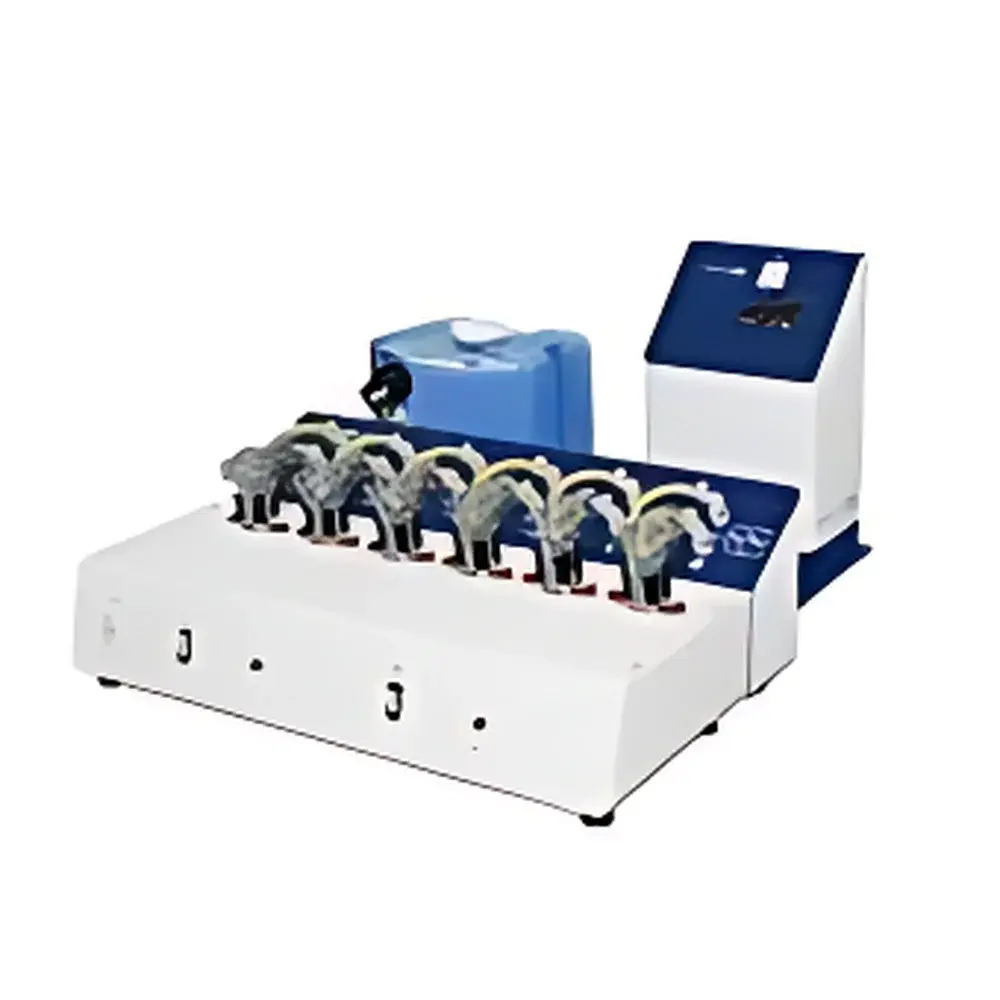
LOGAN FDC-6 Vertical Transdermal Diffusion Cell System
| Brand | LOGAN |
|---|---|
| Origin | USA |
| Manufacturer Type | Authorized Distributor |
| Product Origin | Imported |
| Model | FDC-6 |
| Pricing | Available Upon Request |
Overview
The LOGAN FDC-6 Vertical Transdermal Diffusion Cell System is an engineered platform for in vitro assessment of drug permeation and release kinetics across biological or synthetic membranes. Based on the vertical Franz diffusion cell principle, the FDC-6 employs a precisely controlled, water-jacketed chamber architecture to maintain thermal equilibrium between donor and receptor compartments—critical for simulating physiological skin temperature (typically 32 °C) during transdermal and topical formulation evaluation. Its upright orientation minimizes hydrostatic pressure effects on membrane integrity and ensures consistent diffusion path geometry, supporting regulatory-compliant methodology aligned with USP “Drug Release” and ICH Q5C stability guidance for biopharmaceutical characterization.
Key Features
- Vertical diffusion cell configuration with six independent stations, arranged in two thermally isolated zones (Zone A and Zone B), each accommodating three cells—enabling parallel comparative studies under identical or differentiated experimental conditions.
- Integrated water-jacketed heating system with PID-controlled circulation, delivering ±0.2 °C temperature stability across all receptor compartments over extended test durations (up to 48 h).
- Modular silicone gasket set with interchangeable diameters (1.0 cm², 1.77 cm², and 3.14 cm² active diffusion areas) to standardize dosing volume and surface area ratio—essential for dose-normalized flux calculations per ISO 10993-10 and ASTM E2577.
- Stainless steel donor chambers with precision-machined flanges and PTFE-coated O-rings ensure leak-free sealing and chemical resistance against organic solvents, surfactants, and high-viscosity semisolids (e.g., carbomer gels, oleaginous ointments).
- Ergonomic height-adjustable base plate and quick-release clamping mechanism facilitate rapid membrane mounting, donor loading, and sampling port access without mechanical stress on mounted membranes.
Sample Compatibility & Compliance
The FDC-6 supports broad formulation compatibility—including hydrogels, microemulsions, nanostructured lipid carriers (NLCs), polymer matrix patches, spray-on films, and leave-on cosmetics such as sunscreens and facial serums. It accommodates both excised human/porcine epidermis and synthetic membranes (e.g., Strat-M®, Cellu-Derm™, and polymeric nitrocellulose). All wetted components comply with USP Class VI biocompatibility requirements. The system design conforms to GLP documentation standards, with traceable calibration records for temperature sensors and volumetric sampling syringes. When integrated with validated analytical workflows (e.g., HPLC-UV or LC-MS/MS quantification), data generated meets FDA 21 CFR Part 11 expectations for electronic records and signatures when paired with compliant LIMS or instrument control software.
Software & Data Management
While the FDC-6 operates as a hardware-only platform (no embedded controller), it is fully compatible with third-party laboratory automation and data acquisition systems. Temperature logs from external calibrated RTDs can be synchronized with sampling timestamps via CSV export. Users commonly integrate the system with Empower™, LabSolutions™, or custom Python-based scripts for automated flux calculation (Jss = dQ/dt × 1/A), lag time derivation, and permeability coefficient (Kp) modeling using Fick’s first law. Audit trails, user access controls, and electronic signature support are implemented at the enterprise software layer—not within the instrument itself—ensuring alignment with GMP Annex 11 and EU GMP Chapter 4 requirements.
Applications
- Comparative bioequivalence assessment of generic transdermal patches per FDA draft guidance (2022) on in vitro release testing (IVRT).
- Formulation screening of penetration enhancers (e.g., terpenes, fatty acids) in topical corticosteroids and NSAID gels.
- Stability-indicating release profiling of photolabile actives (e.g., retinoids, avobenzone) under controlled UV exposure protocols.
- Regulatory submission support for cosmetic ingredient safety dossiers under SCCS Notes of Guidance (2021) and ASEAN Cosmetic Directive Annex II.
- Academic research on stratum corneum barrier function using tape-stripped or enzyme-treated membranes.
FAQ
Is the FDC-6 compliant with USP ?
Yes—the cell geometry, membrane clamping force, receptor volume (typically 5–7 mL), and agitation method (magnetic stirring at 600 rpm) align with USP specifications for transdermal and topical dosage forms.
Can I use porcine ear skin with this system?
Absolutely. The standard 12-mm donor opening and adjustable gasket depth accommodate freshly excised or frozen-thawed porcine epidermis mounted on polyester supports.
Does LOGAN provide validation protocols for IQ/OQ/PQ?
LOGAN supplies comprehensive vendor documentation including Design Qualification (DQ) summaries, Factory Acceptance Test (FAT) reports, and template protocols for Installation Qualification (IQ) and Operational Qualification (OQ); Performance Qualification (PQ) must be executed in-house per site-specific SOPs.
What maintenance is required for long-term reliability?
Routine cleaning with isopropanol and deionized water after each run; annual verification of water bath temperature uniformity and seal integrity using calibrated reference thermistors and helium leak detection.
Is technical support available outside North America?
Yes—LOGAN maintains authorized service partners in the EU, APAC, and LATAM regions, offering remote diagnostics, on-site calibration, and operator training certified to ISO/IEC 17025 standards.





