
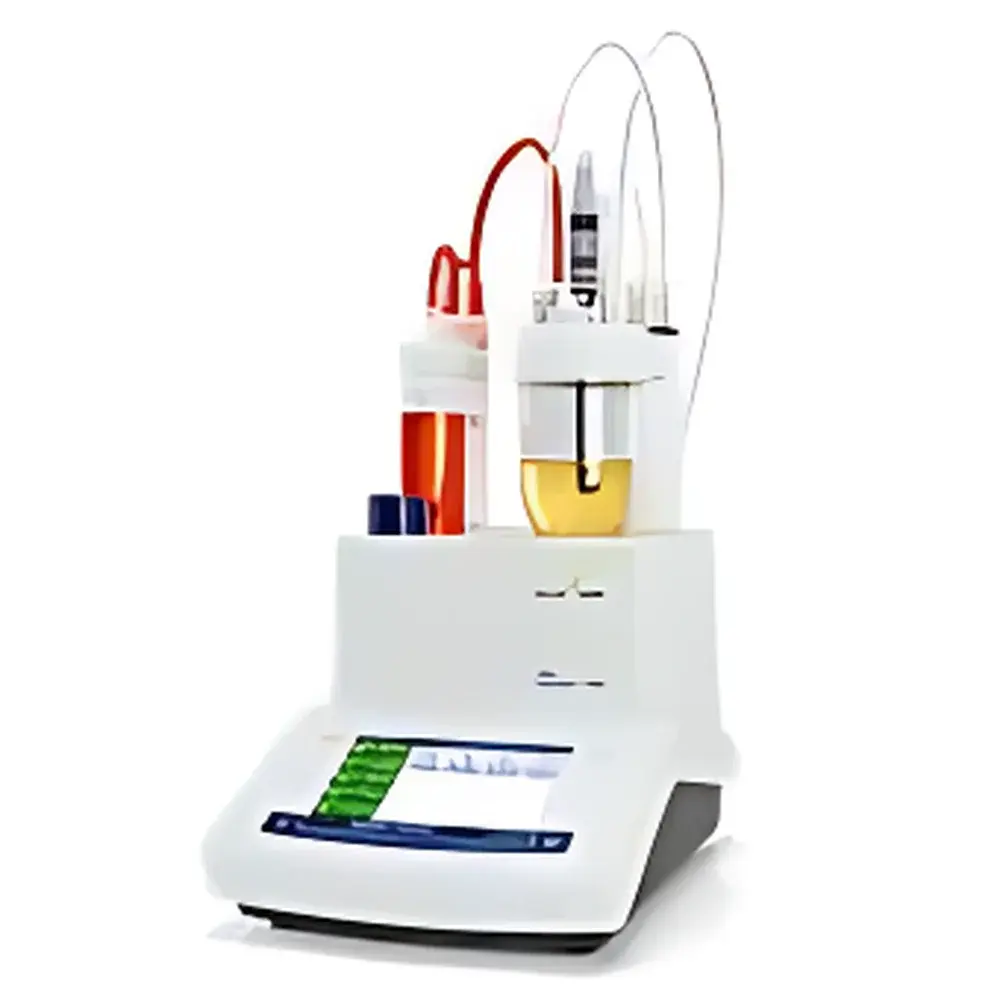
METTLER TOLEDO V20S/V30S Volumetric Karl Fischer Titrator
| Brand | METTLER TOLEDO |
|---|---|
| Origin | Switzerland |
| Instrument Type | Volumetric Karl Fischer Moisture Analyzer |
| Titration Mode | Fully Automated |
| Moisture Range | 10 ppm to 100% |
| Resolution | 0.1 µL (burette resolution) |
| One-Click Method Shortcuts | 12 (V20S), 4 (V30S), 12 (C10S), 12 (C20S), 12 (C30S) |
| Solvent Manager | Hardware-integrated, hot-pluggable |
| Smart Burette | RFID-enabled, auto-recognized |
| User Management | 4-level permission system with password protection |
| Software Integration | LabX Express / LabX Server via USB or TCP/IP |
| GLP-Compliant Printing | USB printer or METTLER TOLEDO P25 thermal printer |
| Optional Automation | InMotion KF Heated Autosampler |
Overview
The METTLER TOLEDO V20S and V30S are fully automated volumetric Karl Fischer titrators engineered for precise, trace-level moisture quantification in pharmaceutical, chemical, polymer, and food quality control laboratories. Based on the classical coulometric–volumetric distinction, these instruments implement the stoichiometric iodine-based redox reaction (I₂ + SO₂ + H₂O → 2HI + SO₃) in a rigorously controlled anhydrous environment. Unlike coulometric systems optimized for sub-ppm water content, the V20S/V30S series employs high-precision piston burettes delivering titrant (typically I₂ in methanol–imidazole–SO₂ solvent) with 0.1 µL resolution—enabling reliable measurement across the full dynamic range of 10 ppm to 100% w/w water. The instruments comply with ASTM E203, ISO 8534, USP , and EP 2.5.12, supporting method validation under ICH Q2(R2) guidelines and audit-ready operation in GMP/GLP-regulated environments.
Key Features
- One Click™ intuitive touchscreen interface with customizable home-screen shortcuts—12 programmable methods for V20S and V30S—reducing operator training time and minimizing procedural errors.
- Integrated solvent management system: a dedicated, hot-pluggable hardware module that automates solvent delivery, purging, and waste handling without manual solvent contact—enhancing lab safety and reproducibility.
- RFID-enabled smart burette: each titrant cartridge contains an embedded chip storing concentration, lot number, expiration date, and calibration history—automatically loaded upon installation to prevent use of expired or mismatched reagents.
- Robust 4-tier user access control with encrypted password protection, session logging, and role-based permissions—fully aligned with FDA 21 CFR Part 11 requirements for electronic records and signatures when used with LabX Server.
- Modular connectivity: native USB and Ethernet (TCP/IP) interfaces support seamless integration with LabX Express (standalone) or LabX Server (networked, multi-instrument) software for centralized method deployment, data archiving, and electronic signature workflows.
Sample Compatibility & Compliance
The V20S/V30S accommodates liquid, solid, and viscous samples—including hygroscopic powders, oils, resins, and lyophilized APIs—via direct injection, oven coupling (with optional InMotion KF heated autosampler), or gas extraction modules. All sample introduction pathways maintain strict moisture exclusion through sealed vial handling, dry gas purging, and inert atmosphere conditioning. Instrument design conforms to IEC 61010-1 safety standards, while analytical performance meets ISO/IEC 17025 competency criteria for testing laboratories. Full audit trail generation—including method changes, user actions, titrant consumption, and environmental logs—is retained for regulatory inspection readiness per EU Annex 11 and WHO TRS 992.
Software & Data Management
LabX software serves as the central command and compliance layer: LabX Express provides local instrument control, real-time titration curve visualization, and GLP-compliant report generation; LabX Server extends functionality to networked deployment, database-driven result review, electronic approval workflows, and automated backup to secure SQL or cloud storage. All raw data—including titration curves, endpoint detection algorithms (e.g., dynamic slope thresholding), and metadata—are stored in immutable format. Printer output—via standard USB or METTLER TOLEDO P25 thermal unit—includes timestamped headers, operator ID, sample ID, method version, and digital signature fields, satisfying ALCOA+ data integrity principles.
Applications
- Pharmaceutical QC: residual moisture in active pharmaceutical ingredients (APIs), excipients, and final dosage forms per USP and Ph. Eur. 2.5.12.
- Chemical manufacturing: water content verification in solvents (e.g., acetonitrile, THF), catalysts, and monomers prior to polymerization.
- Electronics materials: moisture screening in solder pastes, encapsulants, and lithium battery electrolytes where ppm-level water induces degradation.
- Food & feed analysis: determination of water activity-related moisture in starches, dairy powders, and pet food formulations under AOAC 985.21.
- Research & development: kinetic moisture uptake studies using temperature-controlled sample chambers coupled with InMotion KF autosamplers.
FAQ
What distinguishes volumetric from coulometric Karl Fischer titration?
Volumetric KF measures water by dispensing standardized iodine-containing titrant from a burette; it is optimal for samples containing >100 ppm water. Coulometric KF generates iodine electrochemically at the anode and is preferred for sub-100 ppm applications.
Can the V30S be integrated into a LIMS environment?
Yes—via LabX Server’s ODBC-compliant database and REST API, enabling bidirectional data exchange with validated LIMS platforms under 21 CFR Part 11-compliant authentication protocols.
Is method validation support available for GMP audits?
METTLER TOLEDO provides IQ/OQ documentation templates, performance qualification protocols, and on-site validation assistance aligned with ASTM E2500 and Annex 15.
How does the solvent manager ensure consistent titration performance?
It maintains constant solvent composition and pH by automatically replenishing reagent volume, evacuating spent solution, and performing periodic system flushes—all synchronized with titration cycles to eliminate drift.
What happens if an expired titrant cartridge is installed?
The RFID chip triggers an audible/visual alert and blocks method execution until the cartridge is replaced—preventing nonconforming results and ensuring data integrity.





