
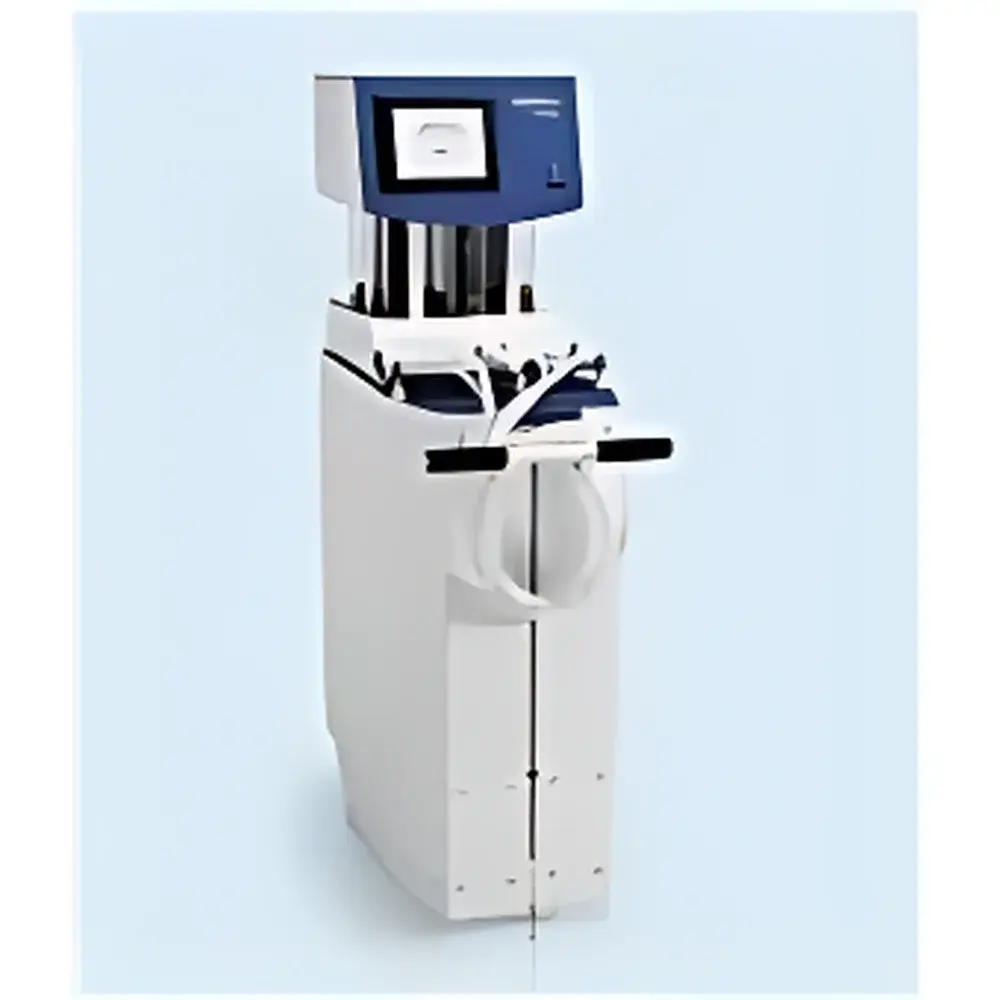
LOGAN MDS-600PL Automated Solvent Delivery and Degassing System
| Brand | LOGAN |
|---|---|
| Origin | USA |
| Model | MDS-600PL |
| Application | Automated, temperature-controlled, deaerated solvent delivery for dissolution testing |
| Mobility | Floor-standing, castor-mounted mobile platform |
| Solvent Compatibility | Aqueous buffers, surfactant-containing media (e.g., SDS, polysorbates), organic-aqueous mixtures |
| Delivery Capacity | Up to 1000 mL per vessel |
| Throughput | Simultaneous delivery to 6 dissolution vessels in ≤2 minutes |
| Temperature Control | Integrated pre-heating module (range: 25–45 °C, ±0.5 °C stability) |
| Deaeration Method | Vacuum-assisted membrane degassing |
| Dissolved Oxygen Monitoring | Built-in electrochemical DO sensor (range: 0–20 mg/L, resolution: 0.01 mg/L) |
| User Interface | 7-inch capacitive touchscreen with intuitive parameter configuration and real-time status feedback |
| Cleaning Design | Conical reservoir geometry with full-drain capability and smooth-surface wetted path |
| Regulatory Alignment | Designed to support USP <711>, <1092>, and FDA Guidance for Industry — Dissolution Testing of Immediate-Release Solid Oral Dosage Forms |
Overview
The LOGAN MDS-600PL Automated Solvent Delivery and Degassing System is an engineered solution for pharmaceutical quality control laboratories requiring high-fidelity, reproducible solvent preparation and delivery in dissolution testing workflows. Unlike manual or semi-automated approaches, the MDS-600PL integrates three critical unit operations—temperature stabilization, vacuum-assisted degassing, and precision volumetric delivery—into a single mobile platform compliant with current Good Manufacturing Practice (cGMP) and GLP-aligned laboratory environments. It operates on the principle of controlled vacuum degassing across hydrophobic microporous membranes, followed by gravimetrically referenced, peristaltic-pump-driven delivery calibrated against NIST-traceable standards. The system is explicitly designed to eliminate variability introduced by ambient air entrapment, thermal lag, and operator-dependent technique—factors directly implicated in dissolution profile drift, especially for low-solubility or oxygen-sensitive APIs.
Key Features
- Integrated dissolved oxygen monitoring: Real-time electrochemical sensing provides quantitative verification of degassing efficacy prior to delivery, supporting data integrity requirements under FDA 21 CFR Part 11.
- Temperature-stabilized solvent reservoir: Pre-heating module maintains setpoint accuracy within ±0.5 °C across the operational range (25–45 °C), minimizing thermal shock to dissolution vessels and ensuring consistent solubility conditions.
- Modular six-channel delivery architecture: Independently actuated fluid paths enable sequential or parallel filling of up to six USP Apparatus I or II vessels without cross-contamination risk.
- Conical reservoir design: Optimized geometry ensures complete drainage and facilitates rapid, residue-free cleaning between solvent batches—critical for multi-analyte or multi-formulation labs.
- Touchscreen HMI with audit trail: Parameter logging, user authentication, and session-based event recording meet ALCOA+ data governance criteria for regulated environments.
- Universal compatibility: Standardized tubing connections and programmable delivery profiles ensure seamless integration with dissolution systems from Hanson, Agilent, Distek, Sotax, and other major OEMs.
Sample Compatibility & Compliance
The MDS-600PL accommodates a broad spectrum of pharmacopeial dissolution media, including phosphate and citrate buffers (pH 1.2–7.4), surfactant-enhanced solutions (e.g., 0.01–1.0% w/v SDS, 0.1–2.0% w/v polysorbate 80), and mixed organic–aqueous solvents (e.g., ethanol/water, isopropanol/water blends up to 20% v/v). All wetted materials—including fluidic path tubing, reservoir lining, and degassing membranes—are USP Class VI-certified and extractables-leachables tested per ICH Q5C guidelines. The system supports compliance with USP General Chapters (Dissolution), (The Dissolution Procedure: Development and Validation), and ASTM E2503–21 (Standard Guide for Validation of Dissolution Apparatus). Its design enables traceable operation under ISO/IEC 17025-accredited testing laboratories.
Software & Data Management
Control firmware includes embedded validation-ready features: electronic signatures, configurable access levels (administrator/operator), automatic timestamped parameter logs, and exportable CSV reports containing DO values, temperature history, delivery volume per vessel, and cycle duration. Data files are stored locally on encrypted internal memory and can be transferred via USB or network interface (optional Ethernet module). Software architecture conforms to Annex 11 (EU GMP) and Part 11 requirements, including audit trail activation, data immutability enforcement, and change control documentation templates. No cloud dependency or third-party subscription is required for core functionality.
Applications
- Preparation of deaerated dissolution media for BCS Class II and IV compounds where oxygen-induced oxidation or nucleation artifacts compromise assay accuracy.
- High-throughput QC release testing of immediate-release tablets and capsules across multiple batches under identical solvent conditioning parameters.
- Method development studies requiring systematic variation of DO concentration, temperature, or surfactant concentration while maintaining inter-vessel consistency.
- Stability-indicating dissolution protocols where baseline DO must be documented to distinguish chemical degradation from physical disintegration effects.
- Regulatory submission support: Generation of raw data packages demonstrating control over critical process parameters (CPPs) affecting dissolution performance.
FAQ
Does the MDS-600PL require external vacuum or compressed air sources?
No. It incorporates an integrated oil-free vacuum pump and pressure-regulated air manifold, eliminating dependency on facility utilities.
Can the system be validated for use in an FDA-inspected facility?
Yes. IQ/OQ documentation templates, test protocols, and calibration certificates are provided; PQ execution is supported by built-in performance verification routines.
What maintenance intervals are recommended for the degassing membrane and tubing?
Membranes are rated for ≥1,000 cycles under standard buffer use; tubing sets are replaceable as single-use assemblies with lot-traceable certification.
Is remote monitoring or integration with LIMS possible?
Via optional RS-232 or TCP/IP interface, the system supports basic command-response communication for status polling and trigger-based start/stop—custom LIMS integration requires site-specific protocol mapping.
How is temperature uniformity verified across the six delivery channels?
During factory qualification, thermal mapping is performed at each outlet using calibrated PT100 probes; a certificate of conformance is supplied with each unit.





