
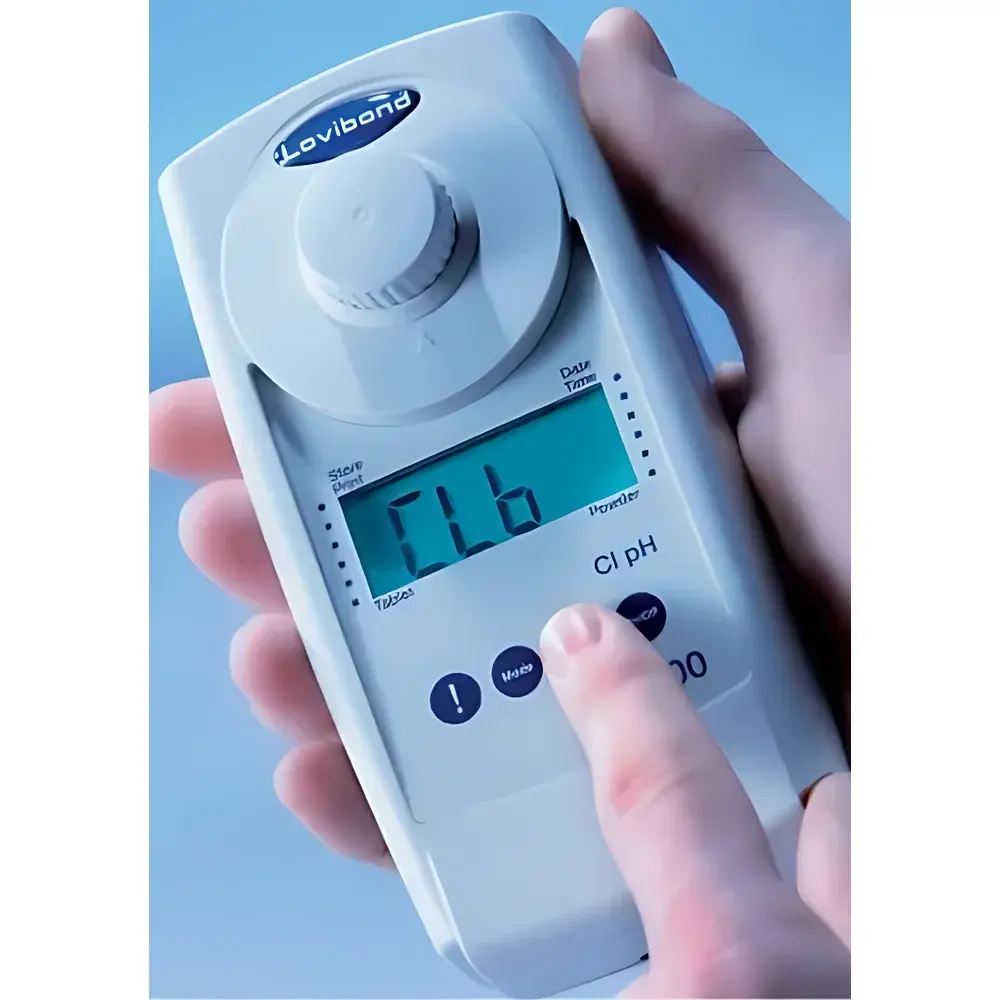
MD100 Portable UV-Vis Photometer
| Origin | Germany |
|---|---|
| Manufacturer Type | Authorized Distributor |
| Origin Category | Imported Instrument |
| Model | MD100 |
| Pricing | Available Upon Request |
Overview
The MD100 Portable UV-Vis Photometer is a compact, solid-state optical analyzer engineered for field-deployable and benchtop quantitative colorimetric analysis in environmental, industrial, and educational laboratories. Unlike traditional scanning spectrophotometers, the MD100 operates on fixed-wavelength photometric principles—utilizing high-stability, narrow-band interference filters paired with calibrated long-life LED light sources (typically centered at 450 nm, 520 nm, 580 nm, 610 nm, and 650 nm, depending on configured assay modules). Its optical path employs a fixed cuvette chamber with precisely defined 10-mm light path length, eliminating mechanical moving parts such as monochromators or scanning gratings. This architecture ensures exceptional long-term photometric stability, minimal drift, and immunity to vibration or orientation-induced measurement variance—critical for mobile or non-climate-controlled environments.
Key Features
- Fixed-wavelength LED-based optical system with thermally stabilized emitters and precision interference filters—guaranteeing wavelength accuracy within ±2 nm and intensity repeatability better than ±0.5% RSD over 1,000 measurements.
- Integrated optical zero tracking (OTZ) function: automatically compensates for baseline drift during extended operation without requiring manual re-zeroing—enabling uninterrupted multi-sample workflows.
- Non-volatile method memory: retains the last-used analytical method—including wavelength selection, calibration curve parameters, and unit configuration—across power cycles for consistent operator experience.
- Modular reagent compatibility: supports pre-formulated tablet reagents (shelf life ≥5 years when stored desiccated at 2–25 °C), powdered reagents, and liquid reagent kits—each validated per ISO 8466-1 for linearity and robustness.
- Compact, ruggedized housing (IP65-rated enclosure) with integrated rechargeable Li-ion battery (≥12 hours continuous use) and intuitive single-button interface—designed for glove-compatible operation in wastewater treatment plants, food processing facilities, or remote field sites.
Sample Compatibility & Compliance
The MD100 accepts standard 10-mm square glass or disposable plastic cuvettes (1.0–3.5 mL volume) and accommodates turbid, colored, or mildly particulate samples when used with appropriate filtration or centrifugation pretreatment. It complies with ISO/IEC 17025:2017 general requirements for competence of testing and calibration laboratories and supports traceable calibration via NIST-traceable neutral density filters. When deployed in regulated environments (e.g., drinking water compliance per EPA Method 365.4 or ASTM D1253 for residual chlorine), the instrument’s OTZ functionality and method-lock capability align with GLP documentation requirements. Data output meets basic 21 CFR Part 11 readiness when paired with optional secure USB logging firmware (v2.3+), enabling audit trails and electronic signature support.
Software & Data Management
The MD100 operates autonomously without PC dependency; however, optional PC connectivity via micro-USB enables firmware updates and method transfer using the vendor’s cross-platform MD-Link Utility (Windows/macOS/Linux). All measurement data—including sample ID, timestamp, absorbance value, calculated concentration, and operator tag—can be exported as CSV or PDF reports with embedded calibration metadata. Internal memory stores up to 500 results with time/date stamping. For laboratory information management system (LIMS) integration, ASCII serial output mode (9600 baud, RS-232 emulation) is supported through adapter cable, facilitating direct ingestion into platforms compliant with ASTM E1384 or HL7 standards.
Applications
- Environmental monitoring: quantification of nitrate, phosphate, ammonia, iron, copper, free/residual chlorine, and total hardness in surface water, groundwater, and effluent streams.
- Industrial process control: rapid verification of cleaning agent concentration (e.g., alkaline wash solutions), sanitizer efficacy (peracetic acid, quaternary ammonium), and boiler water chemistry (silica, hydrazine).
- Educational laboratories: teaching fundamental Beer-Lambert law principles, calibration curve construction, and interferences from matrix effects—without requiring spectrometer-grade infrastructure.
- Food & beverage QA: routine testing of sulfite levels in wine, iodine in salt, and nitrite in cured meats per AOAC 993.03 and ISO 20036 protocols.
FAQ
Does the MD100 require annual recalibration by an accredited service provider?
No—its LED/filter optical system is factory-calibrated with lifetime stability specifications. Users perform functional verification using supplied reference standards before each analytical session per ISO/IEC 17025 clause 5.9.3.
Can the MD100 measure absorbance across a continuous spectrum?
No—it is a discrete-wavelength photometer, not a scanning spectrophotometer. Wavelength selection is predefined per assay module; spectral scanning is outside its design scope.
Is method validation documentation available for regulatory submissions?
Yes—vendor-supplied validation packages include system suitability test (SST) protocols, limit of detection (LOD)/limit of quantitation (LOQ) studies per ICH Q2(R2), and inter-laboratory precision data aligned with ISO 5725-2.
What reagent formats are validated for use with the MD100?
Only reagents certified by the original equipment manufacturer (OEM) are validated for metrological equivalence. Third-party tablets or powders may introduce bias due to inconsistent dissolution kinetics or spectral interference.
How is photometric accuracy verified in the field?
Using included NIST-traceable neutral density filters (OD 0.5, 1.0, 2.0) and certified liquid standards (e.g., potassium dichromate in 0.005 M H₂SO₄ per USP ), following the instrument’s built-in verification procedure.





