
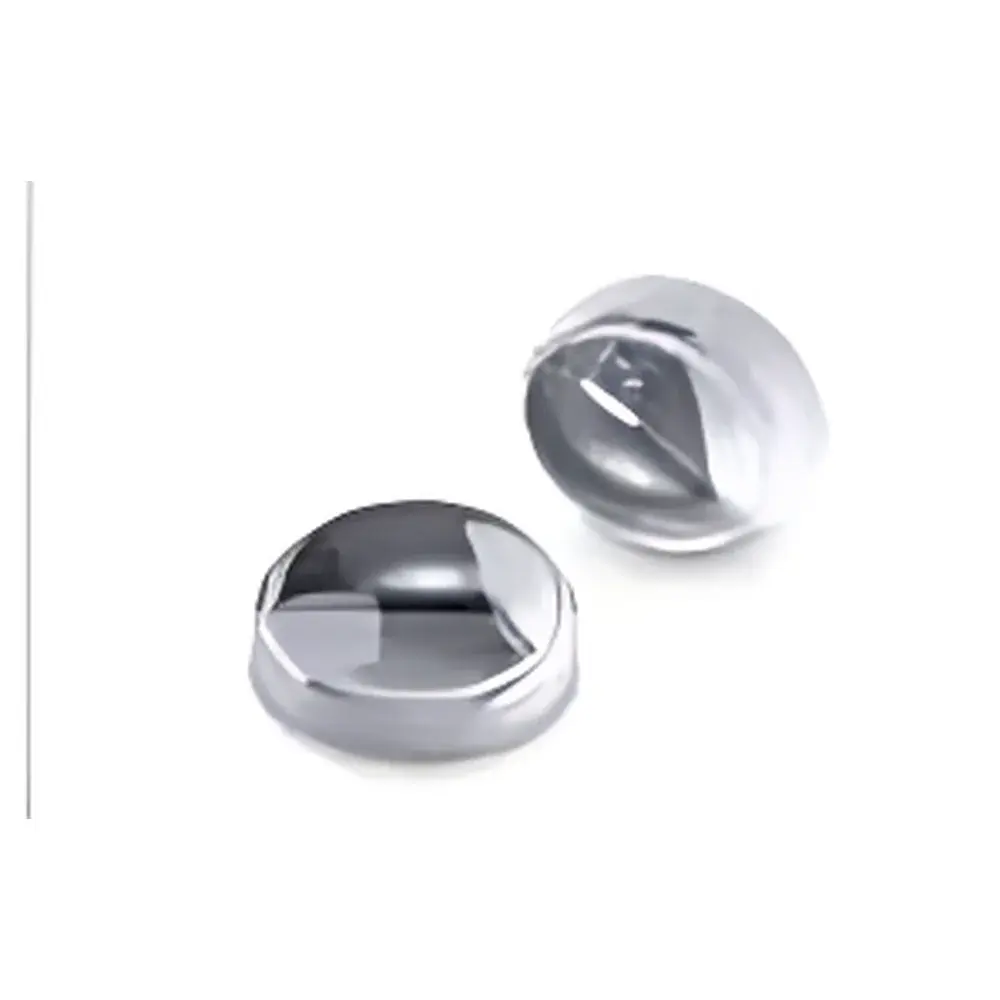
Anteryon AC Series Aspheric Lenses
| Brand | Anteryon |
|---|---|
| Origin | Netherlands |
| Product Type | Aspheric Optical Lens (Glass Molded) |
| Mounting | Unmounted |
| Design Wavelength | 355–785 nm |
| Numerical Aperture (NA) | up to 0.95 |
| Wavefront RMS Error | ≤0.06 λ (typ. 0.02–0.04 λ @ 632.8 nm) |
| Operating Temperature | −30 °C to +85 °C |
| Compliance | ISO 10110-5, MIL-PRF-13830B scratch-dig, RoHS, REACH |
Overview
The Anteryon AC Series Aspheric Lenses are high-precision, glass-molded aspheric optics engineered for demanding laser beam shaping applications in industrial, medical, and scientific instrumentation. Unlike conventional spherical lenses or injection-molded plastic aspherics, the AC series leverages Anteryon’s proprietary glass replication technology—combining precision diamond-turning of master molds with high-fidelity thermal forming of optical-grade borosilicate glass (e.g., SCHOTT AF32® or equivalent). This process delivers diffraction-limited performance across a broad spectral range (355 nm to 785 nm), with wavefront root-mean-square (RMS) errors consistently below 0.04 waves at design wavelength—verified via interferometric testing per ISO 10110-5. The lenses exhibit exceptional surface fidelity, minimal mid-spatial-frequency errors, and negligible residual stress-induced birefringence—critical for polarization-sensitive systems such as fiber coupling, free-space laser collimation, and confocal microscopy illumination paths.
Key Features
- Diffraction-Limited Performance: Optimized for single-mode and multimode semiconductor lasers; typical Strehl ratios >0.98 at NA ≤ 0.7 and >0.92 at NA up to 0.95.
- High Numerical Aperture Support: NA values up to 0.95 achieved without compromising wavefront quality—enabling tight focusing and high étendue collection in compact optical trains.
- Deep-UV Compatible Materials: Substrate options include UV-fused silica and low-OH borosilicate variants rated for sustained exposure down to 248 nm (with optional AR coatings).
- Hermetic Integration Ready: Edge geometry and thermal expansion coefficient (CTE ≈ 3.2 × 10⁻⁶/K) enable direct laser welding or epoxy bonding into metal or ceramic housings without induced astigmatism.
- Robust Environmental Stability: Qualified per MIL-STD-810G for thermal cycling (−30 °C ↔ +85 °C, 100 cycles), humidity (85% RH, 1000 h), and mechanical shock (50 g, 11 ms half-sine pulse).
- Scalable Manufacturing: Production capacity exceeds 200,000 units per week—ensuring consistent lot-to-lot metrology traceability and rapid fulfillment of OEM volume requirements.
Sample Compatibility & Compliance
The AC series is compatible with standard TO-can, butterfly, and coaxial laser packages (e.g., 5.6 mm, 9 mm, and C-mount footprints). All lenses undergo 100% automated inspection using Zygo Verifire™ interferometers and phase-shifting white-light profilometry. Surface quality meets MIL-PRF-13830B 10–5 scratch-dig specification. Coating options include broadband antireflection (BBAR) from 400–700 nm (R<0.25% avg.), V-coats for 635 nm or 785 nm diodes (R<0.1% peak), and custom dual-band designs. Full compliance documentation—including material certificates, coating spectral data, and environmental test reports—is provided with each shipment. The lenses conform to ISO 9001:2015 manufacturing controls and support GLP/GMP-aligned validation protocols including IQ/OQ/PQ documentation packages upon request.
Software & Data Management
Anteryon provides a comprehensive optical design support package including Zemax-compatible .ZAR and Code V .SEQ files for all AC models, pre-validated with tolerancing analysis (RSS and Monte Carlo). Metrology datasets—including full-aperture PV and RMS wavefront maps, MTF curves at multiple field points, and focal shift vs. temperature—are delivered in HDF5 format with metadata compliant with ASTM E2911-13 (Standard Guide for Digital Data Exchange in Optical Testing). For integration into automated assembly lines, lens-specific alignment fiducials and centroid offset data are supplied in STEP AP242 format. Traceability is maintained through unique serial numbering linked to internal LIMS (Laboratory Information Management System) records covering raw material batch, mold ID, annealing cycle log, and final interferometric verification timestamp.
Applications
- Laser diode collimation and focus conditioning in LiDAR transceivers (905 nm and 1550 nm variants available on request)
- Fiber coupling optics for telecom and datacom transceivers (SMF-28, PM fiber, and multimode patch cords)
- Confocal and multiphoton microscope scan lenses and tube lenses
- Medical laser delivery systems (dermatology, ophthalmology, and surgical ablation platforms)
- Machine vision illumination optics requiring uniform line or spot generation
- Free-space optical interconnects in high-performance computing and AI accelerator modules
FAQ
What is the typical lead time for custom AC-series lens designs?
Standard catalog AC lenses ship within 2 weeks ex-factory; custom geometries (e.g., modified CA, non-standard FR, or hybrid asphere-holographic surfaces) require 8–12 weeks for mold qualification and first-article inspection.
Are AC lenses suitable for ultrafast laser applications?
Yes—when specified with low-dispersion substrate grades and chirped-pulse compatible AR coatings, AC lenses support pulses <100 fs at 800 nm with measured group delay dispersion (GDD) <±5 fs² over ±1% bandwidth.
Can Anteryon provide ISO/IEC 17025-accredited calibration reports?
Yes—third-party accredited calibration (by NMi or VSL) for focal length, NA, and wavefront error is available as an add-on service with NIST-traceable uncertainty budgets.
Do AC lenses require active temperature stabilization in operation?
No—thermal defocus coefficients are typically <1.5 µm/°C across the full operating range; passive athermalization suffices for most industrial enclosures meeting IPC-CC-830B Class 2 humidity control.
Is there a minimum order quantity (MOQ) for OEM volume procurement?
No MOQ applies for standard AC models; blanket orders with quarterly releases are supported under framework agreements with consignment stock options at regional distribution hubs.




