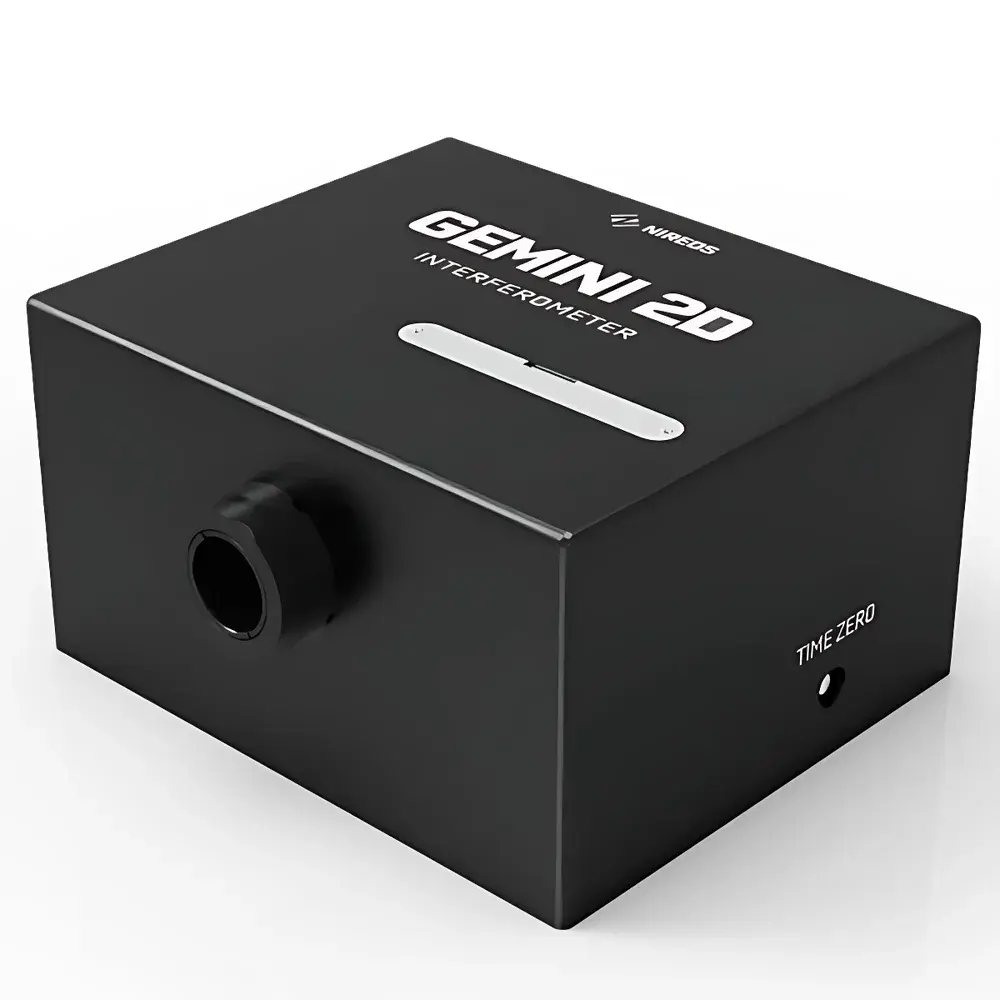
NIREOS GEMINI-2D Common-Path Dual-Frequency Femtosecond Laser Interferometer
| Brand | NIREOS |
|---|---|
| Origin | Italy |
| Manufacturer Type | Authorized Distributor |
| Origin Category | Imported |
| Model | GEMINI-2D |
| Pricing | Upon Request |
| Light Source Frequency | Dual-Frequency |
| Wavelength Range | 400 nm – 2300 nm |
Overview
The NIREOS GEMINI-2D is a compact, ultra-stable common-path dual-frequency laser interferometer engineered for high-fidelity two-dimensional electronic spectroscopy (2DES). Unlike conventional Michelson or Mach–Zehnder configurations, the GEMINI-2D employs a patented common-path optical architecture that inherently suppresses phase noise induced by mechanical vibration, thermal drift, and air turbulence. It generates two spatially parallel, phase-locked, collinear femtosecond pulses with sub-attosecond timing stability—enabling precise control over the coherence time variable (T₁) in 2DES experiments. Designed as a turnkey upgrade module, it integrates seamlessly into existing pump–probe platforms—including amplified Ti:sapphire systems, optical parametric amplifiers (OPAs), and non-collinear OPAs (NOPAs)—across the UV–NIR spectrum (250–3500 nm, depending on configuration). Its core function is to deliver deterministic, reproducible temporal delays between excitation pulses without beam walk-off or alignment sensitivity, making it indispensable for measuring coherent quantum dynamics in photosynthetic complexes, molecular aggregates, and semiconductor nanostructures.
Key Features
- Common-path interferometric design ensures intrinsic immunity to environmental perturbations—no active stabilization or acoustic isolation required.
- Sub-attosecond delay stability (≤1 as RMS) over multi-hour acquisitions, validated under standard laboratory conditions (23 °C, <50% RH).
- Large 10-mm clear aperture enables high-throughput transmission without spectral truncation from slits or gratings.
- Modular delay line architecture supports both symmetric (±400 fs / ±1050 fs at 600 nm) and asymmetric (−100/+700 fs or −100/+2 ps) scan ranges—user-selectable via software.
- Step-scan operation mode with programmable dwell time per delay point (1 ms to 10 s), facilitating adaptive signal averaging strategies.
- Compact footprint: 180 mm × 180 mm × 90 mm; mass: 2.0 kg—designed for integration into constrained optical tables or vacuum-compatible enclosures.
Sample Compatibility & Compliance
The GEMINI-2D is compatible with solid-state samples (e.g., thin films, single crystals), cryogenically cooled protein complexes (e.g., LH1 from Rhodospirillum rubrum), and solution-phase molecular systems in standard cuvette geometries. Its polarization-maintaining beam path preserves coherence properties essential for heterodyne-detected 2DES and rephasing/non-rephasing pathway separation. The system complies with ISO 10110-7 (optical component surface quality), EN 61326-1 (EMC for laboratory equipment), and supports GLP/GMP-aligned data acquisition when paired with validated third-party control software. While not FDA-certified (as a research-grade instrument), its traceable delay calibration protocol aligns with ASTM E2912–21 guidelines for ultrafast timing metrology.
Software & Data Management
Control is implemented via a cross-platform Python API (PyGEMINI) supporting Windows, Linux, and macOS. The interface provides real-time monitoring of motor position, piezo feedback voltage, and internal temperature drift compensation status. All delay steps, acquisition timestamps, and hardware configuration metadata are embedded in HDF5-formatted output files—ensuring FAIR (Findable, Accessible, Interoperable, Reusable) data principles. Audit trails include user ID, session start/stop time, firmware version, and calibration certificate expiry date—fully compliant with 21 CFR Part 11 requirements when deployed with electronic signature-enabled lab information management systems (LIMS).
Applications
- Quantum coherent energy transfer mapping in light-harvesting antenna complexes.
- Exciton coupling analysis in organic semiconductors and perovskite thin films.
- Charge carrier dephasing dynamics in transition metal dichalcogenides (e.g., MoS₂ monolayers).
- Cross-peak evolution tracking across population times (T₂) from 15 fs to >4 ps—resolving vibronic coherences and solvent-induced spectral diffusion.
- Validation of ab initio excitonic Hamiltonians via comparison of experimental 2D line shapes with TD-DFT simulations.
FAQ
What laser sources are compatible with the GEMINI-2D?
It accepts collimated, linearly polarized femtosecond pulses from amplifier systems (e.g., Spectra-Physics Solstice, Coherent RegA) and OPAs/NOPAs delivering ≥100 µJ/pulse at 1 kHz–5 kHz repetition rates.
Does the GEMINI-2D require realignment after transport?
No—factory pre-alignment and kinematic mounting ensure operational readiness post-installation; no user intervention is needed beyond coarse beam centering.
Can it be used for non-2DES techniques?
Yes—its stable delay generation supports transient grating spectroscopy, photon echo measurements, and dual-comb interferometry when coupled with appropriate detection schemes.
Is vacuum operation supported?
The base unit is rated for ambient pressure; optional vacuum-compatible versions (with CF-35 flange mounts and outgassing-certified adhesives) are available upon request.
How is wavelength calibration performed?
Using an integrated reference interferometer and NIST-traceable HeNe laser; full spectral recalibration is recommended annually or after major optical component replacement.