
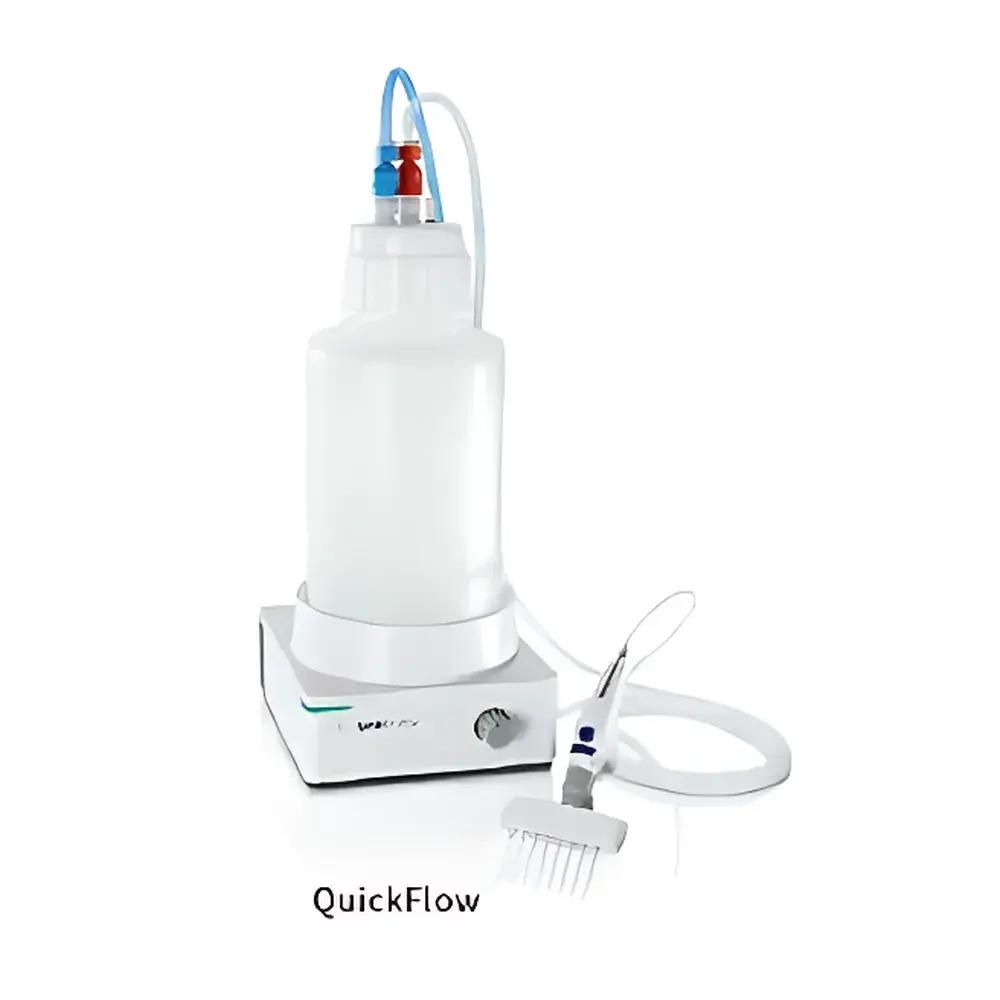
METTLER TOLEDO QuickFlow Vacuum Liquid Aspiration System
| Brand | METTLER TOLEDO |
|---|---|
| Origin | Switzerland |
| Manufacturer Type | Authorized Distributor |
| Origin Category | Imported |
| Model | QuickFlow |
| Quotation | Upon Request |
| Ultimate Vacuum | Not Applicable |
| Maximum Pumping Speed | Not Applicable |
| Dimensions | Not Specified |
Overview
The METTLER TOLEDO QuickFlow Vacuum Liquid Aspiration System is an ergonomically engineered, non-contact vacuum-based liquid handling platform designed for routine and high-throughput laboratory workflows requiring precise, repeatable, and contamination-controlled aspiration of aqueous and low-viscosity biological or chemical solutions. Unlike traditional vacuum aspirators relying on manual footswitches or continuous hand-actuated valves, the QuickFlow employs a pressure-regulated vacuum manifold coupled with intelligent liquid-level sensing to deliver consistent aspiration force while eliminating operator-induced variability. Its core architecture integrates a brushless diaphragm vacuum pump, integrated pressure control circuitry, and optical liquid-level detection — enabling real-time monitoring without physical probe immersion. This system is purpose-built for applications where sterility maintenance, operator fatigue reduction, and procedural consistency are critical — particularly in cell culture labs, clinical diagnostics preparation, and quality control environments operating under GLP or ISO 15189 frameworks.
Key Features
- Ergonomic continuous aspiration mode: Eliminates repetitive thumb/foot actuation, reducing musculoskeletal strain during extended use sessions (per ISO 11228-3 ergonomic assessment guidelines).
- Non-contact optical liquid-level detection: Uses infrared beam interruption sensing to monitor fill level in collection vessels; triggers simultaneous audible alarm, visual LED indicator, and automatic pump shutdown at pre-set threshold — preventing overflow and cross-contamination.
- Modular adapter system: Includes single-channel, 8-channel, and suction pipette adapters — all constructed from autoclavable, chemically resistant polypropylene and PTFE-coated stainless steel components.
- Self-sealing quick-connect fluid path: Patented push-to-connect fittings automatically seal upon disconnection, containing residual liquid within the collection bottle and minimizing aerosol generation and environmental exposure.
- Full-system sterilizability: All wetted parts — including tubing, adapters, and collection bottles — are rated for 121 °C, 20 min steam sterilization (EN 285 compliant), supporting reuse in aseptic processing workflows.
Sample Compatibility & Compliance
The QuickFlow system is validated for aspiration of aqueous buffers, saline solutions, cell culture media, serum-containing preparations, and dilute enzymatic reagents (viscosity ≤ 10 mPa·s). It is not intended for volatile organic solvents, highly corrosive acids/bases, or viscous suspensions (>50 cP). Device construction complies with IEC 61010-1:2010 for electrical safety in laboratory equipment. The optical sensor module meets IP54 ingress protection rating. Documentation supports traceability per ISO/IEC 17025 requirements, and audit-ready calibration records are available upon request for regulatory submissions (e.g., FDA 21 CFR Part 11–aligned electronic logs when paired with optional METTLER TOLEDO LabX software).
Software & Data Management
While the base QuickFlow operates as a standalone hardware unit, integration with METTLER TOLEDO LabX™ software (v3.10 or later) enables full digital workflow capture — including aspiration start/stop timestamps, total volume processed per session, and event-triggered alerts (e.g., level alarm activation). LabX provides secure user authentication, electronic signature support, and configurable audit trails meeting ALCOA+ principles. All data is stored in encrypted SQLite or SQL Server databases, with optional export to CSV, PDF, or LIMS-compatible XML formats. No local data storage occurs on the device itself — ensuring compliance with institutional data governance policies.
Applications
- Cell culture supernatant removal and medium exchange in T-flasks, multiwell plates, and bioreactors.
- Decanting wash buffers during ELISA, Western blot, and immunohistochemistry protocols.
- Aspiration of excess liquid following centrifugation or filtration steps in molecular biology workflows.
- Pre-analytical sample preparation in clinical laboratories — including urine, CSF, and plasma aliquoting under CLIA-certified conditions.
- Supporting ISO 13485-compliant manufacturing processes for in vitro diagnostic reagent kits.
FAQ
Is the QuickFlow compatible with third-party collection bottles?
Yes — provided bottles feature standard 29/32 or 38/43 conical neck threads and are constructed from autoclavable, vacuum-rated materials (e.g., borosilicate glass or polypropylene). METTLER TOLEDO recommends using certified QuickFlow-branded bottles to ensure optimal seal integrity and sensor alignment.
Can the optical level sensor be recalibrated by the end user?
No — the infrared emitter/detector pair is factory-calibrated and sealed. Calibration verification is performed during annual service visits using NIST-traceable reference standards.
What maintenance intervals are recommended?
The diaphragm pump requires inspection every 12 months or after 2,000 hours of cumulative operation; filter cartridges should be replaced every 6 months or when differential pressure exceeds 15 kPa.
Does QuickFlow meet FDA 21 CFR Part 11 requirements?
The hardware alone does not constitute a Part 11 system; however, when operated under LabX software with enabled electronic signatures, audit trail logging, and role-based access control, it supports full Part 11 compliance for regulated environments.
Is chemical resistance data available for wetted components?
Yes — a comprehensive compatibility matrix covering >120 common laboratory solvents and reagents is provided in the Technical Reference Manual (Document No. QF-TRM-EN-Rev.4.2).



