
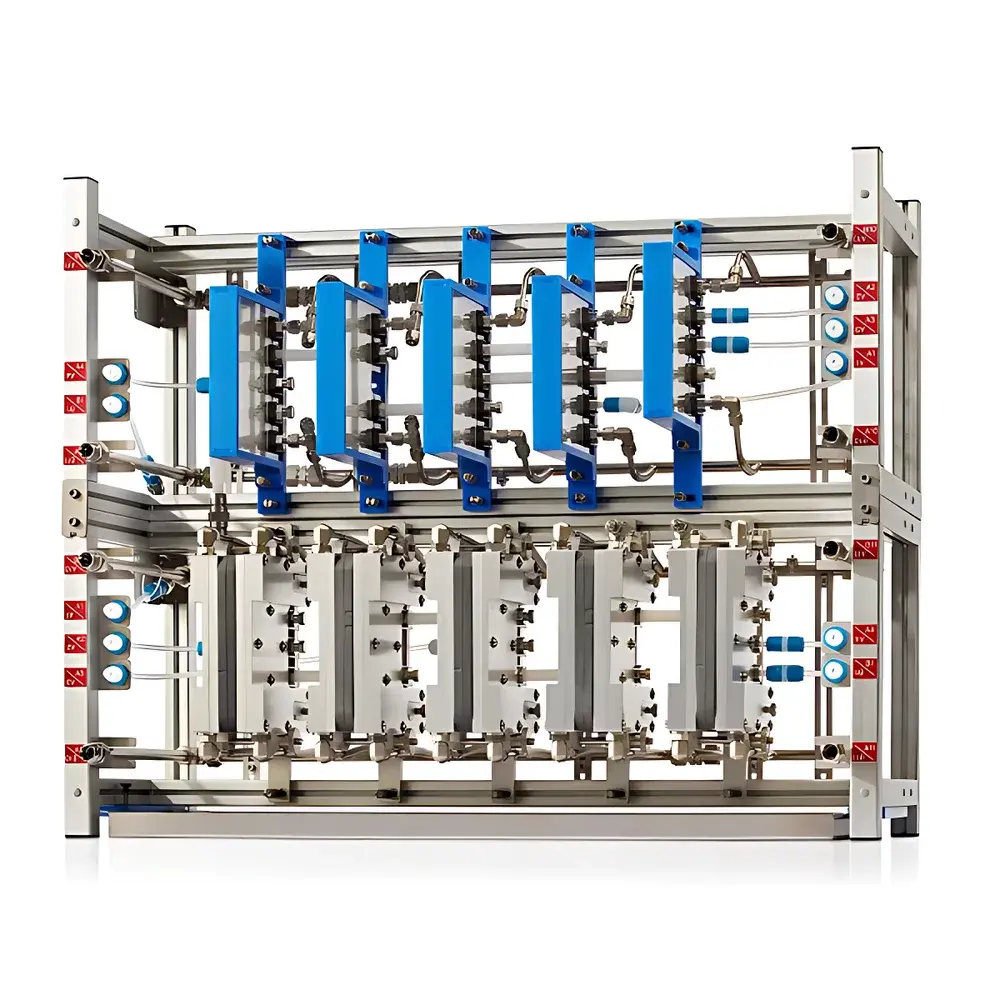
Corning G1 Hybrid Microchannel Reactor
| Brand | Corning |
|---|---|
| Origin | USA |
| Model | G1 Hybrid |
| Flow Rate Range | 15–250 mL/min |
| Temperature Range | −60 °C to 200 °C |
| Maximum Inlet Pressure (gauge) | 18 bar |
| Reactor Architecture | Dual-module, modularly configurable (independent or series operation) |
| Core Materials | Corning® Advanced-Flow™ glass modules (optically transparent, photochemically compatible) + silicon carbide (SiC) modules (high chemical resistance, suitable for quenching and aggressive reagents including concentrated alkalis) |
| Compliance | Designed for GLP-compliant lab-scale flow chemistry development |
Overview
The Corning G1 Hybrid Microchannel Reactor is an engineered platform for precision-controlled continuous-flow synthesis, integrating two distinct reactor module technologies—optically transparent borosilicate glass and chemically inert silicon carbide—within a single, compact instrument frame. Built upon Corning’s proprietary Advanced-Flow™ architecture, the system operates on the principle of laminar flow with precisely defined residence time distribution, enabling reproducible heat and mass transfer characteristics essential for exothermic, photochemical, or highly reactive transformations. Its dual-module design supports both parallel method scouting and sequential reaction cascades, making it particularly suited for process intensification studies, kinetic profiling, and scalable route validation in pharmaceutical, fine chemical, and academic research laboratories.
Key Features
- Hybrid Module Configuration: Combines Corning’s signature glass microchannels—enabling real-time visual monitoring and UV/visible-light-mediated photochemistry—with robust SiC modules resistant to caustic media (e.g., >30% w/w NaOH), strong oxidants, and acidic halogenation reagents.
- Wide Operational Envelope: Supports temperature control from −60 °C (via external cryogenic circulator integration) to +200 °C (with pressurized heating block), and inlet pressures up to 18 bar gauge—facilitating high-boiling solvent systems, supercritical conditions, and gas-liquid reactions.
- Modular Flow Flexibility: Each module functions autonomously with independent temperature and pressure control; modules can be operated in parallel for comparative screening or connected in series for multi-step syntheses without intermediate workup.
- Precision Flow Delivery: Compatible with third-party syringe or HPLC pumps delivering stable flow rates between 15 and 250 mL/min, ensuring consistent residence times across varying viscosities and phase compositions.
- Robust Thermal Management: Integrated cartridge heaters and Peltier-based cooling elements provide rapid thermal response (<2 min to stabilize ±0.5 °C at 150 °C), minimizing axial temperature gradients and supporting Arrhenius-based kinetic analysis.
Sample Compatibility & Compliance
The G1 Hybrid accommodates diverse feedstocks—including suspensions (≤50 µm particle size), biphasic mixtures, and viscous solutions (up to 500 cP)—without clogging, thanks to its trapezoidal channel geometry and smooth SiC/glass surface finish. All wetted materials comply with USP Class VI and ISO 10993 biocompatibility standards. The system architecture supports audit-ready documentation practices: temperature/pressure/time-stamped logs are exportable in CSV format, and optional integration with LIMS or ELN platforms enables alignment with FDA 21 CFR Part 11 requirements for electronic records and signatures. It meets ASTM E2500-13 guidelines for equipment qualification in early-phase process development.
Software & Data Management
While the G1 Hybrid operates via hardware-integrated digital controllers (no proprietary software license required), it provides analog and digital I/O interfaces (0–10 V, RS485, Modbus TCP) for seamless integration into SCADA or LabVIEW-based automation frameworks. Real-time sensor data—including inlet/outlet temperatures, backpressure, and optional inline IR or UV-Vis absorbance signals—can be logged at 1 Hz resolution. Exported datasets include metadata headers compliant with ISA-88 and ISA-95 nomenclature, facilitating traceability in GMP-aligned tech transfer packages.
Applications
- Kinetic studies of fast nitration, diazotization, or Grignard additions under controlled residence time
- Photocatalytic C–H functionalization using integrated LED arrays (365 nm or 455 nm)
- Safe handling of thermally unstable intermediates (e.g., diazonium salts, azides) via precise residence time limitation
- Acid–base quenching sequences where glass-to-SiC transition prevents corrosion-induced contamination
- Process validation for API intermediate synthesis per ICH Q5A and Q7 guidance
FAQ
Can the G1 Hybrid be used for reactions requiring strict anhydrous or inert-atmosphere conditions?
Yes—both glass and SiC modules support standard Swagelok® or VICI Valco™ fittings for leak-tight connections; optional purge ports enable continuous N₂ or Ar sparging prior to and during operation.
Is cleaning validation supported for multi-product use?
The smooth, non-porous surfaces of Corning glass and SiC allow validated cleaning protocols using solvents such as acetone, isopropanol, or dilute HNO₃; typical carryover levels are <10 ppm as verified by HPLC-UV rinse testing.
Does Corning provide application support for reaction optimization?
Corning offers technical consultation services—including residence time distribution modeling, thermal safety assessment (RC1e compatibility), and scale-up pathway analysis—to support clients from lab-scale screening through kilo-lab implementation.
Are replacement modules available as consumables?
Yes—glass and SiC reactor cartridges are field-replaceable with tool-free installation; each module carries a unique serial number and calibration certificate traceable to NIST standards.



