
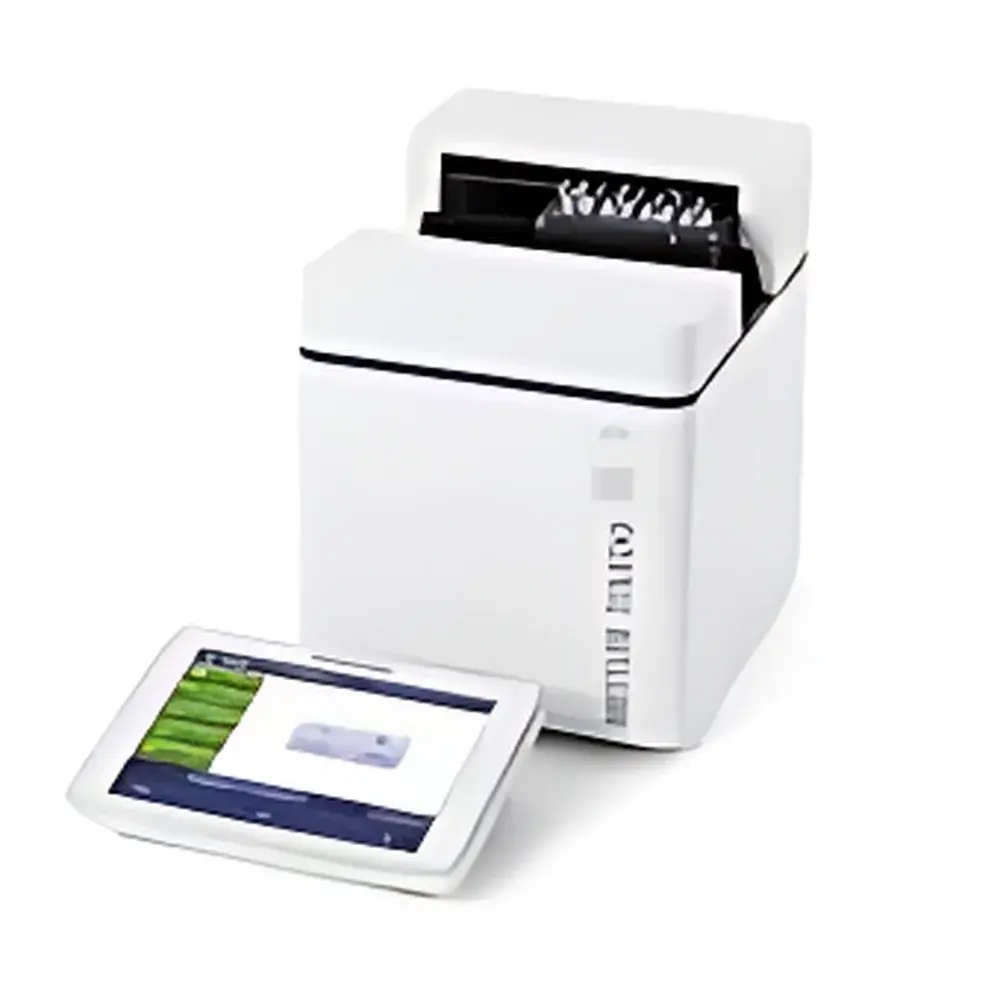
METTLER TOLEDO UV5/UV7 Excellence UV-Vis Spectrophotometer
| Brand | METTLER TOLEDO |
|---|---|
| Origin | Switzerland |
| Model | UV5, UV7 |
| Optical Design | Single-beam with pulsed xenon lamp |
| Detector | 2048-pixel CCD array |
| Wavelength Range | 190–1100 nm |
| Wavelength Accuracy | ±1.0 nm (UV5), ±0.8 nm (UV7) |
| Stray Light | <0.01% T at 198 nm (KCl) |
| Scan Speed | Full spectrum in ≤1 s |
| Photometric Accuracy | ±0.01 A (K₂Cr₂O₇) |
| Wavelength Resolution (toluene in n-hexane) | >1.5 nm (UV5), >1.9 nm (UV7) |
| Display | 7″ QVGA color TFT touchscreen (400 × 800 px) |
| Dimensions (L×W×H, without controller) | 208 × 255 × 228 mm |
| Weight (with controller) | 6.4 kg |
Overview
The METTLER TOLEDO UV5 and UV7 Excellence UV-Vis Spectrophotometers are single-beam, full-spectrum instruments engineered for precision, regulatory compliance, and operational efficiency in pharmaceutical, chemical, and quality control laboratories. Leveraging FastTrack™ optical architecture—comprising a high-stability pulsed xenon lamp and a 2048-channel CCD array detector—the systems deliver complete 190–1100 nm spectral scans in under one second, eliminating warm-up delays and enabling true “instant-on” operation. Unlike traditional tungsten/halogen or deuterium lamp-based designs, the xenon flash source ensures consistent intensity across the entire UV-Vis range without spectral drift or lamp aging artifacts. The optical path incorporates fused silica fiber optics to maximize light throughput and signal-to-noise ratio, while rigorous factory calibration against NIST-traceable standards (e.g., holmium oxide for wavelength, potassium dichromate for photometric accuracy) ensures metrological integrity across instrument lifetime.
Key Features
- OneClick™ intuitive touchscreen interface with customizable quick-access keys (12 on UV5; 12 on UV7) for direct launch of preconfigured measurements or user methods
- Single-beam design optimized for stability, reproducibility, and minimal maintenance—no moving grating or mechanical wavelength selection
- CertiRef™ integrated certification kit enables on-site performance verification per ISO 8579 and ASTM E275, supporting routine instrument qualification (IQ/OQ)
- FillPalMini peristaltic pump (field-mountable left/right) for automated liquid handling in kinetic or multi-sample workflows
- CuvetteChanger automatic 8-position cell changer with open-access sample compartment for rapid manual cuvette insertion or robotic integration
- Robust 7″ QVGA color TFT touchscreen (400 × 800 resolution) with glove-compatible operation and multilingual UI (English, German, French, Spanish, Italian, Chinese, Russian, Portuguese)
Sample Compatibility & Compliance
The UV5/UV7 accommodate standard 10-mm square quartz, glass, or plastic cuvettes (including disposable types), as well as microvolume adapters and flow cells compatible with FillPalMini. Both models meet essential optical performance criteria outlined in USP , Ph. Eur. 2.2.25, and JP 2.03 for spectrophotometric assay validation. The UV7 further satisfies enhanced requirements for pharmacopoeial compliance—including tighter wavelength accuracy (±0.8 nm), improved resolution (>1.9 nm), and extended method validation support—making it suitable for GMP-regulated environments subject to FDA 21 CFR Part 11 and EU Annex 11. All firmware and LabX® software modules maintain full audit trail functionality, electronic signature support, and secure user role management aligned with ALCOA+ data integrity principles.
Software & Data Management
LabX® UV/VIS software provides centralized method development, execution, and data archiving across networked instruments. It supports creation of validated SOPs with embedded calculation templates (e.g., concentration, % transmittance, kinetics, DNA/RNA purity), configurable pass/fail limits, and automated report generation compliant with GLP/GMP documentation standards. Raw spectral data, metadata (operator, timestamp, instrument ID, calibration status), and processed results are stored in encrypted SQLite databases with optional export to CSV, PDF, or XML. Instrument-internal storage retains up to 20,100 measurement records; external USB drives enable portable backup, while TCP/IP connectivity allows real-time result streaming to LIMS or enterprise servers. All software updates are digitally signed and version-controlled per ICH Q5A change management protocols.
Applications
These spectrophotometers serve critical roles in raw material identification (e.g., excipient verification via spectral overlay), quantitative analysis (active pharmaceutical ingredient assays per USP ), dissolution testing (multi-point kinetic monitoring), nucleic acid quantification (A260/A280 ratios), enzyme kinetics (NADH/NADPH monitoring at 340 nm), and cleaning validation (residue detection down to ppm levels). The UV7’s enhanced resolution and accuracy make it particularly suited for complex matrix analysis—such as impurity profiling in APIs or spectral deconvolution of overlapping peaks in formulation stability studies—where robust peak separation and baseline fidelity are mandatory.
FAQ
Does the UV5/UV7 require lamp warm-up before measurement?
No. The pulsed xenon lamp operates without thermal stabilization delay, enabling immediate spectral acquisition upon power-on.
Can the instrument be integrated into a regulated laboratory network?
Yes. LabX® software supports 21 CFR Part 11-compliant electronic signatures, audit trails, and role-based access control for deployment in GxP environments.
What is the maximum number of user-defined methods supported?
Up to 20,100 methods can be stored internally, with unlimited archival capacity via LabX® server-based management.
Is stray light performance verified at multiple wavelengths?
Stray light is certified at 198 nm (KCl cutoff filter) and 340 nm (NaNO₂) per ISO 9022-15, with reported values <0.01% T.
How is wavelength accuracy maintained over time?
Automatic self-calibration using internal holmium oxide and didymium reference filters occurs at startup and optionally at scheduled intervals, traceable to NIST SRM 2034.




