
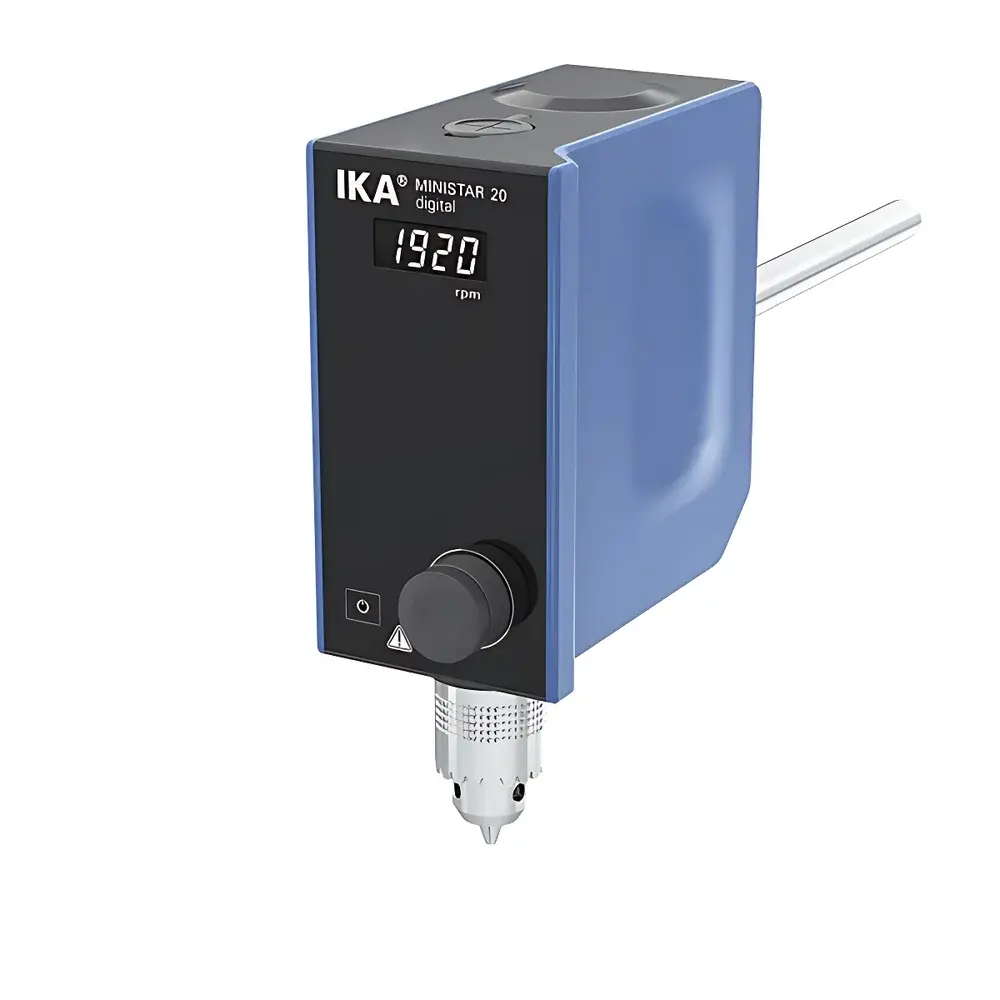
IKA MINISTAR 20 digital Overhead Stirrer
| Brand | IKA |
|---|---|
| Origin | Germany |
| Model | MINISTAR 20 digital |
| Max. Stirring Volume (H₂O) | 15 L |
| Motor Input Power | 60 W |
| Motor Output Power | 46 W |
| Drive Type | Brushless DC Motor |
| Speed Range | 0/50–2000 rpm |
| Speed Display | LED |
| Speed Setting Accuracy | ±1 rpm |
| Speed Measurement Deviation | ±1 % (n > 300 rpm), ±3 rpm (n < 300 rpm) |
| Max. Viscosity | 10,000 mPa·s |
| Max. Output Torque | 20 N·cm |
| Continuous Duty Cycle | 100 % |
| Shaft Clamp Type | Fixed Chuck |
| Clamp Range | Ø 0.5–8.2 mm |
| Hollow Shaft ID | 8.5 mm |
| Hollow Shaft Insertion (at standstill) | Yes |
| Extension Arm Diameter | 13 mm |
| Extension Arm Length | 160 mm |
| Rated Torque | 0.075 N·m |
| Housing Material | Cast Aluminum Coated / Thermoplastic Polymer |
| Dimensions (W × H × D) | 70 × 193 × 147 mm |
| Weight | 1.56 kg |
| Ambient Temperature Range | 5–40 °C |
| Relative Humidity Limit | 80 % |
| Ingress Protection | IP54 (DIN EN 60529) |
| USB Interface | Yes |
| Input Voltage | 100–240 V AC |
| Frequency | 50/60 Hz |
| Device Input Power | 69 W |
| Standby Power Consumption | 0.5 W |
| DC Supply | 24 V = |
| Current Draw | 2900 mA |
Overview
The IKA MINISTAR 20 digital is a compact, brushless DC motor-driven overhead stirrer engineered for precision, reliability, and long-term operational stability in academic, industrial, and quality control laboratories. Designed according to fundamental principles of torque-controlled rotational mixing, it delivers consistent shear input across a wide viscosity range—from low-viscosity aqueous solutions up to 10,000 mPa·s—without speed droop or thermal derating under continuous load. Its brushless architecture eliminates carbon wear, ensuring maintenance-free operation and high reproducibility over thousands of hours. The device operates within a regulated speed range of 50–2000 rpm with ±1 rpm setting resolution and real-time LED feedback, enabling precise method transfer and protocol adherence in GLP- and GMP-aligned workflows.
Key Features
- Brushless DC motor technology for zero brush wear, extended service life, and stable torque delivery across the full speed range
- High-resolution LED display showing actual rotational speed in real time, with ±1 rpm setting accuracy and traceable speed measurement compliance
- Hollow shaft design (ID 8.5 mm) permitting insertion of temperature probes, pH electrodes, or sampling tubes during stationary operation—critical for in-process monitoring in reaction calorimetry or fermentation studies
- Robust cast aluminum housing with thermoplastic polymer coating, rated IP54 per DIN EN 60529 for resistance to dust ingress and water splashing in standard lab environments
- Integrated USB interface supporting firmware updates and future software compatibility—enabling alignment with evolving laboratory informatics infrastructure
- Compact footprint (70 × 193 × 147 mm) and lightweight construction (1.56 kg) optimized for benchtop integration, fume hood use, or mobile reactor setups
- Full 100% duty cycle rating ensures uninterrupted operation during extended synthesis, dissolution, or homogenization protocols
Sample Compatibility & Compliance
The MINISTAR 20 digital accommodates standard laboratory vessels including glass beakers (up to 15 L), jacketed reactors, and stainless-steel mixing tanks. Its fixed chuck accepts stirring rods from Ø 0.5 to 8.2 mm, supporting PTFE-coated, glass, or Hastelloy shafts for chemical compatibility across acidic, alkaline, and organic media. The unit complies with IEC 61000-6-3 (EMC emission standards) and IEC 61000-6-2 (immunity), and its electrical safety conforms to IEC 61010-1 for laboratory equipment. While not intrinsically safe, its IP54 rating supports use in non-hazardous areas per ATEX Category 3 (Zone 2). Documentation packages include EU Declaration of Conformity and RoHS-compliant material declarations—facilitating audit readiness for ISO/IEC 17025, FDA 21 CFR Part 11 (when paired with validated data capture systems), and internal QA/QC procedures.
Software & Data Management
The MINISTAR 20 digital does not incorporate embedded data logging or PC connectivity beyond firmware update capability via USB. However, its precise speed control and repeatability support integration into externally validated systems: when used with third-party acquisition hardware (e.g., National Instruments DAQ modules or LabVIEW-based controllers), speed setpoints and runtime can be logged with timestamping and electronic signature support. Firmware updates preserve backward compatibility and are distributed through IKA’s official support portal—ensuring version traceability and change control documentation for regulated environments. No local storage or user-accessible memory is present, eliminating data integrity concerns related to uncontrolled file modification.
Applications
- Preparation of homogeneous suspensions and emulsions in pharmaceutical formulation development (e.g., API dispersion in liquid dosage forms)
- Controlled agitation during dissolution testing per USP and Ph. Eur. 2.9.3, particularly in vessel configurations requiring overhead drive geometry
- Mixing of viscous polymer solutions and adhesives in R&D labs, where torque consistency at low speeds (<200 rpm) is critical for structural integrity assessment
- Stirring in corrosion-resistant reactors for electrochemical synthesis or catalyst slurry preparation
- Integration into automated platforms for sequential reagent addition and mixing steps in synthetic chemistry workflows
- Calibration verification of viscometers and rheometers using standardized Newtonian fluids under defined shear rates
FAQ
Does the MINISTAR 20 digital support external speed control via analog voltage or RS232?
No—speed is adjusted exclusively via the front-panel rotary encoder; no analog or serial control inputs are provided.
Can the hollow shaft accommodate a Pt100 temperature probe during operation?
Yes, but only when the shaft is stationary; insertion while rotating may damage the probe or cause imbalance.
Is the device suitable for use inside a nitrogen-purged glovebox?
Yes, provided ambient temperature and humidity remain within specified limits (5–40 °C, ≤80 % RH) and ventilation prevents condensation on electronics.
What is the maximum recommended vessel diameter for stable operation with a standard anchor impeller?
For optimal flow pattern and torque transmission, vessel diameter should not exceed 200 mm when using impellers ≤80 mm in width.
Does IKA provide calibration certificates traceable to national standards?
Factory calibration is performed per internal SOPs; accredited third-party calibration services (e.g., DKD/DAkkS) are available upon request with additional lead time and cost.



