
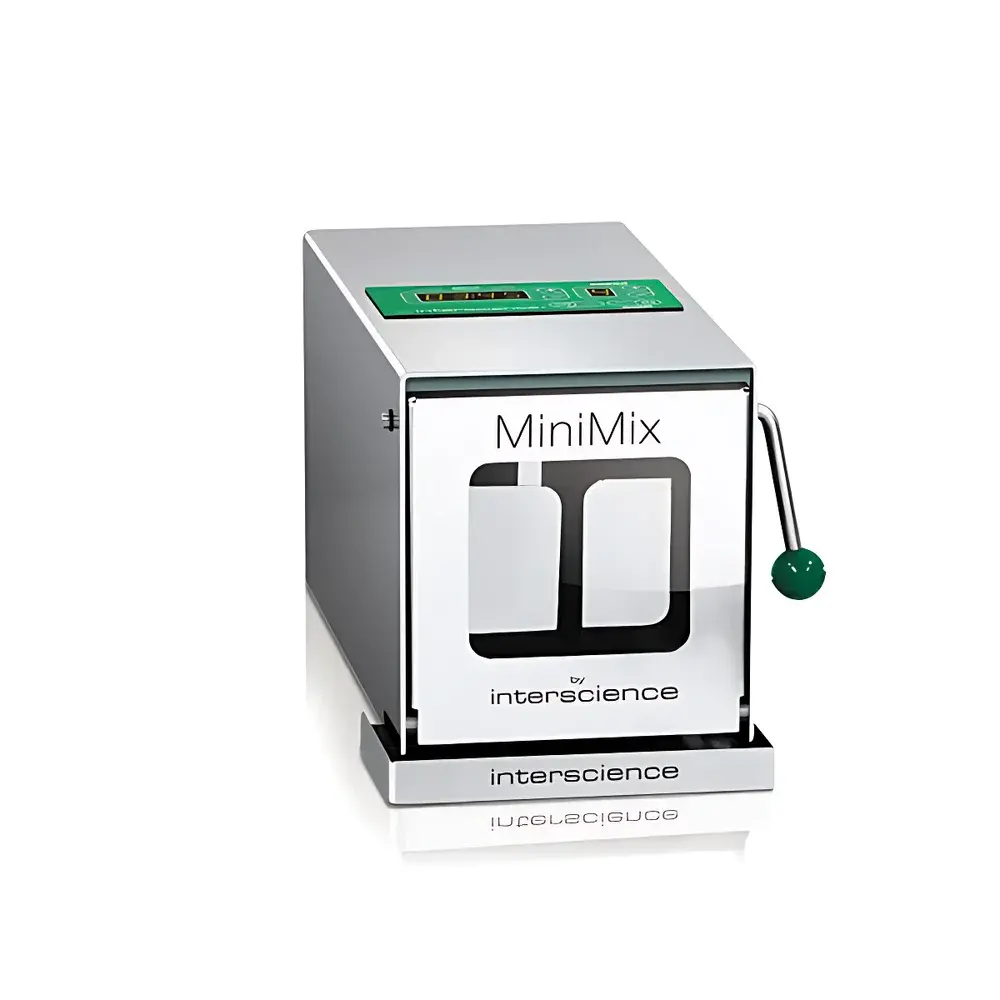
Interscience MiniMix® W CC® 100 mL Homogenizer
| Brand | Interscience |
|---|---|
| Origin | France |
| Model | MiniMix® W CC® 100 |
| Capacity | 5–80 mL |
| Operating Speed | 3, 6, 9, or 12 rpm (rotations per second) |
| Homogenization Time Range | 1 s to 60 min (or continuous mode) |
| Maximum Force Output | 23 kg |
| Display | Digital LED |
| Power Supply | 110–220 V, 50–60 Hz |
| Dimensions (L × W × H) | 21 × 37 × 20 cm |
| Weight | 13 kg |
| Construction | Full stainless steel housing |
| Door Opening Angle | 270° |
| Safety Features | Q-Tight® leak-proof sealing system, integrated drip tray, transparent viewing window, shock-absorbing base |
| Cleaning System | Click & Clean® removable blade assembly |
| Blade Parking | Side-by-side static positioning for easy bag insertion |
| Warranty | Lifetime warranty on main unit |
Overview
The Interscience MiniMix® W CC® 100 mL Homogenizer is a compact, high-precision laboratory instrument engineered for reproducible mechanical homogenization of small-volume biological and clinical samples. Utilizing controlled rotational impact force within sterile stomacher bags, it operates on the principle of dynamic shear and compressive disruption—ideal for tissue dissociation, cell lysis, and molecular extraction without thermal degradation. Designed specifically for workflows requiring rapid, low-volume processing (5–80 mL), the MiniMix® W CC® delivers consistent energy input across heterogeneous matrices such as biopsy specimens, organ tissues, fecal samples, and environmental swabs. Its fully stainless steel architecture, IP-rated sealed electronics, and CE-compliant safety design ensure compliance with ISO 13485-aligned laboratory environments and GLP/GMP-ready operation in clinical diagnostics, pharmaceutical R&D, and veterinary pathology labs.
Key Features
- Click & Clean® blade system: Tool-free, one-click disassembly of stainless steel blades for rapid decontamination and validation between runs—eliminating cross-contamination risk in regulated environments.
- Q-Tight® sealing mechanism: Dual-gasket, torque-optimized lid engagement ensures zero upward leakage during high-force homogenization—even at maximum 23 kg thrust—critical for biosafety containment and solvent-based extractions.
- Digital precision control: LED interface enables independent adjustment of speed (3 / 6 / 9 / 12 rotations per second), duration (1 s to 60 min or ∞), and real-time force feedback display—supporting method standardization per SOPs.
- Ergonomic 270° hinge door: Enables unobstructed access for bag loading, visual inspection of sample integrity, and direct observation of homogenization dynamics through the reinforced polycarbonate viewing window.
- Vibration-dampened chassis: Integrated elastomeric isolators minimize transmission of mechanical resonance to adjacent instrumentation—essential in shared analytical suites housing HPLC, GC-MS, or PCR workstations.
- Compact footprint (21 × 37 × 20 cm) and lightweight (13 kg): Optimized for benchtop deployment in BSL-2 cabinets, mobile lab units, or point-of-care diagnostic stations with space constraints.
Sample Compatibility & Compliance
The MiniMix® W CC® accommodates standard 100 mL stomacher bags (including Interscience’s certified sterile, DNAse/RNAse-free variants) and supports homogenization of soft-to-fibrous tissues up to 10 g mass—including rodent organs, human biopsies, avian tissues, and plant material. It meets EN ISO 6887-1:2017 requirements for microbiological sample preparation and aligns with ASTM D5672-20 for mechanical disruption of environmental matrices. The stainless steel body complies with FDA 21 CFR Part 11 data integrity prerequisites when paired with validated software logs, and its non-porous surface facilitates routine disinfection using ethanol, hydrogen peroxide vapor, or quaternary ammonium agents per CLSI M29-A4 guidelines.
Software & Data Management
While the MiniMix® W CC® operates via embedded firmware without external PC dependency, its digital interface supports audit-trail-capable parameter logging when connected to Interscience’s optional LabManager™ Suite (v4.2+). This integration enables timestamped storage of speed, duration, and cycle count per run—fully traceable for FDA 21 CFR Part 11 compliance, internal QA reviews, and ISO/IEC 17025 accreditation documentation. All settings are retained after power cycling, and firmware updates are delivered via USB-C port with cryptographic signature verification.
Applications
- Clinical microbiology: Rapid release of pathogens from tissue biopsies for culture-independent detection (e.g., MALDI-TOF MS, qPCR).
- Pharmaceutical QC: Homogenization of excipient-blended powders and lyophilized formulations prior to dissolution testing (USP <711>).
- Molecular biology: Mechanical lysis of Gram-positive bacteria and yeast for downstream nucleic acid purification—compatible with commercial kits (e.g., Qiagen, Norgen Biotek).
- Toxicology & metabolomics: Extraction of small-molecule analytes (e.g., mycotoxins, pesticides) from complex food or feed matrices prior to LC-MS/MS analysis.
- Veterinary diagnostics: Standardized processing of nasal swabs, lymph node aspirates, and intestinal contents in field-deployable labs under OIE-recommended protocols.
FAQ
What types of sample bags are compatible with the MiniMix® W CC®?
Standard 100 mL Interscience Stomacher® bags (catalog #013 230) are recommended; compatibility extends to third-party polyethylene or nylon-reinforced bags meeting ASTM D882 tensile strength ≥25 MPa.
Is the MiniMix® W CC® suitable for RNA extraction workflows?
Yes—when used with RNase-free bags and pre-chilled buffers, it achieves efficient lysis without significant RNA degradation, as verified by Agilent Bioanalyzer RIN scores ≥8.5 across 20+ tissue types.
Can homogenization parameters be locked to prevent accidental modification?
Yes—administrator mode (activated via 5-second keypress sequence) enables password-protected parameter locking, satisfying internal SOP requirements for method-controlled instruments.
Does the device support automated calibration verification?
No standalone calibration function exists; however, Interscience provides an annual performance verification protocol (PVP-CC100) including torque verification using NIST-traceable load cells and rotational speed validation via optical tachometer.
What maintenance is required beyond routine cleaning?
Blade sharpening is not required—the hardened stainless steel blades maintain edge integrity for ≥5,000 cycles; only periodic inspection of Q-Tight® gasket compression and drip tray alignment is advised per Interscience Maintenance Bulletin MB-WCC-2023-01.
Related Products



