
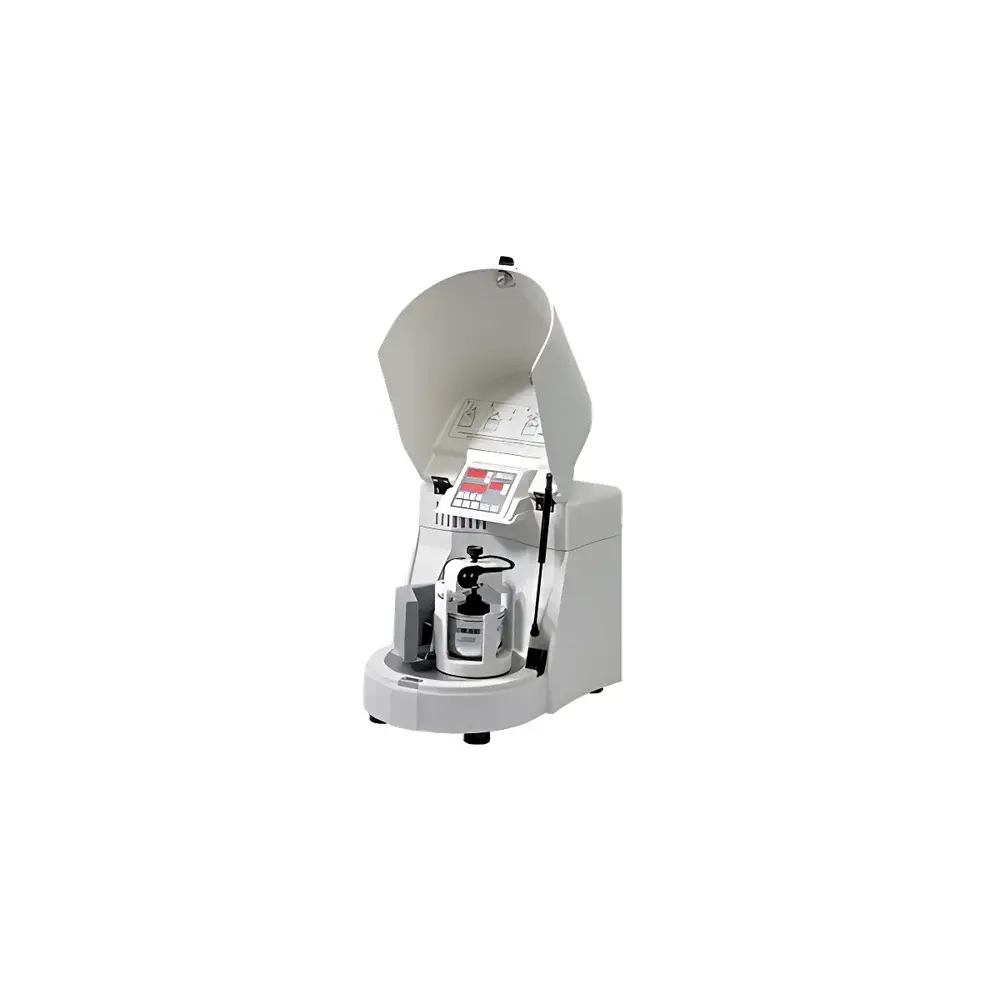
FRITSCH PULVERISETTE 6 Classic Planetary Micro Mill
| Brand | FRITSCH |
|---|---|
| Origin | Germany |
| Model | PULVERISETTE 6 Classic |
| Maximum Feed Size | < 10 mm |
| Maximum Sample Volume per Bowl | 225 mL |
| Final Particle Size | < 1 µm |
| Number of Simultaneous Samples | Up to 2 |
| Grinding Bowl Volumes | 80 mL, 250 mL, 500 mL |
| Grinding Ball Diameters | 3, 5, 10, 15, 20, 30, 40 mm |
| Grinding Modes | Dry and Wet |
| Voltage/Frequency | 100–120 V / 200–240 V, 1–phase, 50–60 Hz |
| Power Consumption | 1100 W |
| Net Weight | 63 kg |
| Gross Weight | 93 kg |
| Dimensions (W × H × D) | 37 × 53 × 50 cm |
| Optional In-situ Monitoring | GTM (Grinding Temperature & Pressure Monitoring) System |
| Available Bowl & Ball Materials | Agate, Silicon Nitride, Aluminum Oxide, Zirconium Oxide, Stainless Steel, Tempered Steel, Tungsten Carbide |
Overview
The FRITSCH PULVERISETTE 6 Classic Planetary Micro Mill is a high-energy laboratory grinding instrument engineered for reproducible, contamination-controlled size reduction of solid materials down to the sub-micron range. Operating on the principle of planetary ball milling, it subjects samples to intense mechanical energy through the combined rotational and orbital motion of grinding bowls—generating centrifugal accelerations up to 22 g. This mechanism enables efficient particle size reduction, homogenization, mechanical alloying, amorphization, and mechanochemical synthesis. Designed for rigorous R&D and quality control environments, the instrument supports both dry and wet grinding protocols and accommodates inert atmosphere processing via sealed, gas-tight grinding bowls—critical for air-sensitive or oxidation-prone materials such as metal powders, battery cathode precursors, and reactive nanocomposites.
Key Features
- High-precision programmable control with time resolution down to 1 second for both grinding duration and cooling intervals—enabling strict thermal management during extended milling cycles.
- Interchangeable grinding bowls in three volumes (80 mL, 250 mL, 500 mL) and seven standardized ball diameters (3–40 mm), allowing systematic optimization of impact energy, frequency, and collision dynamics.
- Seven certified grinding material options—including agate, silicon nitride, zirconium oxide, aluminum oxide, stainless steel, tempered steel, and tungsten carbide—ensuring compatibility with diverse sample chemistries and minimizing cross-contamination risks.
- Integrated GTM (Grinding Temperature & Pressure Monitoring) interface for real-time in-situ measurement of internal bowl temperature and pressure during operation—supporting thermally sensitive reaction monitoring and process validation.
- Robust cast-aluminum housing with vibration-damping feet and electromagnetic braking system for safe, repeatable start/stop sequences and operator protection.
- Gas-tight bowl sealing capability compatible with argon, nitrogen, or other inert atmospheres—essential for preventing oxidation or hydrolysis during mechanochemical synthesis.
Sample Compatibility & Compliance
The PULVERISETTE 6 Classic processes brittle, fibrous, soft, hard, and composite materials—including metals, ceramics, polymers, pharmaceuticals, geological specimens, and catalysts. Its design conforms to ISO 13320 (laser diffraction particle size analysis) sample preparation requirements and supports GLP-compliant workflows when paired with traceable calibration standards and audit-ready documentation practices. While not intrinsically certified for hazardous area use, optional explosion-proof configurations and ATEX-compatible accessories are available upon request. All grinding components meet EU Regulation (EC) No 1935/2004 for food-contact safety where applicable, and material certificates (e.g., CoA for zirconia purity ≥95%) can be supplied for regulated applications.
Software & Data Management
The instrument operates via an intuitive front-panel interface with non-volatile memory for storing up to 20 user-defined grinding programs. For enhanced traceability, optional PC connectivity (RS-232 or USB) enables remote parameter configuration, real-time data logging (time-stamped RPM, elapsed time, pause events), and export of CSV-formatted logs compatible with LIMS integration. When used with GTM sensors, temperature and pressure datasets are synchronized with grinding events—facilitating correlation of thermal history with phase transformation or reaction kinetics. All operational records support 21 CFR Part 11–aligned electronic signature and audit trail capabilities when deployed within validated laboratory informatics systems.
Applications
- Mechanical alloying of Ni–Al, Fe–Si, and Ti–Nb systems for metastable phase formation.
- Top-down synthesis of nanostructured oxides (e.g., TiO₂, ZnO) and layered double hydroxides (LDHs) via high-energy attrition.
- Preparation of homogeneous precursor blends for solid-state battery electrode manufacturing (e.g., LiCoO₂ + conductive carbon).
- Cell disruption and DNA/RNA extraction from microbial biomass using cryo-assisted wet grinding.
- Homogenization of heterogeneous geological samples prior to XRF or ICP-MS analysis.
- Pharmaceutical co-grinding to enhance solubility and bioavailability of BCS Class II compounds.
FAQ
What is the maximum recommended sample volume per grinding bowl?
The maximum usable volume is 225 mL per bowl, corresponding to ≤⅔ fill level for optimal grinding efficiency and mechanical stability.
Can the instrument operate under inert atmosphere?
Yes—gas-tight bowls with O-ring seals and purge valves allow controlled inert gas (N₂, Ar) purging before and during grinding.
Is GTM monitoring available as a factory-installed option?
GTM sensors are optional accessories; installation requires pre-order configuration and calibration by FRITSCH-certified service engineers.
How is cross-contamination minimized between runs?
All bowl and ball sets are autoclavable or solvent-cleanable; agate and zirconia components exhibit negligible leaching in acidic or alkaline media per ASTM C724 testing protocols.
Does the PULVERISETTE 6 Classic comply with CE and RoHS directives?
Yes—the unit carries CE marking and complies with Directive 2014/30/EU (EMC) and 2011/65/EU (RoHS), with full technical documentation available upon request.



