
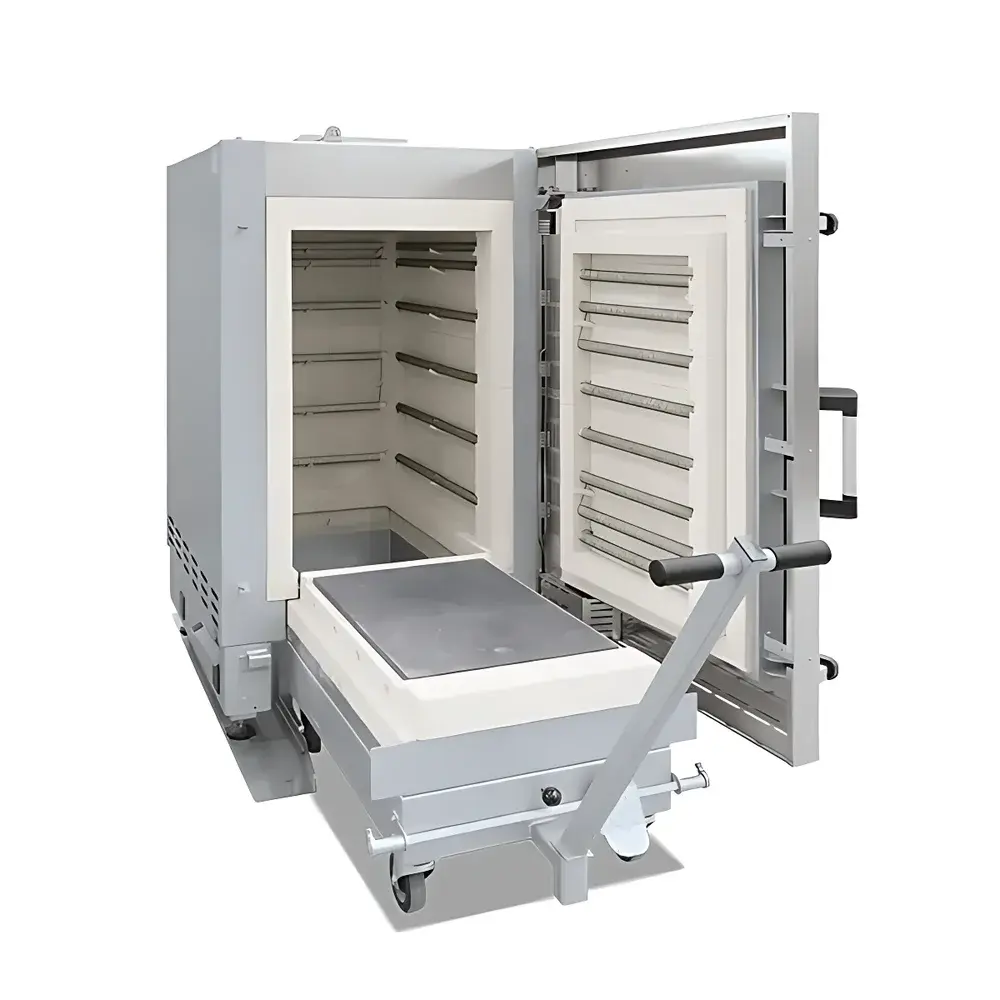
Nabertherm LH15/12–LF120/14 Professional Laboratory Box Furnace
| Brand | Nabertherm |
|---|---|
| Origin | Germany |
| Model | LH15/12–LF120/14 |
| Max. Temperature | 1200–1400 °C |
| Chamber Dimensions (W×D×H) | 250×250×250 mm to 500×500×500 mm |
| Chamber Volume | 15–216 L |
| External Dimensions (W×D×H) | 680×860×1170 mm to 990×1280×1530 mm |
| Power Supply | 3-phase, 5.0–26.0 kW |
| Weight | 150–470 kg |
Overview
The Nabertherm LH15/12–LF120/14 is a modular, high-precision laboratory box furnace engineered for demanding thermal processing applications in materials science, metallurgy, ceramics, and analytical chemistry laboratories. Designed and manufactured in Germany, this furnace series operates across three maximum temperature classes—1200 °C, 1300 °C, and 1400 °C—enabling controlled heat treatment, ashing, sintering, calcination, and annealing under reproducible atmospheric conditions. Its core architecture employs either refractory brick insulation (LH series) or hybrid insulation combining low-thermal-mass ceramic fiber with strategically placed firebrick corners (LF series), ensuring optimal thermal efficiency, rapid heating/cooling cycles, and long-term dimensional stability. Five-sided radiant heating—via high-alloy resistance wire elements mounted on ceramic support tubes—delivers exceptional temperature uniformity (±3 °C at 1200 °C, per DIN 17007 and ASTM E220) throughout the working chamber. The self-supporting arched roof and brick-to-brick sealed door minimize dust ingress and enhance thermal integrity during extended operation.
Key Features
- Modular design supporting both LH (refractory brick insulation) and LF (hybrid fiber + corner brick) configurations for application-specific thermal response profiles
- Five-sided heating system with ceramic-tube-mounted FeCrAl heating elements for uniform radiant heat distribution and extended service life
- Silicon carbide (SiC) hearth plate providing mechanical protection to the bottom heating zone and enabling stable, flat sample placement
- Manually ground brick-to-brick door seal ensuring low-leakage chamber integrity and minimizing ambient air infiltration
- Quick-action door closure mechanism and infinitely adjustable air inlet valve at the furnace base for precise atmosphere control
- Optional accessories include linear motor–driven lift doors, parallel-guided high-temperature doors, wall- or floor-mounted control cabinets, electric exhaust dampers, cooling fans, and inert gas feedthroughs with O-ring–sealed flanges
- Quartz glass process chamber and quartz door shield available for ultra-pure atmospheres and contamination-sensitive applications (e.g., semiconductor precursor studies)
Sample Compatibility & Compliance
The LH15/12–LF120/14 accommodates crucibles, boats, and trays made from alumina, silicon carbide, quartz, platinum, and stainless steel—compatible with standard ISO 8573-1 Class 3 compressed air and technical-grade nitrogen, argon, or forming gas (N₂/H₂). All models conform to IEC 61000-6-3 (EMC emission limits), IEC 61000-6-2 (immunity), and EN 61000-3-12 (harmonic current limits). Optional configurations meet GLP/GMP documentation requirements, including audit-trail–enabled controllers compliant with FDA 21 CFR Part 11 when integrated with Nabertherm’s THERMOCOM software suite. Temperature validation follows EURAMET cg-18 guidelines, and routine calibration adheres to ISO/IEC 17025–accredited procedures.
Software & Data Management
Furnaces are supplied with programmable digital controllers (e.g., Nabertherm THERMOCOM 7 or THERMOCOM 9) featuring multi-step ramp-soak profiles, real-time data logging (≥10,000 points), and USB/Ethernet connectivity. Optional THERMOCOM Lab software enables remote monitoring, automated report generation (PDF/CSV), and integration into LIMS environments via OPC UA or Modbus TCP. Full traceability—including operator ID, timestamped setpoints, actual temperatures, power consumption, and alarm history—is retained for ≥30 days onboard and indefinitely when exported. Controller firmware supports configurable alarm thresholds, safety interlocks (e.g., overtemperature cutoff, door-open shutdown), and password-protected parameter modification.
Applications
- Thermal gravimetric analysis (TGA) support: compatible with manual or automated microbalance integration for combustion loss determination
- Ceramic sintering and densification studies under controlled oxidizing or inert atmospheres
- Metallurgical heat treatment of alloys, including stress relieving, homogenization, and solution annealing
- Ash content determination per AOAC 923.03, ASTM D3174, and ISO 1171
- Preparation of catalyst supports and battery cathode precursors requiring precise calcination profiles
- Research-scale glass frit melting and glaze firing in materials development labs
- Calibration reference furnace use for secondary thermocouple verification (Type S/R/B)
FAQ
What is the difference between LH and LF furnace models?
The LH series uses multilayer, fiber-free lightweight refractory brick insulation optimized for long-term stability and thermal consistency. The LF series combines low-heat-capacity ceramic fiber insulation with firebrick reinforcement at corners and edges—reducing preheat time by up to 40% and accelerating cooldown without compromising structural integrity.
Can this furnace be used under vacuum or reducing atmospheres?
Standard models are rated for inert or mildly oxidizing atmospheres only. Vacuum operation requires optional reinforced shell construction, welded flanges, and vacuum-rated door seals; reducing atmospheres (e.g., H₂/N₂) demand additional safety interlocks, leak-tested gas lines, and explosion-proof controller variants—available upon request.
Is temperature uniformity validated per industry standards?
Yes. Uniformity mapping is performed per DIN 17007 and ASTM E220 at 1200 °C, 1300 °C, and 1400 °C using nine-point sensor arrays. Certification reports—including uncertainty budgets—are provided with each unit.
How is compliance with 21 CFR Part 11 ensured?
When equipped with THERMOCOM 9 controller and validated THERMOCOM Lab software, the system supports electronic signatures, audit trails, role-based access control, and immutable data export—fully aligned with FDA requirements for regulated pharmaceutical and medical device R&D environments.



