
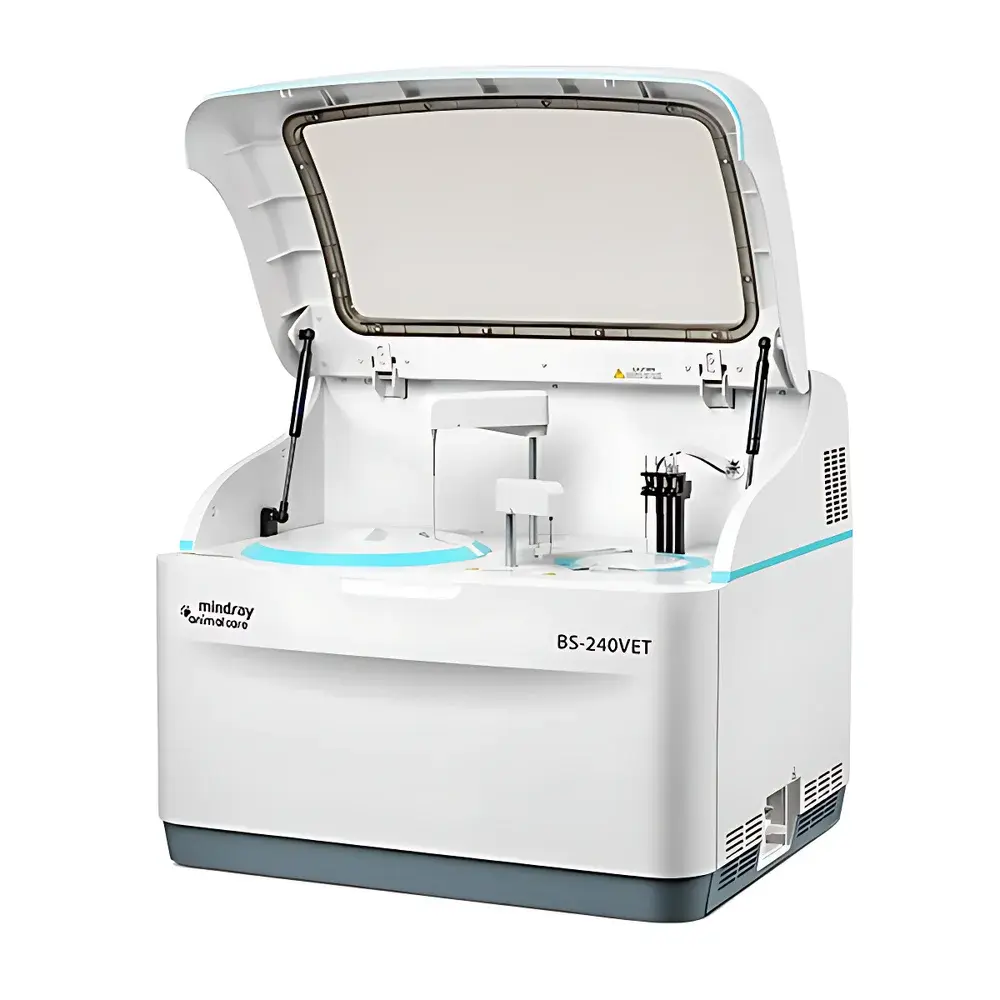
Mindray BS-240 Vet Veterinary Biochemistry Analyzer
| Brand | Mindray |
|---|---|
| Origin | Shanghai, China |
| Manufacturer Type | Authorized Distributor |
| Country of Origin | China |
| Model | BS-240 Vet |
| Instrument Type | Veterinary Clinical Chemistry Analyzer |
| Regulatory Certification | CNAS-Accredited Reference Laboratory (ISO/IEC 17025) |
| Sample Volume Minimum | 2 µL |
| Reaction Volume Minimum | 100 µL |
| Temperature Control | Reaction Disk at 37 ± 0.1 °C (enclosed thermostatic system), Reagent Storage at 2–12 °C (continuous refrigeration) |
| Carryover Rate | < 0.05% |
| Software Interface | Fully Localized Chinese GUI with Veterinary-Specific Workflow Logic |
| Parameter Flexibility | Up to 64 selectable assays |
| Reference Intervals | Species-specific (canine and feline), validated against multi-center clinical serum cohorts |
| Data Traceability | AAA Traceability Architecture (Analytical–Algorithmic–Archival), compliant with GLP audit requirements |
Overview
The Mindray BS-240 Vet is a dedicated veterinary clinical chemistry analyzer engineered for precision, reproducibility, and species-specific diagnostic relevance in small-animal practice. Built upon Mindray’s clinically validated human biochemistry platform and rigorously adapted for veterinary physiology, the system employs photometric measurement principles—specifically dual-wavelength endpoint and kinetic colorimetric/spectrophotometric analysis—to quantify enzymatic activity, metabolites, electrolytes, proteins, and other biochemical analytes in whole blood, serum, or plasma. Its architecture integrates core analytical modules—including a high-fidelity optical path with focused light beam geometry, temperature-stabilized reaction disc, and intelligent reagent management—within a compact benchtop footprint optimized for high-throughput clinic environments. Unlike generic analyzers repurposed for animal use, the BS-240 Vet embeds veterinary clinical logic at the firmware level, enabling physiologically appropriate calibration curves, dynamic reaction monitoring, and real-time interference detection calibrated against feline and canine biological matrices.
Key Features
- Species-tailored reference intervals: Clinically derived canine and feline reference ranges, established through multicenter validation across >1,200 serum samples and aligned with current ACVP (American College of Veterinary Pathologists) and WSAVA (World Small Animal Veterinary Association) guidelines.
- Veterinary-optimized software platform: Fully localized Chinese user interface with intuitive workflow navigation, one-touch panel selection, and context-aware parameter grouping (e.g., “Renal Panel”, “Hepatic Function Screen”, “Critical Care Profile”).
- Selective retest capability: Operators may reanalyze individual analytes without rerunning full panels—reducing reagent consumption, turnaround time, and labor cost while preserving sample integrity.
- AAA traceability framework: Analytical (calibration traceable to NIST-maintained reference materials), Algorithmic (reaction kinetics modeled per assay protocol), and Archival (full audit trail of raw absorbance data, calibration logs, QC events, and operator actions)—fully compliant with GLP documentation standards.
- Low-volume precision fluidics: Dual-stage injection pump with polished stainless-steel sampling probes, dynamic liquid-level sensing, and volume-tracking compensation ensures accurate dispensing down to 2 µL, minimizing sample draw requirements from critical patients.
- Cross-contamination control: 3D立体 cleaning (steric needle washing) using preheated deionized water and detergent, combined with reaction cup thermal rinsing at 85 °C, achieves carryover < 0.05%—validated per CLSI EP10-A3 protocol.
Sample Compatibility & Compliance
The BS-240 Vet accepts native serum, lithium heparin plasma, and EDTA plasma specimens in standard microtubes (1.1–5.0 mL). It supports hemolysis, icterus, and lipemia index estimation via spectral scanning at 600 nm, 505 nm, and 700 nm respectively—enabling semi-quantitative interference flagging. All assay methods comply with internationally recognized veterinary diagnostic standards, including WSAVA Quality Assurance Guidelines and ISO 15197:2013 (for glucose methodology). The onboard reference laboratory—accredited under CNAS (China National Accreditation Service, equivalent to ILAC-MRA signatory status)—maintains traceability to SI units via participation in Randox RIQAS and CAP VET surveys. System validation reports include linearity, precision (within-run CV ≤ 2.5%, between-run CV ≤ 3.8%), and limit-of-detection assessments per CLSI EP5-A3 and EP17-A2.
Software & Data Management
The embedded veterinary information system (VIS) provides role-based access control, electronic QC charting (Levey-Jennings, Westgard rules), and automated calibration verification. Raw absorbance data, reaction curves, and error logs are stored in encrypted SQLite databases with timestamped operator IDs. Export formats include HL7 v2.5.1, CSV, and PDF—with customizable report templates supporting bilingual (Chinese–English) output, clinical interpretation notes per analyte, and graphical trend visualization over time. Audit trails meet FDA 21 CFR Part 11 requirements for electronic records and signatures when deployed with network authentication and Windows domain integration.
Applications
Primary applications span outpatient diagnostics, emergency triage, pre-anesthetic screening, chronic disease monitoring (e.g., CKD staging, diabetes mellitus management), and therapeutic drug monitoring (e.g., phenobarbital, digoxin). The system supports extended assay menus including ALT, AST, ALP, GGT, BUN, creatinine, glucose, fructosamine, total bilirubin, albumin, globulin, calcium, phosphorus, sodium, potassium, chloride, cholesterol, triglycerides, amylase, and lipase—with method-specific calibrators and controls supplied by Mindray. Optional connectivity enables integration with HIS/LIS platforms via TCP/IP or RS-232.
FAQ
Does the BS-240 Vet support canine and feline-specific calibration curves?
Yes—each assay includes species-optimized calibration algorithms and reference material sets validated exclusively on canine and feline sera.
Can raw kinetic data be exported for third-party analysis?
Yes—absorbance vs. time files (.csv) and reaction curve metadata are exportable via USB or network share.
Is the system compatible with external QC materials?
Yes—it accepts commercially available veterinary QC sera (e.g., Bio-Rad Lyphochek, Randox Acusera) with configurable target ranges and warning limits.
What maintenance protocols are required for long-term accuracy?
Daily probe cleaning and weekly optical alignment verification are recommended; no routine lamp replacement is needed—the halogen source has a rated lifetime of ≥2,000 hours.
How is software updated and validated post-update?
Firmware updates are delivered via secure Mindray portal with version-controlled release notes; each update undergoes internal IQ/OQ testing per ISO 13485:2016 Annex C prior to distribution.





