
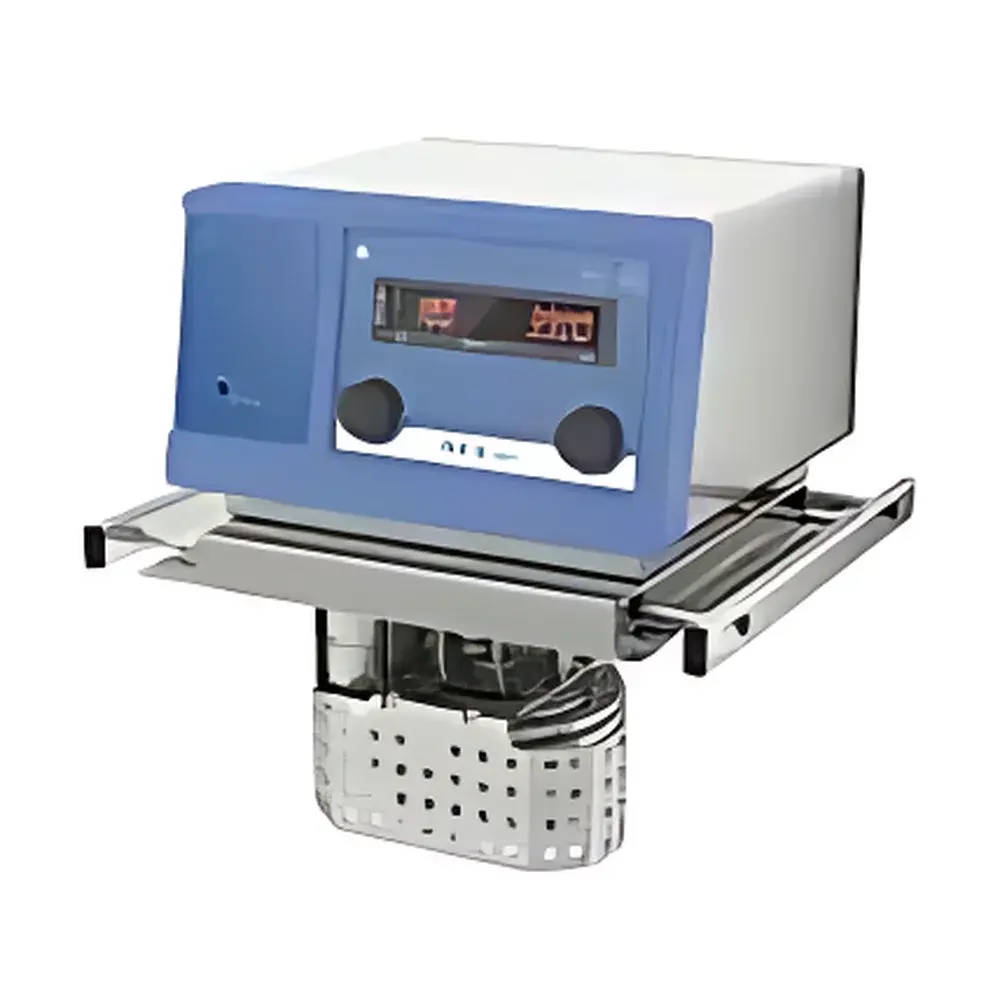
IKA IC basic Immersion Circulator Thermostat
| Brand | IKA |
|---|---|
| Origin | Germany |
| Model | IC basic |
| Heating Power | 2500 W |
| Temperature Range | −20 °C to 200 °C |
| Temperature Stability | ±0.02 K |
| Display Resolution | 0.1 °C |
| Pump Type | Pressure/Suction |
| Max Flow Rate | 20 L/min |
| Max Pressure | 0.5 bar |
| Safety Circuit Range | 0–260 °C |
| External Sensor Interface | PT100 |
| Communication | RS232 & USB |
| IP Rating | IP21 |
| Dimensions (W×D×H) | 285 × 313 × 291 mm |
| Weight | 8.5 kg |
| Compliance | DIN 12876 Class III (FL), UL Certified, EN 60529, 230/115 V, 50/60 Hz |
Overview
The IKA IC basic Immersion Circulator Thermostat is an engineered solution for precise, stable, and safe temperature control in laboratory-scale liquid thermal management applications. Designed according to DIN 12876 standards for equipment handling flammable liquids, it operates as a pressure/suction-capable immersion circulator—capable of both internal bath regulation and external jacketed reactor or coil-based temperature control. Its core thermal architecture integrates a high-efficiency 2500 W heating element with dual PT100 working and PT1000 safety temperature sensors, enabling closed-loop control with ±0.02 K stability across its full operating range of −20 °C to 200 °C. The unit supports both open-bath and closed-loop configurations, and—when paired with an optional external cooling coil—can extend effective low-temperature operation down to ambient conditions. All electrical and mechanical subsystems comply with UL certification requirements and meet the stringent safety classification DIN 12876 Class III (FL), indicating suitability for use with combustible media under continuous-duty conditions.
Key Features
- High-precision temperature control with ±0.02 K stability per DIN 12876, supported by dual-sensor redundancy (PT100 process sensor + PT1000 safety cutoff)
- Integrated pressure/suction pump with fully adjustable flow (0–20 L/min) and pressure output up to 0.5 bar (pressure side) and 0.3 bar (suction side)
- Large, backlit LED display showing real-time temperature, pump speed, and status indicators—readable at multiple viewing angles
- Intuitive rotary encoder and tactile keypad interface for menu navigation, parameter entry, and system configuration
- Dual communication interfaces (RS232 and USB) for bidirectional integration with IKA’s labworldsoft® software suite—enabling remote control, data logging, firmware updates, and audit-trail-compliant operation
- Configurable safety circuit with user-defined upper/lower limits (0–260 °C), optical and acoustic alarms for deviation, overtemperature, and sensor failure events
- M16×1 external connection port for direct integration into jacketed reactors, condensers, or custom thermal manifolds
- Stainless steel universal extension arm with 260–360 mm clamping range, compatible with standard glassware and stainless steel baths ≥150 mm depth
Sample Compatibility & Compliance
The IC basic is validated for use with aqueous solutions, silicone oils, glycols, and other thermally stable organic heat transfer fluids—including those classified as flammable (DIN 12876 FL designation). Its Class III safety rating confirms structural integrity, thermal insulation, and fail-safe shutdown logic appropriate for continuous operation with combustible media. The device conforms to EN 60529 (IP21 ingress protection), UL 61010-1 (electrical safety), and meets essential requirements of the EU Machinery Directive 2006/42/EC and Low Voltage Directive 2014/35/EU. It supports GLP- and GMP-aligned workflows through labworldsoft®’s configurable electronic logbook, timestamped event history, and 21 CFR Part 11–ready user access controls when deployed with appropriate IT infrastructure.
Software & Data Management
Via RS232 or USB, the IC basic connects seamlessly to labworldsoft®—IKA’s native laboratory software platform. This enables automated temperature ramping, multi-step protocols, synchronized pump-speed modulation, and time-stamped acquisition of temperature and flow data at user-defined intervals. All system events—including safety triggers, sensor faults, and manual interventions—are recorded with ISO 8601 timestamps and operator IDs. Firmware updates are performed securely through the same interface, ensuring long-term compliance with evolving regulatory expectations. Export options include CSV and XML formats compatible with LIMS, ELN, and statistical process control systems.
Applications
- Precision temperature conditioning of reaction mixtures in jacketed glass reactors (e.g., Grignard, hydrogenation, polymerization)
- Calibration of thermometers, RTDs, and thermocouples against traceable reference standards
- Viscosity measurement support for rotational rheometers requiring thermostated sample environments
- Controlled crystallization, dissolution testing, and accelerated stability studies per ICH Q1 guidelines
- Thermal preconditioning of chromatographic columns, detectors, and autosampler trays
- Integration into custom-built thermal cycling rigs for materials testing (e.g., coefficient of thermal expansion, phase transition analysis)
FAQ
What is the minimum bath depth required for stable operation?
A minimum immersion depth of 150 mm is required to ensure adequate thermal coupling and prevent dry-run activation of the safety cutoff.
Can the IC basic be used for sub-ambient temperature control?
Not natively—but when connected to an external chiller or cooling coil, it can maintain setpoints near ambient; dedicated refrigerated circulators are recommended for active sub-zero control.
Is calibration documentation provided with the instrument?
Yes—each unit ships with a factory calibration certificate traceable to national standards; optional on-site or accredited third-party recalibration services are available.
Does the device support password-protected parameter locking for regulated environments?
Yes—labworldsoft® enables role-based access control, parameter lockdown, and electronic signature capture in compliance with 21 CFR Part 11 when configured with validated software settings.
What maintenance is required to sustain long-term accuracy?
Annual verification of sensor drift and pump performance is recommended; routine cleaning of the immersion probe and pump inlet screen is sufficient for daily operation.
Related Products



