
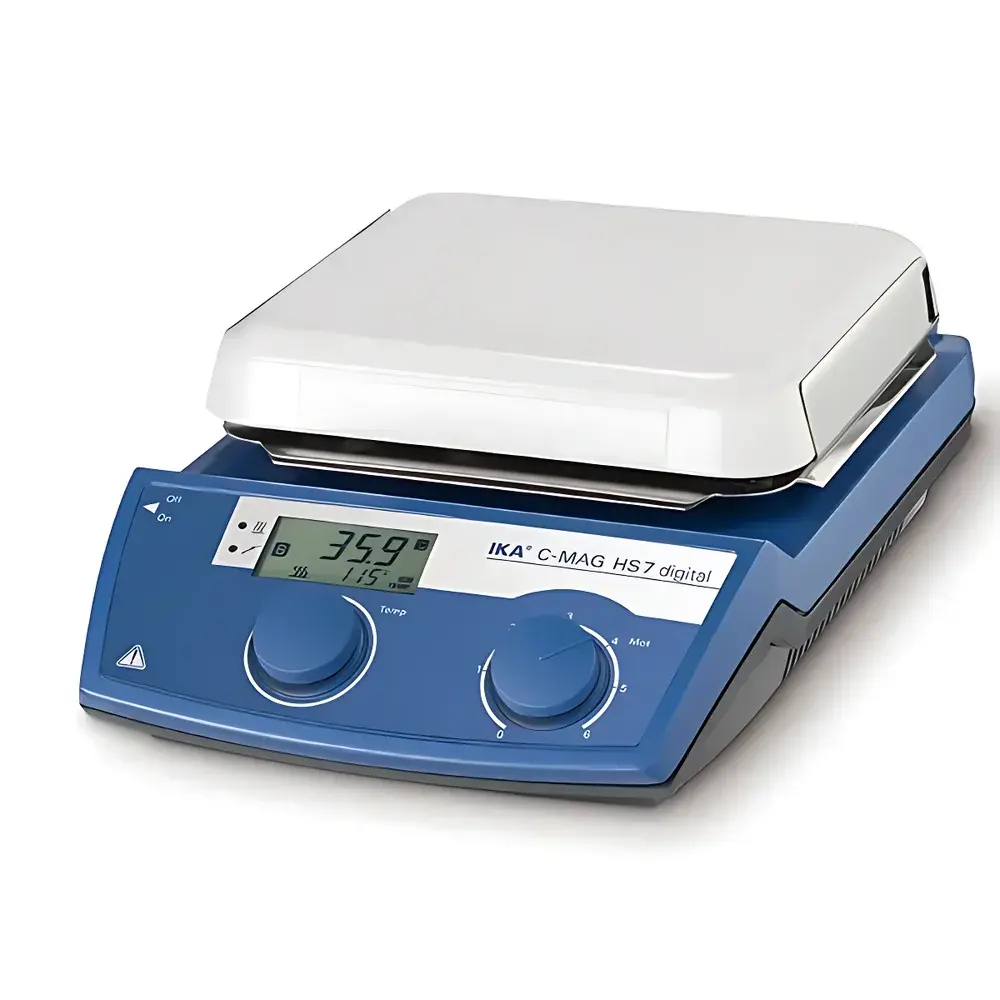
IKA C-MAG HS 7 digital Magnetic Stirrer with Heating
| Brand | IKA |
|---|---|
| Origin | Germany |
| Model | C-MAG HS 7 digital |
| Max. Stirring Volume (H₂O) | 10 L |
| Motor Output Power | 1.5 W |
| Rotation Direction | Counterclockwise |
| Speed Control | Dial (0–6) |
| Speed Range | 100–1500 rpm |
| Max. Stir Bar Length | 80 mm |
| Heater Power Output | 1000 W |
| Heating Temperature Range | 50–500 °C |
| Heating Rate | 5 K/min |
| Temperature Setting Accuracy (Heating Plate) | ±5 K |
| Medium Temperature Control Accuracy (with PT1000) | ±0.5 K |
| Medium Temperature Display Resolution (with PT1000) | 0.1 K |
| Safety Cut-off Temperature | 550 °C |
| Working Plate Material | Ceramic |
| Plate Dimensions | 180 × 180 mm |
| Device Dimensions (W × H × D) | 215 × 105 × 330 mm |
| Weight | 5 kg |
| Ambient Operating Temperature | 5–40 °C |
| Relative Humidity Limit | 80 % |
| Protection Class | IP21 (DIN EN 60529) |
| Voltage | 230 V |
| Frequency | 50/60 Hz |
| Total Input Power | 1020 W |
| External Temperature Sensor Interface | PT1000 |
| Operating Modes | Standard / Safety / Lock |
| Self-Heating (22 °C ambient, 1 h) | +1 K |
| Control Panel | Elevated LCD with Dual Temperature Display (Setpoint & Actual) |
Overview
The IKA C-MAG HS 7 digital is a high-performance magnetic stirrer with integrated ceramic heating plate, engineered for precision temperature control and robust mixing in research laboratories, quality control environments, and routine analytical workflows. Based on the principle of magnetic coupling—where a rotating permanent magnet beneath the ceramic plate induces torque on a magnetic stir bar immersed in the sample—the instrument delivers consistent rotational agitation without mechanical shaft penetration. Its 1000 W heating system enables rapid thermal ramping (5 K/min) across a broad operational range (50–500 °C), while the seamless, chemically inert ceramic surface resists corrosion from aggressive solvents, acids, and bases—ensuring long-term reliability and ease of decontamination. Designed and manufactured in Staufen, Germany, the device complies with DIN EN 60529 (IP21 ingress protection) and meets essential safety requirements for laboratory electrical equipment under IEC 61010-1.
Key Features
- Integrated ceramic heating plate (180 × 180 mm) with uniform thermal distribution and exceptional chemical resistance
- Dual LCD display showing both setpoint and real-time temperature—enabling immediate verification of thermal equilibrium
- PT1000 sensor interface for direct immersion-based medium temperature feedback; achieves ±0.5 K accuracy in solution temperature control when used with calibrated probe
- Elevated control panel design minimizes risk of liquid ingress during splashing or condensation events
- Three configurable operating modes: Standard (full parameter access), Safety (predefined limits to prevent overheating or overspeed), and Lock (keypad immobilization for unattended operation)
- Fixed hardware-based safety cut-off at 550 °C prevents thermal runaway independent of software state
- Counterclockwise motor rotation optimized for compatibility with standard PTFE- or glass-coated stir bars up to 80 mm in length
- Thermal self-heating characterization verified at +1 K after one hour at ambient 22 °C—supporting stable baseline conditions in temperature-sensitive protocols
Sample Compatibility & Compliance
The C-MAG HS 7 digital accommodates vessels ranging from small beakers (≥50 mL) to large cylindrical containers (up to 10 L capacity with water-equivalent viscosity). Its magnetic drive system maintains stable agitation across low-to-medium viscosity fluids (e.g., aqueous buffers, organic solvents, polymer solutions ≤ 500 mPa·s), though highly viscous or particulate-laden media may require validation of stir bar retention and vortex formation. The device conforms to ISO/IEC 17025-relevant environmental specifications (5–40 °C ambient, ≤80 % RH non-condensing) and supports GLP-compliant documentation through external data logging via analog output or optional RS232 interface. While not inherently 21 CFR Part 11 compliant, its deterministic behavior, error-code reporting (e.g., E1 = overtemperature, E2 = sensor fault), and hardware-enforced safety thresholds facilitate integration into validated systems under GMP or pharmaceutical QA frameworks.
Software & Data Management
This standalone instrument operates without embedded firmware-based data storage or cloud connectivity. All operational parameters—including speed setting (0–6 dial scale), target temperature, active mode, and real-time thermal readout—are displayed locally on the dual-line LCD. For traceable recordkeeping, users may connect an external PT1000-compatible datalogger or integrate the unit into a LabVIEW- or Python-controlled environment using its analog voltage output (0–10 V corresponding to 0–500 °C). Error codes are displayed numerically (e.g., “E3”) to aid rapid troubleshooting without service intervention. No proprietary drivers or software installation is required, ensuring compatibility with air-gapped or legacy Windows/Linux systems common in regulated labs.
Applications
- Controlled-temperature dissolution testing in pharmaceutical development (aligned with USP & Ph. Eur. general chapters on dissolution apparatus calibration)
- Precipitation and crystallization studies requiring stable thermal gradients and homogeneous mixing
- Buffer preparation and reagent synthesis where stoichiometric homogeneity and thermal consistency impact reaction yield
- Pre-analytical sample conditioning prior to HPLC, ICP-MS, or titration workflows
- Calibration of secondary temperature sensors using reference-grade PT1000 probes
- Long-duration stability assays under defined thermal stress (e.g., accelerated degradation per ICH Q1A)
FAQ
Does the C-MAG HS 7 digital support external temperature feedback for closed-loop control?
Yes—it features a dedicated PT1000 input enabling direct connection of an immersion probe for medium-temperature feedback, improving control fidelity beyond surface-based heating.
What is the maximum recommended viscosity for reliable stirring at 1500 rpm?
For continuous operation at top speed, fluid dynamic modeling suggests optimal performance below 300 mPa·s; higher viscosities may necessitate reduced speed or larger stir bars.
Is the ceramic plate resistant to hydrofluoric acid (HF)?
No—while highly resistant to most mineral and organic acids, ceramic plates are not HF-resistant; alternative PTFE-coated hotplates should be considered for HF applications.
Can the unit be operated inside a fume hood without derating?
Yes—provided ambient temperature remains within 5–40 °C and airflow does not exceed 1 m/s directly over the plate, no power or thermal specification derating is required.
How is compliance with laboratory safety standards documented?
Full technical documentation—including CE Declaration of Conformity, RoHS statement, and test reports per IEC 61010-1—is supplied with each unit and available upon request from IKA’s authorized distributors.



