
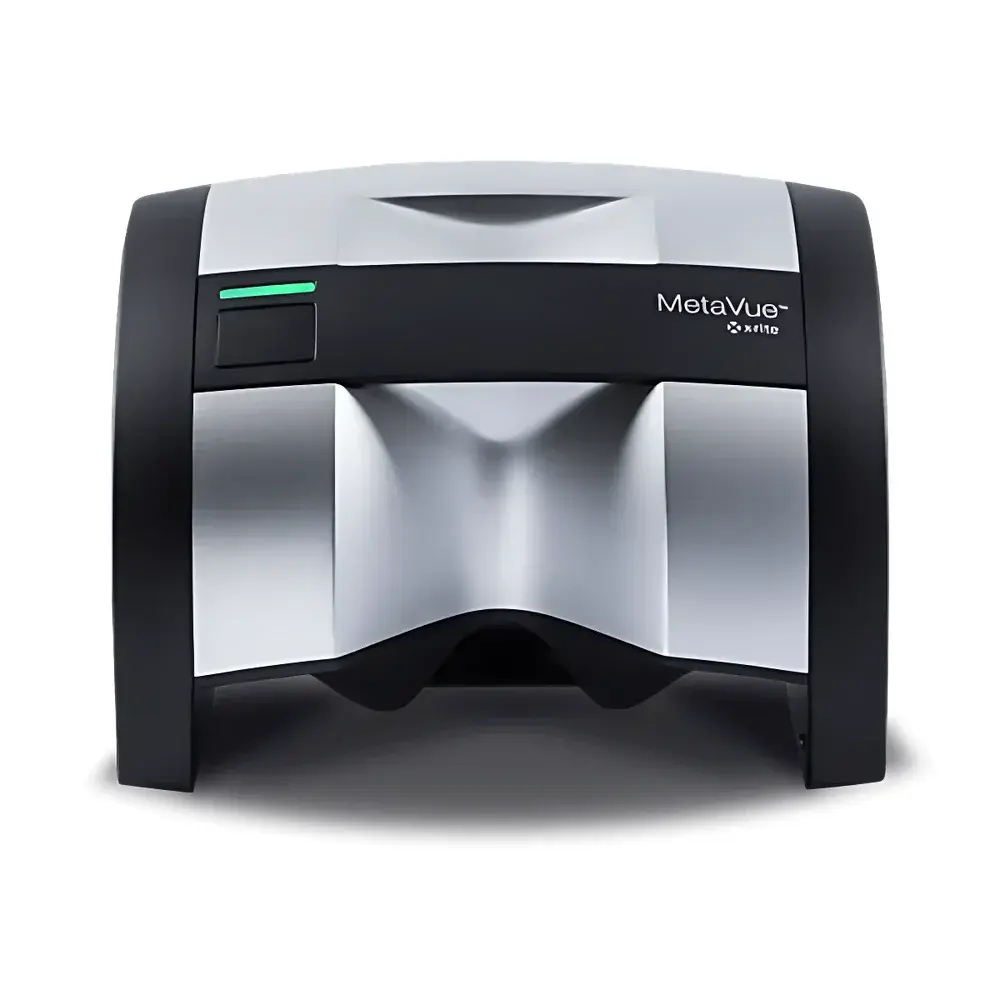
X-Rite MetaVue VS3200 Non-Contact Imaging Spectrophotometer
| Brand | X-Rite |
|---|---|
| Origin | USA |
| Model | MetaVue VS3200 |
| Measurement Geometry | 45/0 |
| Spectral Range | 400–700 nm @ 10 nm resolution |
| Inter-instrument Agreement | Avg. ΔE*ab ≤ 0.15 |
| Repeatability (White Tile) | ≤ 0.025 ΔE*ab |
| Aperture Sizes | 2 mm, 4 mm, 6 mm, 8 mm, 10 mm, 12 mm |
| Sample Position Sensing | Yes |
| Lamp Lifetime | ≥ 350,000 measurements |
| Measurement Cycle Time | < 10 s |
| Compliance Standards | ASTM D2244, ASTM E179, ASTM E308, ASTM E1164, CIE 15, DIN 5033-7, DIN 5036, DIN 6174, ISO 7724-1/2/3, JIS Z 8722 |
| Backward Compatibility | X-Rite VS450 and 964 data formats |
Overview
The X-Rite MetaVue VS3200 is a high-precision non-contact imaging spectrophotometer engineered for quantitative color measurement across heterogeneous, irregular, or delicate surfaces. Operating on the 45/0 optical geometry—where illumination is delivered at 45° relative to the sample normal and detection occurs at 0°—the instrument eliminates specular reflection interference while ensuring compliance with major international colorimetric standards including ISO 7724, CIE 15, and ASTM E308. Its solid-state spectral sensor captures full reflectance spectra from 400 nm to 700 nm at 10 nm intervals, enabling CIELAB, CIELCH, and spectral difference calculations with traceable metrological integrity. Unlike traditional point-measurement devices, the MetaVue VS3200 acquires spatially resolved spectral data across a defined field of view, delivering up to six independent color measurements per single capture—ideal for evaluating multi-color labels, textured substrates, printed packaging, or gradient-coated components without physical contact or sample preparation.
Key Features
- Non-contact measurement architecture eliminates risk of surface damage, contamination, or compression artifacts—critical for soft gels, powders, pastes, and liquid films.
- Motorized, software-selectable aperture sizes (2 mm to 12 mm) enable optimized spatial resolution and signal-to-noise ratio across diverse sample scales—from micro-printed electronics to large-area automotive trim.
- Integrated position-sensing stage and real-time digital preview allow precise region-of-interest (ROI) selection with sub-millimeter targeting accuracy, reducing operator dependency and measurement variability.
- On-device image capture and spectral tagging provide auditable measurement records: each spectrum is time-stamped, georeferenced within the captured image, and stored with full metadata (aperture, geometry, illuminant, observer).
- Robust thermal and photometric stability ensures repeatability ≤ 0.025 ΔE*ab on standard white tiles over extended operational cycles, validated per ASTM E1164 protocols.
- Inter-instrument agreement of ≤ 0.15 ΔE*ab (avg.) supports cross-site color consistency in global supply chains, satisfying internal QA requirements and external audit criteria under ISO 9001 and IATF 16949.
Sample Compatibility & Compliance
The MetaVue VS3200 accommodates challenging sample classes—including translucent films, granular powders, viscous gels, volatile liquids, and thermally sensitive polymers—without requiring masking, fixturing, or surface flattening. Its 45/0 geometry inherently suppresses directional gloss effects common in metallic or pearlescent finishes, while the non-contact design avoids pressure-induced spectral shifts observed in contact-based systems. The instrument conforms to ASTM D2244 for color difference evaluation, ASTM E179 for spectral data interpolation, and ISO 7724-2 for reflectance measurement methodology. All spectral outputs are referenced to CIE 1931 2° standard observer and CIE Illuminant D65 unless otherwise specified—ensuring interoperability with legacy X-Rite platforms such as the VS450 and 964 series via native file format compatibility.
Software & Data Management
The MetaVue VS3200 operates natively with X-Rite’s Color iQC and Color iMatch software suites, supporting GLP-compliant workflows through electronic signatures, user-level access controls, and full audit trail logging per FDA 21 CFR Part 11 requirements. Captured images and spectral datasets are stored in vendor-neutral .ciq and .spc formats, enabling integration into LIMS, MES, or PLM environments without proprietary middleware. Measurement history—including ROI coordinates, aperture configuration, environmental metadata (ambient light compensation status), and operator ID—is embedded directly into each dataset. Batch export functions support automated reporting to Excel, PDF, or CSV, with configurable pass/fail thresholds aligned to internal tolerancing specifications or industry benchmarks such as GMW14872 or Ford CETP.
Applications
- Quality assurance of multi-color flexible packaging where registration, ink laydown, and substrate interaction must be quantified simultaneously.
- Color release testing for pharmaceutical tablets and capsules, where non-destructive assessment of coating uniformity and batch-to-batch consistency is mandated under USP & ICH Q5C guidelines.
- R&D validation of automotive interior trims, especially soft-touch surfaces and brushed metal finishes, where angular dependence and texture-induced metamerism require spatial spectral characterization.
- Textile dye lot verification across woven, knitted, and nonwoven substrates with variable pile height or nap direction.
- Electronics manufacturing—measuring color consistency of OLED displays, PCB silkscreens, and conformal coatings without electrostatic or thermal perturbation.
FAQ
Does the MetaVue VS3200 require calibration with physical standards before each use?
No—built-in reference tile verification and automatic dark-current compensation occur during warm-up and idle states. Daily verification against a supplied ceramic tile is recommended per ISO 7724-3, but full recalibration is only required annually or after impact events.
Can the system measure transparent or backlit samples?
The VS3200 is configured for reflectance mode only; transmittance or diaphragm-based backlight measurement requires optional accessories not included in the base configuration.
Is spectral data export compatible with third-party analysis tools like MATLAB or Python?
Yes—ASCII-exported .spc files contain wavelength-intensity pairs in plain-text format, fully parseable using standard numerical libraries without proprietary codecs.
How does the instrument handle ambient lighting interference?
Dual-band ambient light rejection algorithms operate in real time, suppressing fluctuations from fluorescent, LED, or daylight sources—validated per CIE Technical Report 214-2014.
What is the maximum working distance between the lens and sample?
Standard configuration supports 150 mm ± 5 mm; extended-focus optics (optional) extend this to 300 mm while maintaining aperture fidelity and spectral accuracy.





