
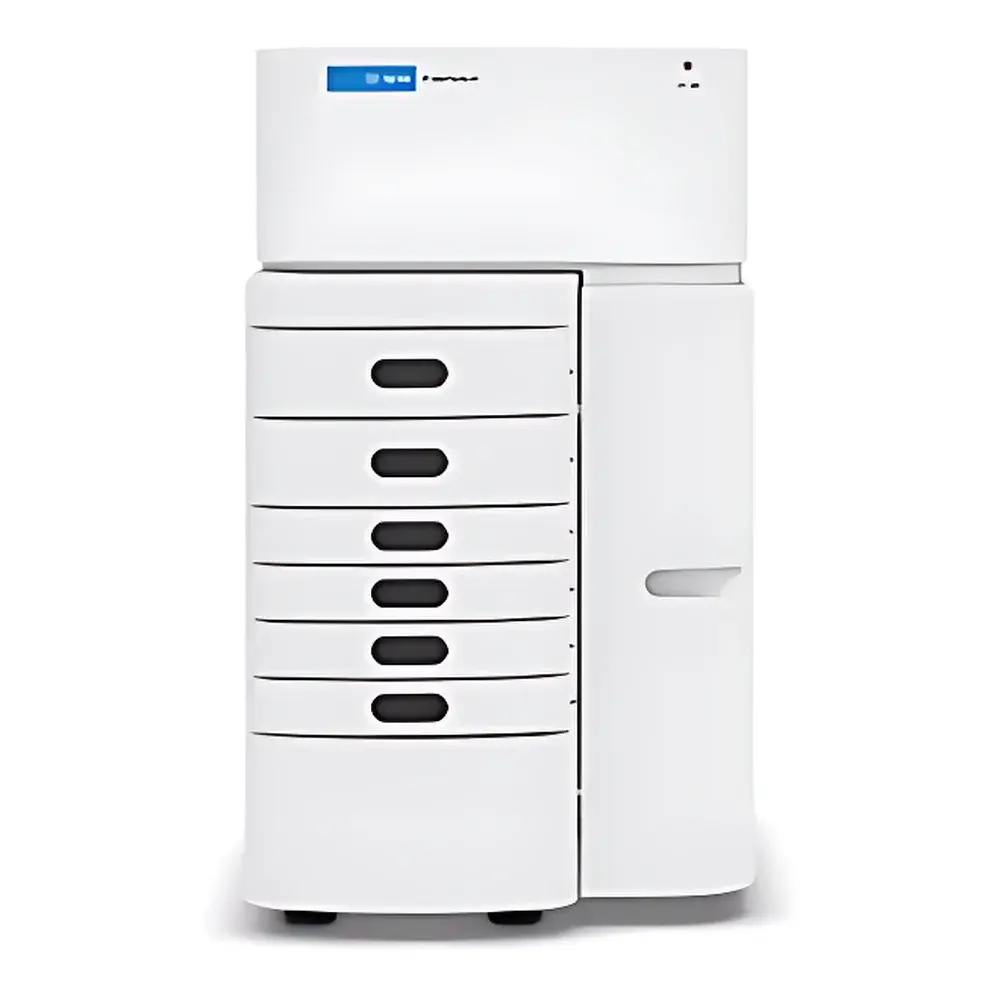
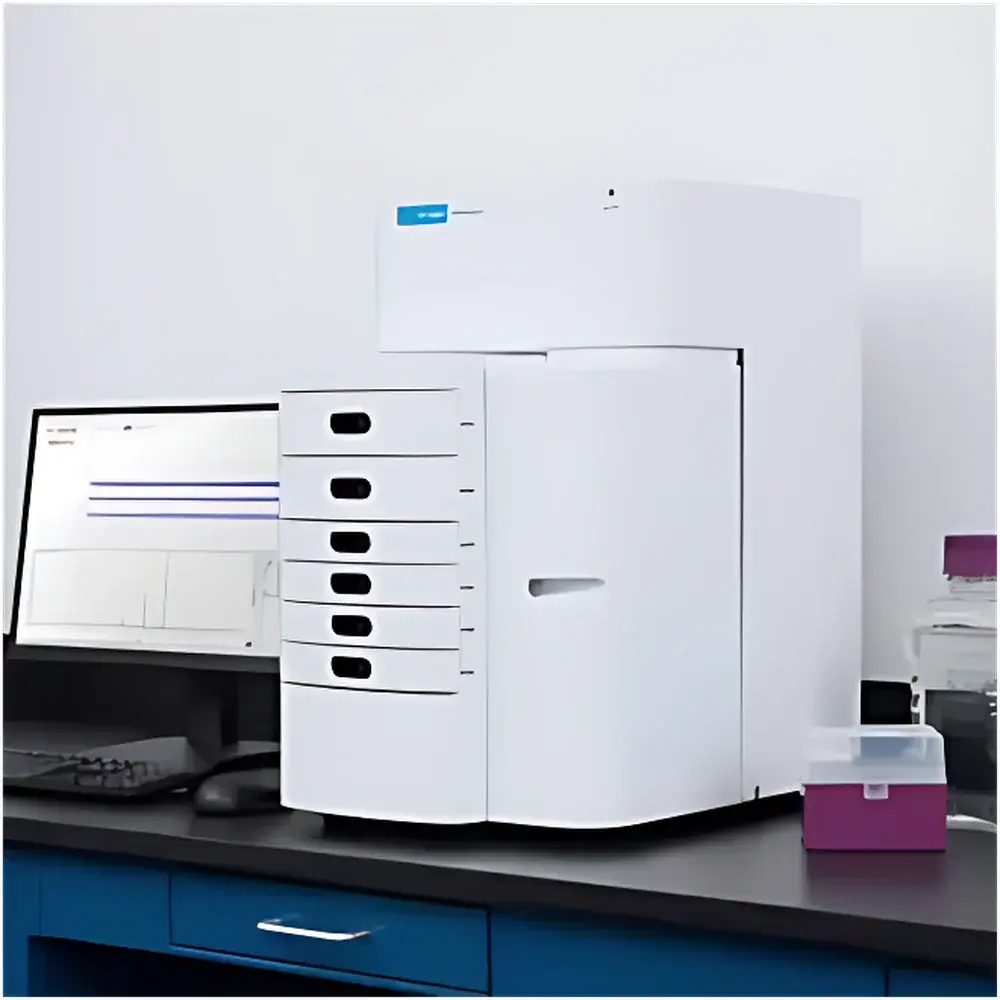
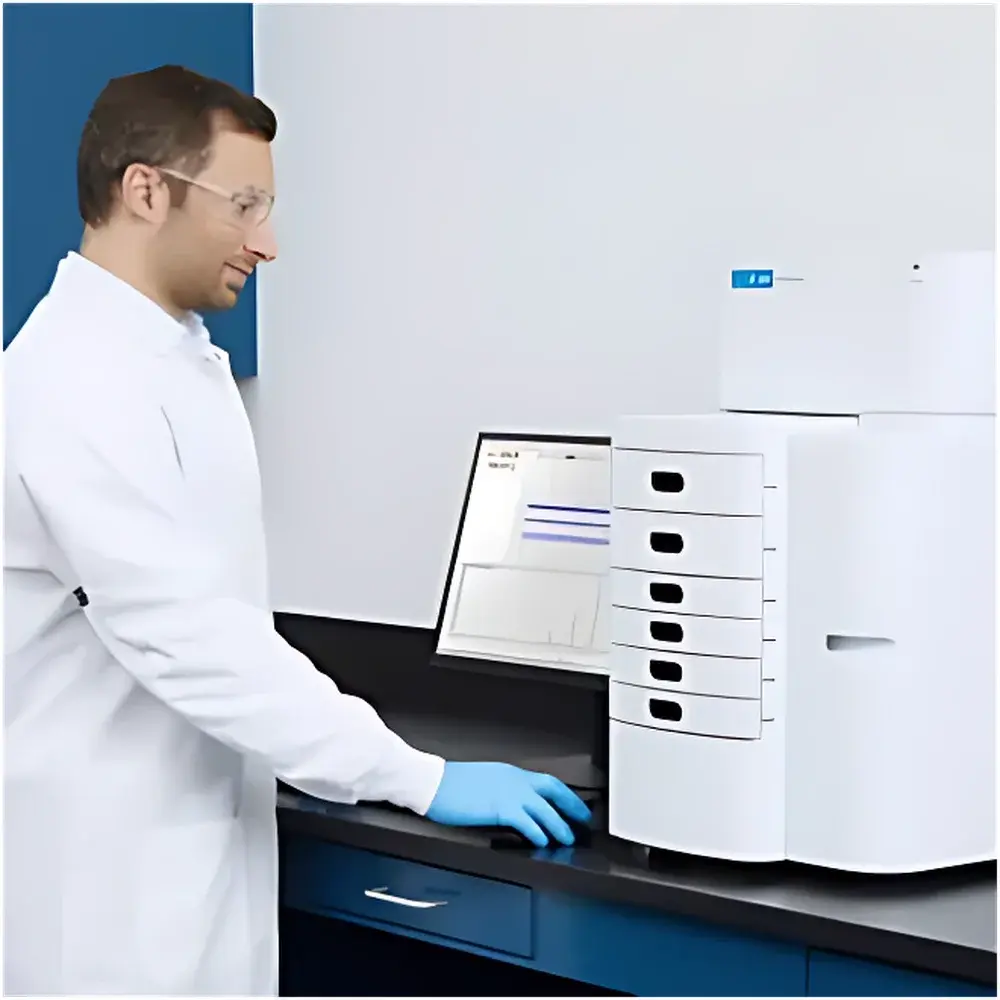
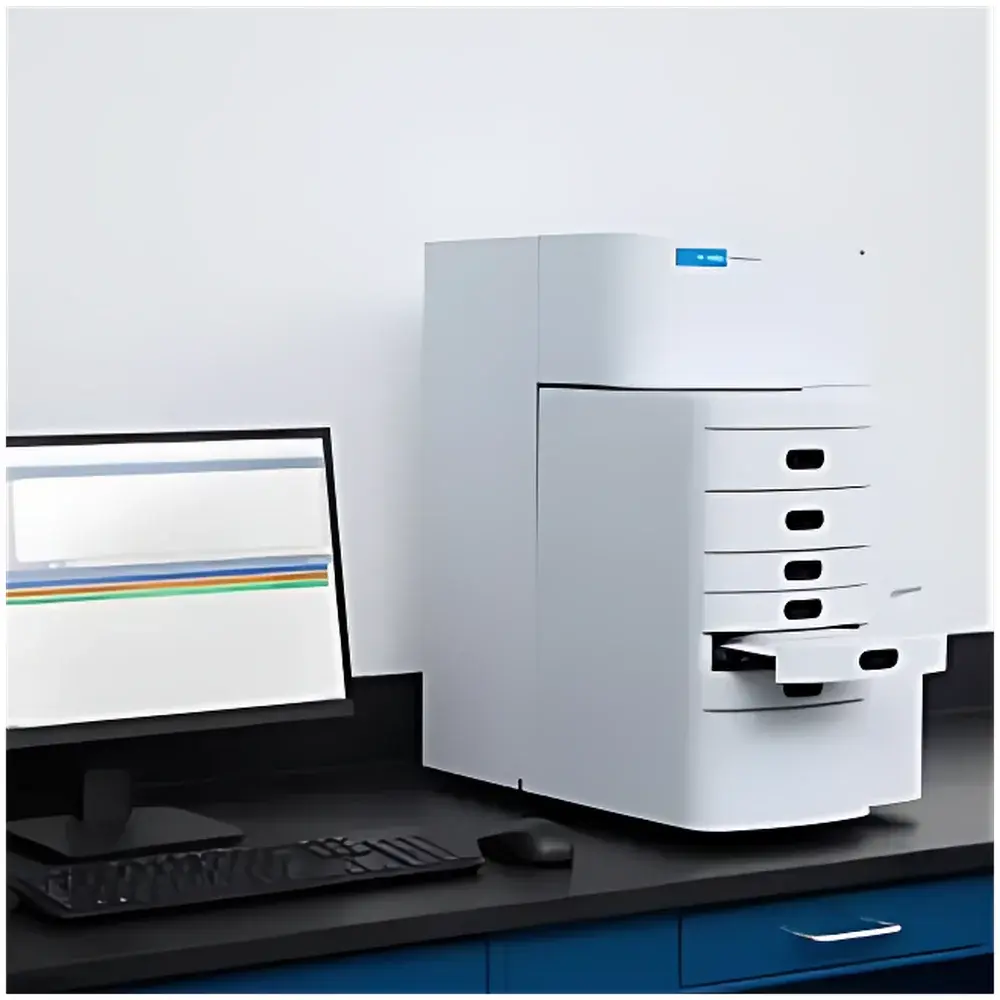
Agilent ProteoAnalyzer Capillary Electrophoresis System for Protein Analysis
| Brand | Agilent Technologies |
|---|---|
| Origin | Malaysia |
| Manufacturer Type | Original Equipment Manufacturer (OEM) |
| Origin Category | Imported |
| Model | ProteoAnalyzer System |
| Instrument Type | Capillary Electrophoresis (CE-SDS) Analyzer for Proteins |
| Sample Capacity | 12 samples per run |
| Voltage/Current Input | 100–240 VAC, 47–63 Hz |
| Dimensions (W × D × H) | 35 cm × 51 cm × 61 cm |
| Weight | 38.5 kg |
| Power Consumption | 150 VA |
| Operating Relative Humidity | 20–80 % RH |
| Temperature Range | Ambient (15–30 °C) |
| Detection Sensitivity | ≥1 ng/µL BSA in PBS |
| Linear Dynamic Range | 2–2000 ng/µL BSA in PBS |
| Separation Range | 10–240 kDa |
| Capillary Format | Parallel capillary array with on-capillary fluorescence detection |
| Separation Chemistry | Capillary Gel Electrophoresis (CGE) with SDS denaturation and covalent fluorescent labeling |
Overview
The Agilent ProteoAnalyzer Capillary Electrophoresis System is a fully automated, parallel-capillary platform engineered for high-throughput, quantitative protein characterization using Capillary Electrophoresis–Sodium Dodecyl Sulfate (CE-SDS) methodology. Unlike traditional slab-gel SDS-PAGE, the ProteoAnalyzer employs fused-silica capillaries filled with polymer-based sieving matrix to achieve rapid, reproducible electrophoretic separation under controlled electric fields. Proteins are first denatured and reduced (or non-reduced), then covalently labeled with a fluorescent dye—enabling real-time, on-capillary laser-induced fluorescence (LIF) detection. Migration time relative to a calibrated molecular weight ladder allows precise determination of apparent molecular weight, while peak area quantitation delivers accurate, linear concentration measurements across three orders of magnitude. Designed for routine quality control (QC) in biopharmaceutical development and manufacturing, the system supports regulatory-compliant workflows for monoclonal antibodies (mAbs), biosimilars, purified protein fractions, and complex lysates—including membrane-associated proteins.
Key Features
- Parallel 12-capillary architecture enables simultaneous analysis of up to 12 samples per run—achieving full CE-SDS separation in ≤30 minutes.
- No gel casting, staining, destaining, or imaging required—eliminating manual variability and reducing hands-on time by >70% versus conventional SDS-PAGE.
- Integrated thermal management maintains capillary temperature stability during electrophoresis, ensuring migration time reproducibility (RSD <1.5% for MW standards).
- Room-temperature-stable reagents—including Agilent’s proprietary P240 Wide-Range Protein Kit—minimize cold-chain dependency and simplify lab logistics.
- Flexible queue-based sample scheduling: users may reorder, insert, or pause runs without interrupting active separations.
- On-instrument capillary regeneration protocol restores baseline performance between runs—supporting heterogeneous sample types (e.g., mAb intermediates followed by crude E. coli lysates) without cross-contamination risk.
- High-resolution separation of glycosylated and non-glycosylated isoforms, charge variants, and degradation products within a single electropherogram.
Sample Compatibility & Compliance
The ProteoAnalyzer accommodates diverse biological matrices without pre-purification: purified IgGs, affinity-eluted fractions, clarified cell culture harvests, and even detergent-solubilized membrane protein extracts. Its robust separation chemistry tolerates moderate levels of salts, residual detergents (e.g., Triton X-100, CHAPS), and reducing agents. The system meets essential requirements for GxP environments: audit trail functionality, electronic signature support, and secure user access control align with FDA 21 CFR Part 11 and EU Annex 11 expectations. Method validation documentation—including specificity, linearity, accuracy, precision, LOD/LOQ, and robustness data—is available per ICH Q5E and USP guidelines. All CE-SDS methods generated on the ProteoAnalyzer are compatible with regulatory submissions to FDA, EMA, and PMDA for biologics comparability and stability studies.
Software & Data Management
Controlled via Agilent OpenLab CDS software (version 2.5 or later), the ProteoAnalyzer provides a validated, 21 CFR Part 11–compliant environment for method development, execution, and reporting. The software includes built-in tools for automatic peak detection, mobility-based MW calibration, relative quantitation (% main peak, % fragments, % aggregates), and batch comparison analytics. Raw electropherograms are stored in vendor-neutral .cdf format; processed results export to CSV, PDF, or XML for integration into LIMS or ELN systems. Audit trails record all user actions—including parameter changes, reprocessing events, and report generation—with immutable timestamps and operator identification. Optional IQ/OQ/PQ documentation packages support installation and operational qualification in regulated laboratories.
Applications
- Release testing of therapeutic proteins per ICH Q5B and USP CE-SDS requirements.
- Comparability assessments during process changes, scale-up, or manufacturing site transfers.
- Stability-indicating assays for forced degradation studies (thermal, oxidative, acidic/basic stress).
- Characterization of post-translational modifications (e.g., deamidation, oxidation-induced mobility shifts).
- Process intermediate monitoring during purification steps (e.g., Protein A eluate purity, polishing step clearance).
- Early-stage candidate screening in synthetic biology and antibody engineering pipelines.
FAQ
What separation mechanism does the ProteoAnalyzer use?
It performs Capillary Gel Electrophoresis (CGE) under SDS-denaturing conditions, where proteins are size-separated in polymer-filled capillaries based on electrophoretic mobility in an applied electric field.
Can it analyze both reduced and non-reduced samples in the same run?
No—reduction state must be consistent per run due to differences in buffer composition and electrophoretic behavior; however, two consecutive runs (one reduced, one non-reduced) can be queued automatically.
Is method transfer from SDS-PAGE straightforward?
Yes—Agilent provides application notes and migration correlation tools to map CE-SDS peaks to corresponding SDS-PAGE bands, facilitating alignment with historical data and regulatory filings.
How is capillary lifetime managed?
Each capillary undergoes automated conditioning and regeneration after every run; typical lifetime exceeds 200 injections when operated per Agilent’s maintenance protocol.
Does the system support unattended overnight operation?
Yes—the instrument supports fully automated multi-run sequences with integrated barcode reading, sample cooling (4 °C), and status alerts via email or network notification.
Related Products





