
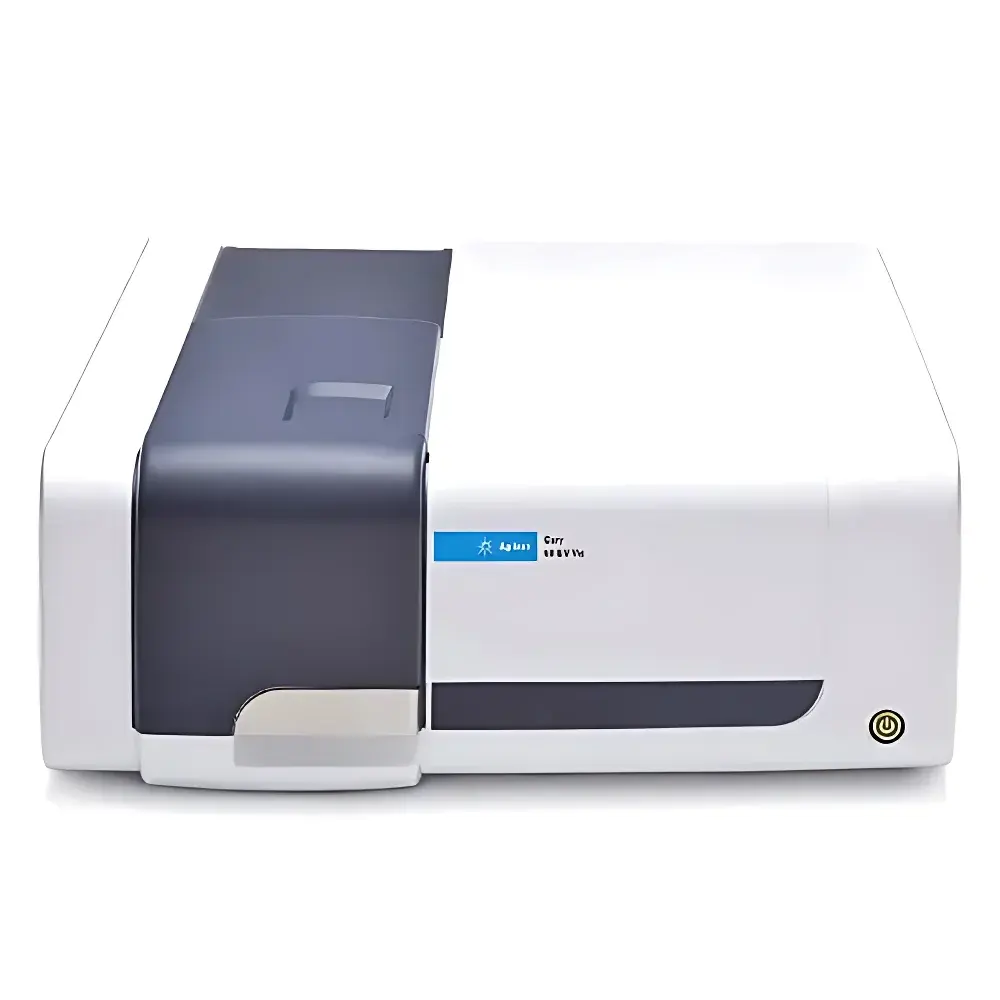
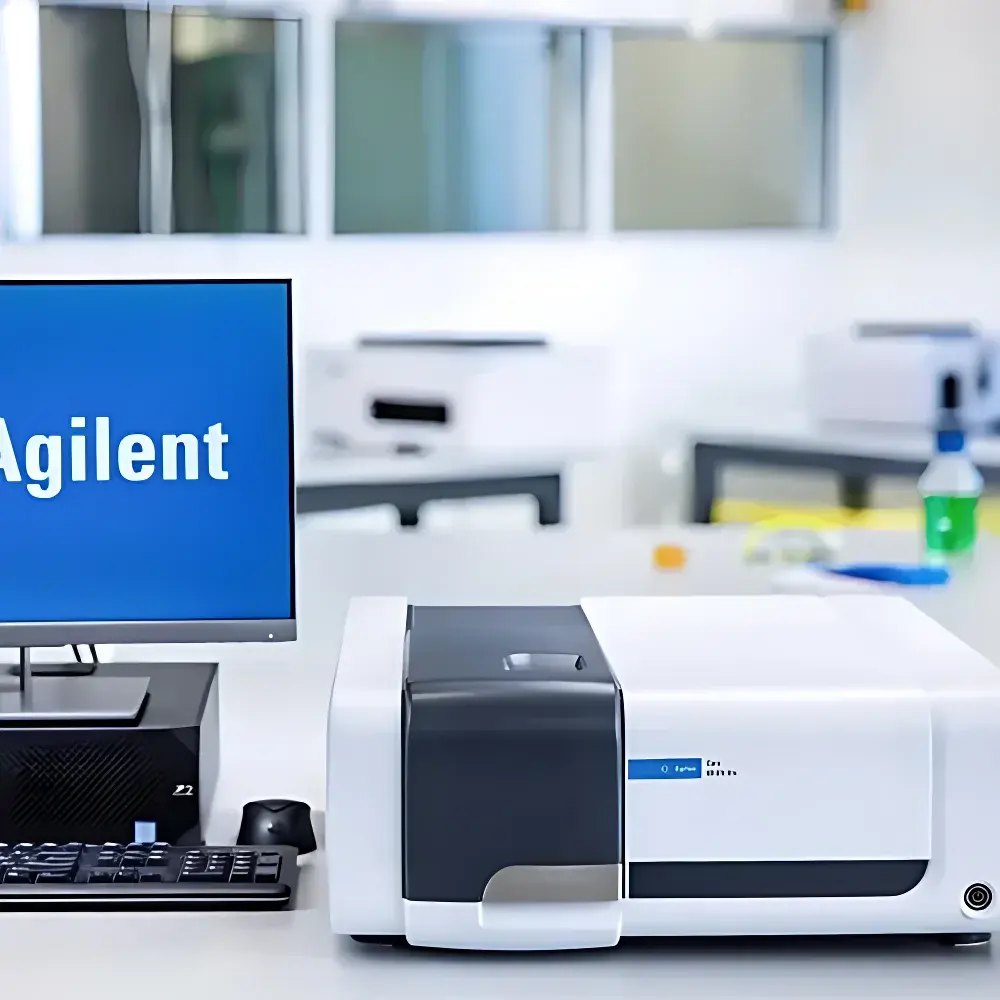
Agilent Cary 60 UV-Vis Spectrophotometer
| Brand | Agilent Technologies |
|---|---|
| Origin | Malaysia |
| Manufacturer Type | Original Equipment Manufacturer (OEM) |
| Import Status | Imported |
| Model | Cary 60 UV-Vis |
| Instrument Architecture | Double-beam |
| Detector | Photomultiplier Tube (PMT) |
| Wavelength Range | 190–1100 nm |
| Automation Level | Automatic Wavelength Scanning |
| Spectral Bandwidth | 1.5 nm (UV-Vis) |
Overview
The Agilent Cary 60 UV-Vis Spectrophotometer is a double-beam, xenon flash lamp–based absorption spectrometer engineered for precision, stability, and operational flexibility across academic, research, and regulated quality control environments. It operates on the fundamental principle of Beer–Lambert law–governed absorbance measurement, where sample transmittance or reflectance is quantified relative to a reference beam across a continuous spectral range. Unlike conventional deuterium/tungsten lamp systems requiring warm-up and periodic replacement, the Cary 60 employs a pulsed xenon lamp operating at 80 Hz—illuminating the sample only during data acquisition. This duty-cycle–controlled illumination minimizes photodegradation of light-sensitive biological and pharmaceutical samples (e.g., proteins, nucleic acids, photosensitive APIs), while eliminating thermal drift and reducing long-term maintenance overhead. With a full-spectrum scan (190–1100 nm) completed in under 3 seconds and data acquisition rates up to 80 points per second, the instrument supports both rapid kinetic profiling and high-resolution spectral characterization without compromising photometric accuracy.
Key Features
- Double-beam optical architecture with real-time reference compensation for enhanced baseline stability and reduced environmental drift.
- Pulsed xenon light source with 10-year limited warranty—eliminates lamp warm-up time, reduces energy consumption by >70% vs. continuous-lamp systems, and avoids spectral discontinuities at the D2/W junction.
- 1.5 nm spectral bandwidth optimized for resolution–sensitivity balance in compliance with ASTM E275 and ISO 9001–aligned spectral performance criteria.
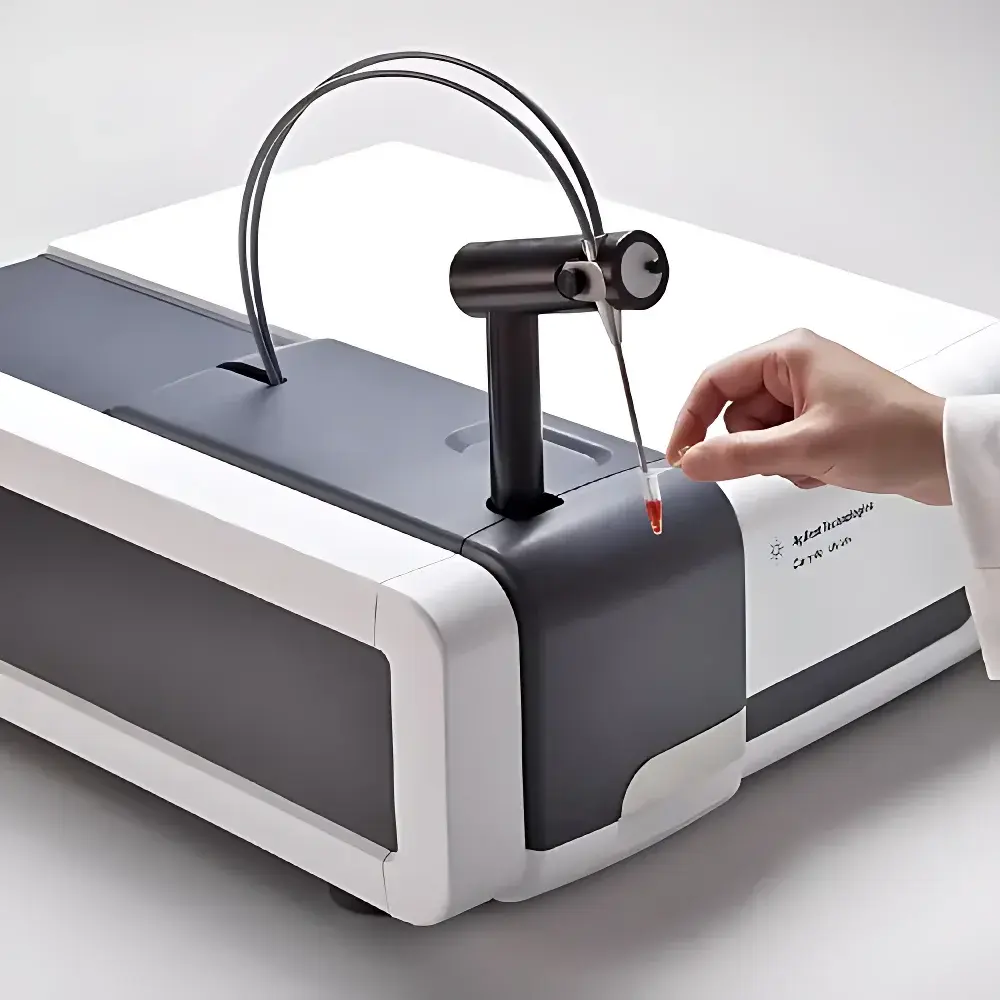
- Room-light immunity enabled by proprietary optical shielding and synchronous detection—allows uninterrupted operation with the sample compartment open and supports fiber-optic probe integration for in situ or remote measurements.
- Z-axis sample height compatibility up to 20 mm; accommodates standard 10 mm cuvettes, long-path cells (up to 100 mm), solid-sample holders (transmission/reflection), and micro-volume adapters.
- Compact footprint (477 × 567 × 196 mm) and low mass (18 kg) facilitate benchtop deployment in space-constrained labs, cleanrooms, or teaching facilities.
Sample Compatibility & Compliance
The Cary 60 supports diverse sample formats—including aqueous/organic solutions, suspensions, thin films, powders, and opaque solids—via interchangeable accessories such as an 18-position automated cell changer, integrating sphere for diffuse reflectance, and fiber-optic probes with customizable pathlengths. Its optical design meets ICH Q2(R2) guidance for spectrophotometric method validation in pharmaceutical development. Optional 21 CFR Part 11–compliant software modules provide audit-trail logging, electronic signatures, role-based access control, and secure data archiving—fully aligned with FDA-regulated QA/QC workflows and GLP/GMP documentation requirements. The instrument has undergone independent life-cycle assessment and holds the My Green Lab ACT (Accountability, Consistency, Transparency) certification—verifying reduced carbon footprint, recyclable component content (>82%), and energy-efficient standby mode (<0.5 W).
Software & Data Management
Cary WinUV software serves as the unified platform for instrument control, method development, spectral processing, and regulatory reporting. It supports customizable workflows—from single-point absorbance checks to multi-wavelength kinetics, derivative spectroscopy, and quantitative batch analysis with calibration curve management. Data export complies with ASTM E1381 and ASTM E1482 standards for interoperability with LIMS and ELN systems. Version-controlled method templates, password-protected parameter locking, and automated report generation (PDF/CSV/XLSX) streamline SOP adherence. For regulated environments, optional Pharma Edition includes full 21 CFR Part 11 functionality—including immutable audit trails, user activity logs, and electronic signature validation—all validated per IQ/OQ protocols.
Applications
The Cary 60 delivers robust performance across multiple domains: routine QC testing of raw materials and finished products (e.g., concentration assays, purity verification per USP ); enzymatic kinetics and protein folding studies requiring photostable illumination; nanoparticle size estimation via plasmon resonance band analysis; colorimetric assay validation (e.g., Bradford, BCA); thin-film thickness determination using interference fringe modeling; and educational demonstrations of spectral theory, Beer’s law, and instrumental error sources. Its fiber-optic capability enables process monitoring in bioreactors, inline fermentation tanks, or solvent recovery lines—extending UV-Vis analytics beyond the traditional lab bench.
FAQ
Does the Cary 60 require lamp warm-up time before measurement?
No—the pulsed xenon lamp operates instantaneously upon command, enabling immediate data acquisition without stabilization delay.
Can the Cary 60 be used for solid sample analysis?
Yes—optional integrating sphere and specular reflectance accessories support quantitative reflectance, transmittance, and haze measurements for polymers, coatings, and pharmaceutical tablets.
Is the instrument compatible with third-party fiber-optic probes?
Yes—standard SMA 905 connectors support industry-standard UV-Vis fiber optics (200–1100 nm transmission), including immersion, flow-cell, and contact-probe configurations.
What regulatory standards does the Cary WinUV Pharma Edition support?
It fully implements 21 CFR Part 11 requirements, including electronic records integrity, user authentication, audit trail retention (≥30 days), and change control for method parameters.
How is photometric accuracy verified during routine use?
Built-in NIST-traceable holmium oxide and neutral density filters enable automated wavelength and photometric calibration—documented within each session’s audit trail.
Related Products





