
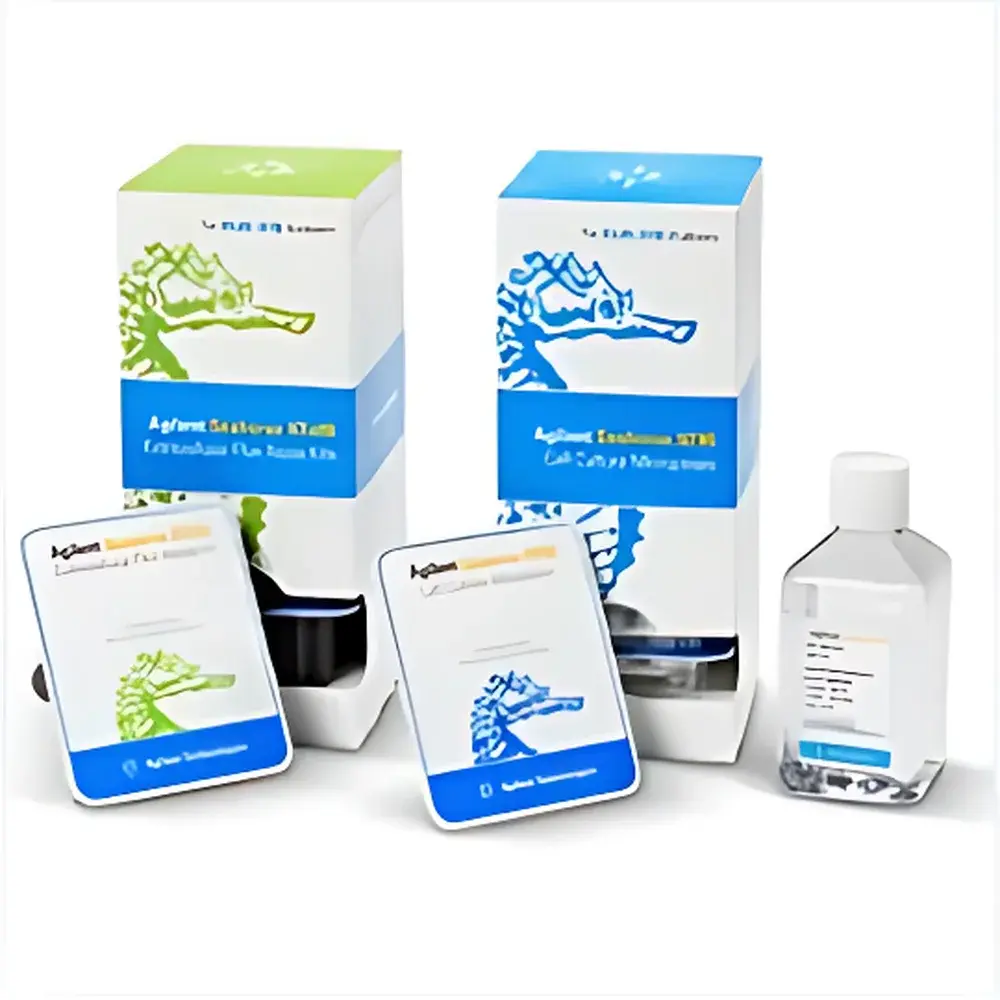
Agilent Seahorse XFe24 Analyzer Consumables
| Brand | Agilent Technologies |
|---|---|
| Origin | USA |
| Manufacturer Type | Original Equipment Manufacturer (OEM) |
| Product Category | Imported Life Science Consumables |
| Model | XFe24 Consumables |
| Pricing | Available Upon Request |
Overview
The Agilent Seahorse XFe24 Analyzer Consumables are a fully integrated, purpose-engineered suite of disposable components designed exclusively for use with the Agilent Seahorse XFe24 Extracellular Flux Analyzer. These consumables operate within the proprietary extracellular flux (XF) platform, which employs solid-state sensor technology to measure real-time oxygen consumption rate (OCR) and extracellular acidification rate (ECAR) from living cells in microplate format. The system quantifies mitochondrial respiration and glycolytic function through sequential injection of metabolic modulators—enabling label-free, non-invasive, kinetic assessment of cellular bioenergetics without genetic modification or fluorescent dyes. Each component is manufactured under strict quality control protocols in Agilent’s U.S.-based facilities to ensure batch-to-batch consistency, low background noise, and high signal-to-noise ratios critical for reproducible metabolic phenotyping.
Key Features
- Proprietary XF Sensor Cartridges (Probe Cards): Pre-calibrated, single-use sensor arrays embedded with fluorescent biosensors for O2 and pH; optimized for 24-well XFe24 assay geometry and thermal stability during incubation and measurement cycles.
- XFe24 Microplates: Sterile, tissue-culture-treated, black-walled, clear-bottom 24-well plates with precisely engineered well geometry to maximize sensor proximity and minimize diffusion delay between cells and sensors.
- FluxPak Kits: Integrated consumable bundles containing sensor cartridges, microplates, assay media (unbuffered XF Base Medium), and pre-formulated reagent sets (e.g., XF Cell Mito Stress Test Kit, XF Glycolysis Stress Test Kit) — all lot-qualified and QC-verified for compatibility and performance.
- XF Assay Media: Chemically defined, bicarbonate-free, low-buffering-capacity basal medium formulated to support physiological pH shifts during ECAR measurement; requires only addition of glucose, glutamine, and pyruvate (or other supplements per experimental design) and final pH adjustment to 7.4 prior to assay.
- Calibration Solutions: Dedicated, temperature-stabilized calibration fluids for on-instrument sensor validation before each run — ensuring traceable accuracy across OCR and ECAR measurements per ISO/IEC 17025-aligned internal calibration standards.
Sample Compatibility & Compliance
The XFe24 consumables support a broad range of adherent and suspension cell types—including primary human T cells, iPSC-derived cardiomyocytes, cancer spheroids, isolated mitochondria, and pancreatic islets—without requiring transfection or labeling. Plates accommodate up to 2 × 10⁵ adherent cells/well or 5 × 10⁵ suspension cells/well while maintaining laminar flow dynamics essential for reliable flux kinetics. All consumables comply with ISO 13485:2016 (medical device quality management), EU Directive 2014/30/EU (EMC), and are certified free of endotoxin (<0.1 EU/mL), mycoplasma, and human DNA contamination. Lot-specific Certificates of Analysis (CoA) and Certificates of Conformance (CoC) accompany every shipment, supporting GLP-compliant study documentation and FDA 21 CFR Part 11–aligned electronic record retention when used with Agilent Wave software.
Software & Data Management
Consumables are natively recognized by Agilent Wave Desktop Software (v2.6+), which auto-detects cartridge lot numbers and links them to instrument calibration logs and assay metadata. The software enforces consumable lifecycle tracking—flagging expired or mismatched components—and embeds audit trails for all plate mapping, reagent assignment, and injection sequence definitions. Raw sensor data (fluorescence intensity vs. time) is stored in vendor-neutral HDF5 format, enabling export to Python (via h5py), MATLAB, or R for advanced modeling (e.g., mitochondrial coupling efficiency, proton leak fraction). Integration with Agilent’s BioAnalyzer Cloud enables secure, role-based sharing of normalized flux data across multi-site research teams while preserving raw file integrity and version-controlled analysis pipelines.
Applications
These consumables enable standardized interrogation of core metabolic pathways in drug discovery, toxicology, immunometabolism, and stem cell differentiation studies. Typical validated applications include: mitochondrial stress testing (oligomycin/FCCP/rotenone-antimycin A), glycolytic rate assays (glucose/oligomycin/2-DG), fatty acid oxidation (palmitate-BSA + etomoxir), and real-time immune cell activation profiling (e.g., LPS-stimulated macrophages). The system supports kinetic profiling over 90+ minutes with sub-minute temporal resolution, facilitating detection of transient metabolic adaptations inaccessible to endpoint assays. Published protocols align with ASTM E3121-18 (Standard Guide for Metabolic Phenotyping of Cells Using Extracellular Flux Analysis) and NIH Common Fund-supported Mitochondrial Physiology Consortium (MitoPrc) benchmarking standards.
FAQ
Are XFe24 consumables compatible with other Seahorse platforms (e.g., XFe96 or XFp)?
No — XFe24 sensor cartridges, microplates, and FluxPaks are mechanically and optically optimized for the XFe24 analyzer’s unique probe arm geometry and optical path length; cross-platform use is not supported and may compromise data integrity.
Can I reuse XFe24 sensor cartridges?
No — sensor cartridges are single-use only. Reuse results in irreversible fluorescence quenching, drift, and failure to meet Agilent’s specified OCR/ECAR sensitivity thresholds (≤0.5 pmol/min OCR detection limit).
Do I need to purchase media separately from FluxPaks?
No — all FluxPak configurations include XF Base Medium, calibration solutions, and assay-specific reagents. Optional supplemental kits (e.g., XF Palmitate-BSA FAO Substrate) are available as standalone items.
How are lot-to-lot variations controlled?
Each consumable lot undergoes functional testing using reference cell lines (e.g., HEK293T, C2C12) against Agilent’s master assay protocol; acceptance criteria include ≤15% CV in basal OCR and ≤10% CV in maximal respiration across ≥3 independent runs.
Is technical support available for assay optimization?
Yes — Agilent provides application-specific protocol guides, online training modules, and direct access to Field Application Scientists (FAS) for experimental design review and troubleshooting — included with instrument service contracts and consumable volume agreements.




