
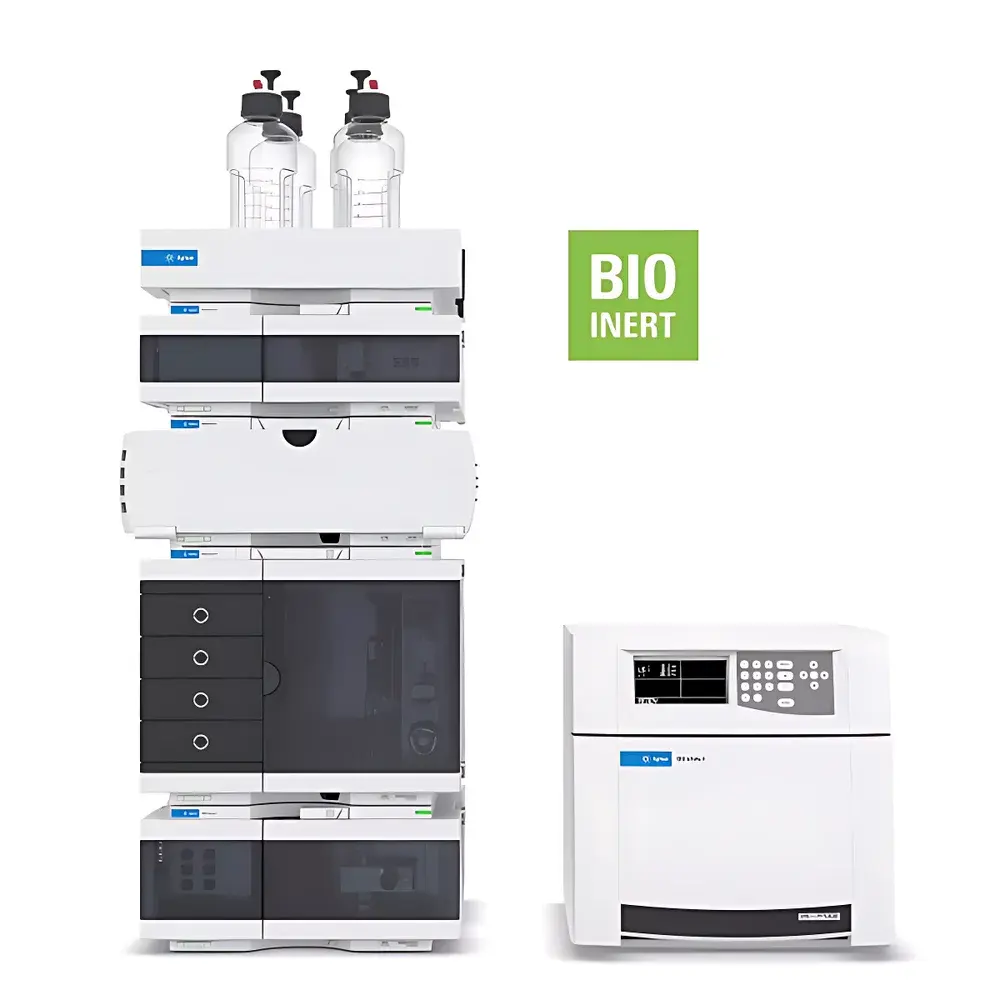
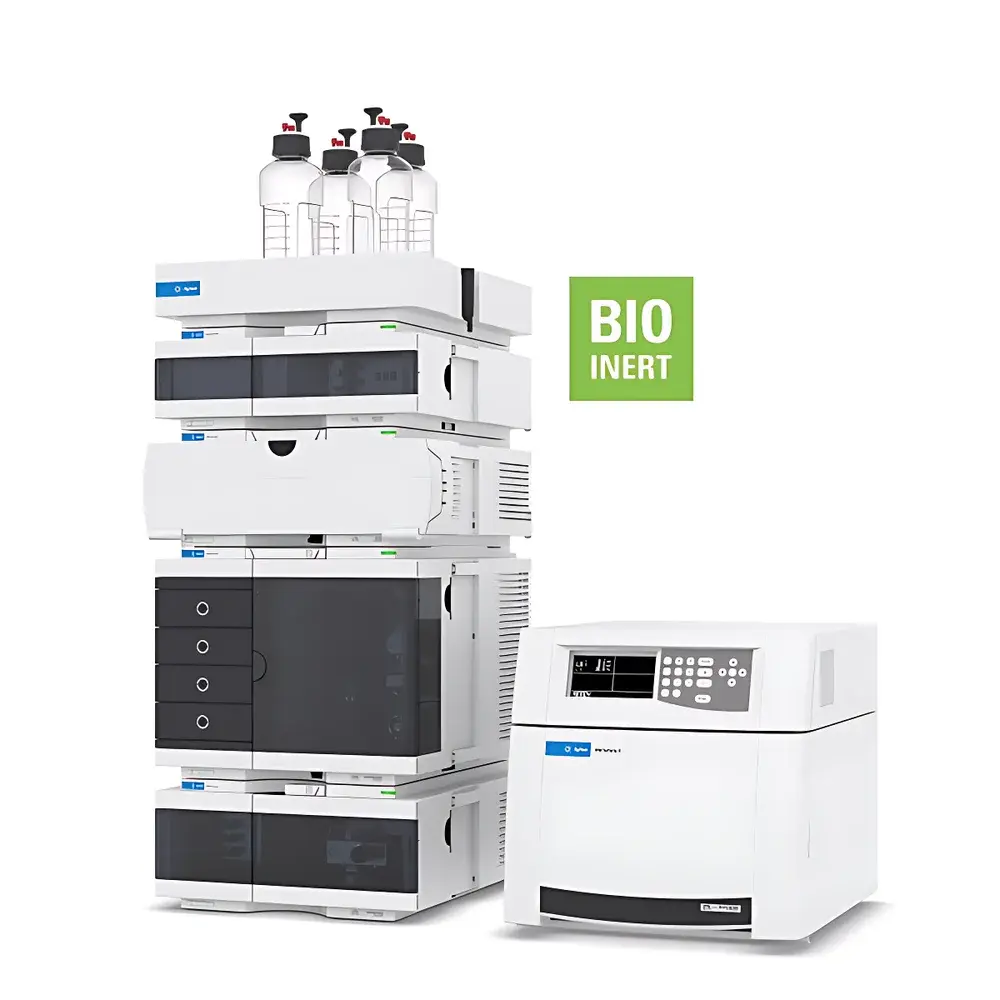
Agilent 1260 Infinity II Bio-SEC Multi-Detector System
| Brand | Agilent Technologies |
|---|---|
| Origin | Germany |
| Manufacturer Type | Original Equipment Manufacturer (OEM) |
| Origin Category | Imported |
| Model | 1260 Infinity II Bio-SEC |
| Instrument Type | Ultra-High Performance Liquid Chromatograph (UHPLC) |
| Application Scope | General-Purpose Biopharmaceutical Characterization |
| Flow Rate Range | Up to 10 mL/min (with G5654A Pump Module) |
| Injection Volume Range | 0.1–100 µL |
Overview
The Agilent 1260 Infinity II Bio-SEC Multi-Detector System is a fully bio-inert, metal-free liquid chromatography platform engineered for absolute, calibration-free macromolecular characterization of therapeutic proteins, monoclonal antibodies (mAbs), antibody-drug conjugates (ADCs), and other biologics. Built upon the industry-standard 1260 Infinity II Bio-Inert LC architecture, this system integrates orthogonal detection modalities—multi-angle light scattering (MALS), dynamic light scattering (DLS), and differential refractometry (dRI)—into a single, low-dead-volume flow path. Unlike conventional size-exclusion chromatography (SEC) that relies on retention time calibration with narrow-distribution polymer standards, the Bio-SEC system delivers true absolute molecular weight (MW), root-mean-square radius (Rg), and hydrodynamic radius (Rh) directly from first principles via Rayleigh-Gans-Debye light scattering theory. This eliminates column aging artifacts, inter-laboratory variability, and systematic bias introduced by conformation-dependent elution behavior—critical for regulatory submissions under ICH Q5E, USP , and FDA guidance on analytical similarity assessment.
Key Features
- Fully bio-inert fluidic path constructed from titanium, PEEK, and sapphire—zero metal contact ensures minimal adsorption, leaching, or catalytic degradation of sensitive biopharmaceuticals.
- Integrated MALS detector with low-dead-volume (<1.5 µL) flow cell enabling high-resolution, peak-preserving detection across the full SEC elution profile.
- Simultaneous DLS capability within the same flow cell permits real-time measurement of Rh at each chromatographic slice—enabling direct correlation between conformational state and elution volume.
- Optimized for compatibility with Agilent’s 1260 Infinity II Bio-Inert Quaternary Pump (G5654A), autosampler (G7167B), and thermostatted column compartment (G7116B), all certified for GLP/GMP environments.
- Pre-aligned optical train and factory-calibrated photodiode array ensure long-term signal stability and inter-system reproducibility without routine user recalibration.
Sample Compatibility & Compliance
The system is validated for use with native-state protein samples ranging from 5 kDa to >10 MDa, including intrinsically disordered proteins, glycoproteins, and virus-like particles (VLPs). It supports standard SEC columns (e.g., Agilent AdvanceBio SEC columns, TSKgel SW series) and operates under isocratic or shallow-gradient conditions compatible with aqueous mobile phases (e.g., PBS, sodium acetate buffers). All hardware and firmware comply with ISO 9001:2015 manufacturing standards and meet essential requirements of the EU IVDR Annex I (for research-use-only instrumentation). Data acquisition and processing workflows are designed to support 21 CFR Part 11-compliant audit trails when deployed with Agilent OpenLab CDS 2.x or MassHunter software in regulated environments.
Software & Data Management
Data acquisition and multi-detector deconvolution are performed using Agilent’s proprietary Bio-SEC Analysis Module, embedded in OpenLab CDS. The module implements Zimm and Debye fitting algorithms for static light scattering data, cumulant analysis for DLS-derived Rh, and universal calibration integration with dRI signals. All raw detector outputs—including angular intensity distributions, autocorrelation functions, and refractive index increments—are retained in vendor-neutral HDF5 format. Batch processing, report templating, and electronic signature workflows adhere to ALCOA+ principles (Attributable, Legible, Contemporaneous, Original, Accurate, Complete, Consistent, Enduring, Available) for audit readiness.
Applications
- Quantitative assessment of higher-order structure (HOS) changes during formulation development, stress testing, and stability studies.
- Detection and sizing of subvisible aggregates (≥10 nm) without reliance on column calibration—critical for comparability protocols per ICH Q5B.
- Discrimination of monomer, dimer, trimer, and higher-order oligomers in biosimilar characterization packages.
- Monitoring conformational heterogeneity (e.g., partially unfolded states, molten globules) through joint Rg/Rh analysis.
- Supporting quality-by-design (QbD) initiatives by linking process parameters (pH, ionic strength, temperature) to solution-phase macromolecular dimensions.
FAQ
Is this system suitable for regulatory submission data packages?
Yes—when operated under validated SOPs and paired with 21 CFR Part 11-enabled software, the system generates data compliant with ICH, USP, and FDA expectations for biophysical characterization.
Does the system require column calibration for molecular weight determination?
No—absolute molecular weight is calculated directly from light scattering intensity and concentration (via dRI), eliminating dependence on polymer standards or column-specific calibration curves.
Can the same flow cell be used for both MALS and DLS measurements?
Yes—the integrated dual-mode flow cell enables sequential or simultaneous acquisition of static and dynamic light scattering signals without hardware reconfiguration.
What is the minimum sample concentration required for reliable Rh determination?
Typical lower limits range from 0.1–0.5 mg/mL for mAbs, depending on instrument alignment, buffer clarity, and detector sensitivity settings.
Is the system compatible with non-Agilent SEC columns?
Yes—any commercially available SEC column with standard 1/16″ tubing connections and pressure ratings ≤400 bar may be integrated into the bio-inert flow path.





