
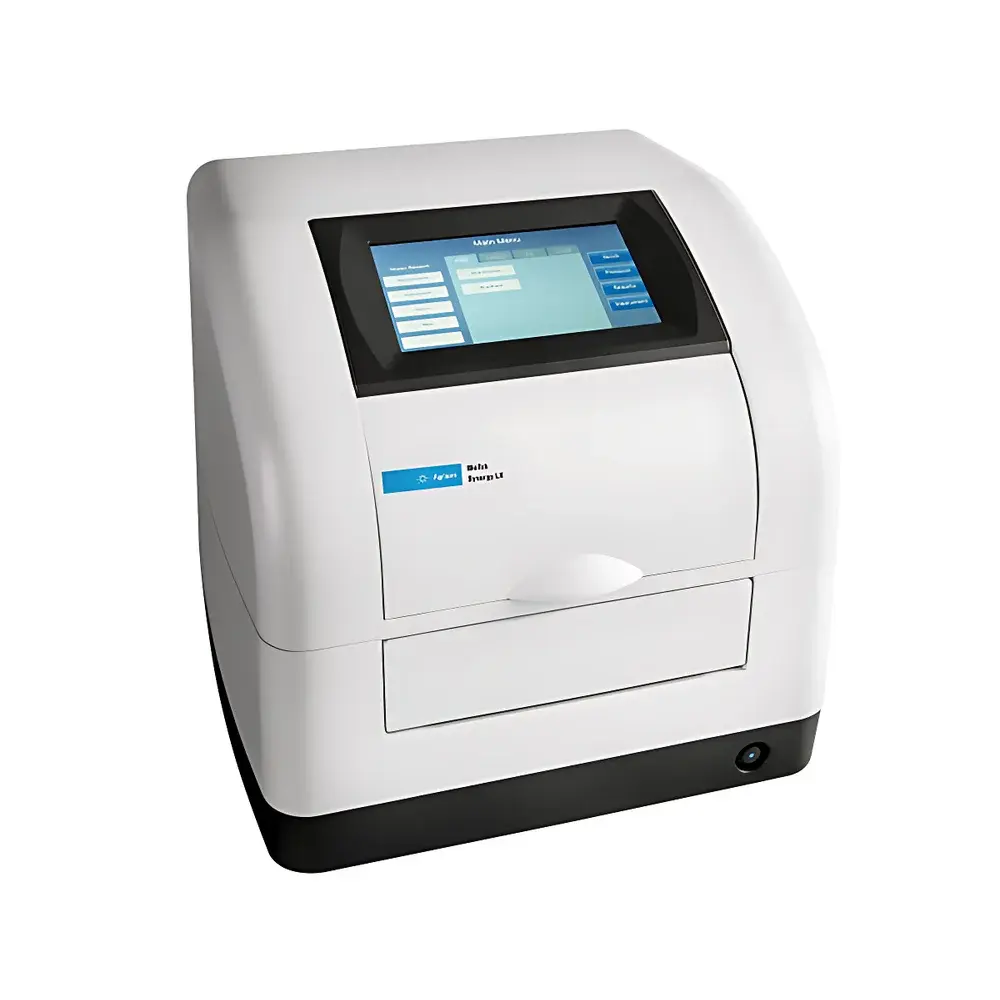
Agilent BioTek Synergy LX Multimode Microplate Reader
| Brand | Agilent Technologies |
|---|---|
| Origin | USA |
| Manufacturer Type | Original Equipment Manufacturer (OEM) |
| Origin Category | Imported |
| Model | Synergy LX |
| Function Type | Multimode |
| Automation Level | Fully Automated |
| Assay Modes | Endpoint, Kinetic, Well-Scanning |
| Curve Fitting Options | Linear, Point-to-Point, Four-Parameter Logistic (4PL) |
| Detector Types | UV-Vis Absorbance, Fluorescence Intensity, Luminescence |
| Wavelength Range | Filter-Based: 320–850 nm |
| Monochromator-Based | 200–999 nm |
| Absorbance Range | 0–4 OD |
| Absorbance Linearity | <1% deviation from ideal over 0–2.5 OD |
| Read Time (96-well plate) | 12 s |
| Absorbance Precision | ±0.0001 OD |
Overview
The Agilent BioTek Synergy LX Multimode Microplate Reader is an engineered solution for laboratories requiring reliable, high-performance detection across absorbance, fluorescence intensity, and luminescence modalities—without the complexity or cost of higher-tier platforms. Built on a robust optical architecture featuring dual-path detection optics and a precision monochromator, the Synergy LX delivers reproducible quantitative data in compliance with core life science assay requirements. Its measurement principle integrates spectrophotometric absorbance (based on Beer-Lambert law), photon-counting luminescence detection, and wavelength-selective fluorescence excitation/emission using high-optical-density dichroic filters and low-noise PMT detectors. Designed for routine QC, academic research, and early-stage drug discovery workflows, the instrument supports standardized protocols for nucleic acid quantification (A260/A280), protein assays (BCA, Bradford), ELISA, cell viability (MTT, resazurin), and reporter gene expression—enabling seamless integration into GLP-aligned environments.
Key Features
- Dual-Optics Architecture: Simultaneous support for filter-based and monochromator-based detection paths ensures flexibility without compromise—filters provide maximum sensitivity in fixed-wavelength assays (e.g., luciferase luminescence), while the 200–999 nm monochromator enables full-spectrum scanning and method development without physical filter changes.
- High-Fidelity Absorbance Performance: Achieves <1% linearity error from 0–2.5 OD and ±0.0001 OD precision—critical for low-concentration nucleic acid and protein measurements where dynamic range and repeatability directly impact downstream interpretation.
- Take3 Micro-Volume Capability: Integrated compatibility with Take3 and Take3 Trio microplates allows direct quantification of 2 µL samples—eliminating dilution errors and preserving precious biological material for DNA, RNA, and protein analysis per ASTM E2750 and ISO 11277 standards.
- Intuitive Touchscreen Interface: A responsive 7-inch capacitive touchscreen runs embedded firmware for rapid assay setup, real-time monitoring, and on-instrument data visualization—including color-gradient heatmaps for immediate outlier identification across 96- or 384-well plates.
- Automated Workflow Integration: Supports orbital and linear shaking modes with programmable speed and duration—essential for homogeneous immunoassays and kinetic enzyme reactions requiring consistent mixing prior to endpoint or time-point reads.
Sample Compatibility & Compliance
The Synergy LX accommodates standard microplate formats from 6- to 384-well, including opaque, clear, and black-walled plates optimized for absorbance, fluorescence, and luminescence applications respectively. It is validated for use with commercially available assay kits compliant with CLSI EP17-A2, USP , and ISO/IEC 17025 guidelines. All onboard software operations—including parameter logging, user authentication, and audit trail generation—meet FDA 21 CFR Part 11 requirements when paired with Gen5 software’s electronic signature and secure data export modules. Instrument calibration certificates traceable to NIST standards are provided at time of installation.
Software & Data Management
Control and analysis are managed through Gen5 v3.x software—a Windows-based platform supporting protocol templating, multi-user role assignment, and automated report generation in PDF, Excel, or CSV formats. Preconfigured methods for common assays (e.g., dsDNA quantification, ELISA curve fitting, IC50 determination) reduce validation burden. Raw data files include metadata headers containing instrument ID, timestamp, operator login, and environmental conditions (ambient temperature/humidity). Export options include USB drive, network share, and direct transfer to LIMS via ODBC-compliant drivers—ensuring interoperability with enterprise laboratory informatics systems under GxP-regulated environments.
Applications
- Nucleic acid and protein concentration determination using A260/A280 ratios and extinction coefficient-based calculations
- Enzyme-linked immunosorbent assays (ELISA) with kinetic and endpoint read modes per ISO 15197 and CLSI EP05-A3
- Cell proliferation and cytotoxicity assessment via MTT, XTT, and ATP-based luminescent assays
- Gene reporter assays (e.g., firefly and Renilla luciferase) requiring high signal-to-background ratios
- Turbidity measurements for microbial growth kinetics and aggregation studies in 96-well format
- Fluorescence polarization (FP) and time-resolved fluorescence (TRF) enabled via optional filter modules
FAQ
Does the Synergy LX support FDA 21 CFR Part 11 compliance?
Yes—when operated with Gen5 software configured with user access controls, electronic signatures, and audit trail logging, the system meets all technical and procedural requirements for regulated environments.
Can I perform spectral scans without changing filters?
Yes—the integrated monochromator enables continuous wavelength selection from 200–999 nm, allowing full UV-Vis spectral acquisition without manual filter swaps.
What is the minimum sample volume supported for nucleic acid quantification?
Using the Take3 microplate, the system measures 2 µL samples directly—no dilution or cuvette transfer required.
Is shaking functionality programmable?
Yes—linear and orbital shaking modes are fully configurable in speed (100–1,200 rpm), duration (1–300 s), and delay timing pre-read.
How is data integrity ensured during export?
All exported files retain embedded metadata and checksums; Gen5 supports encrypted ZIP archives and digital signing to prevent tampering during transfer to external analysis tools.





