
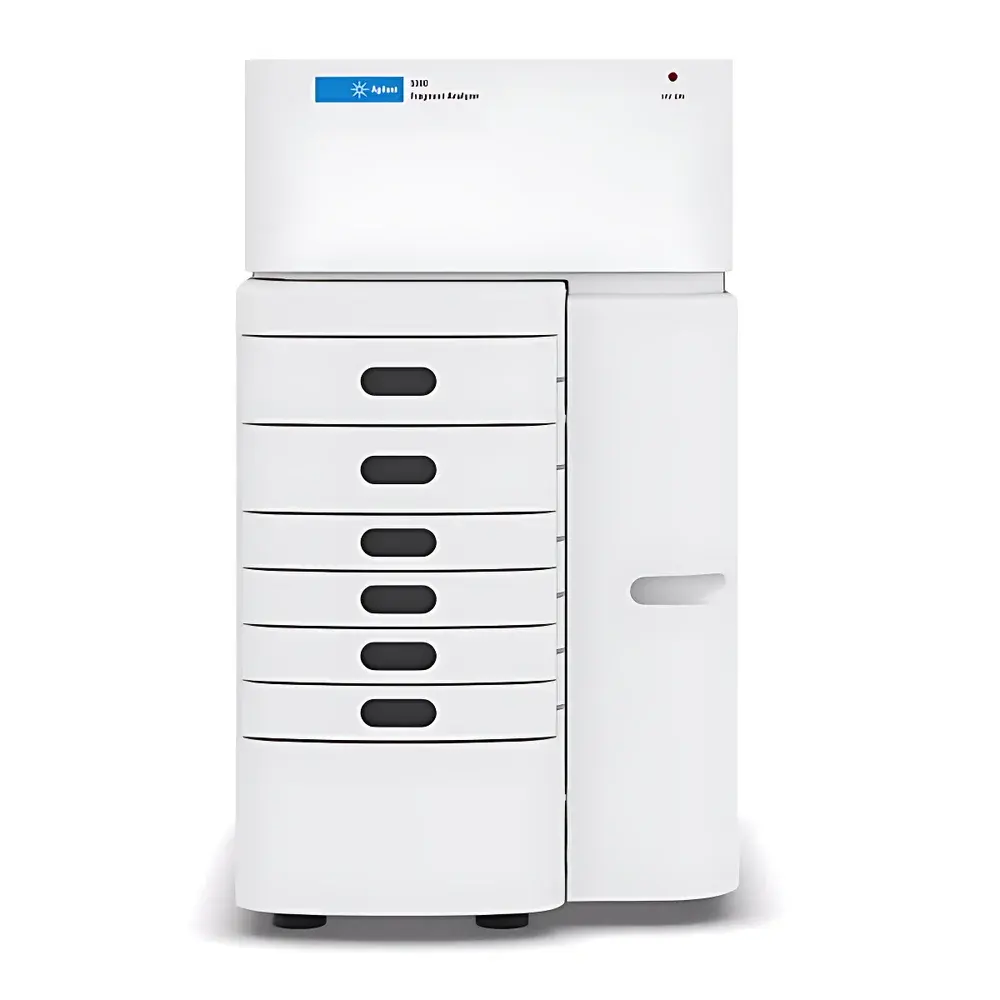
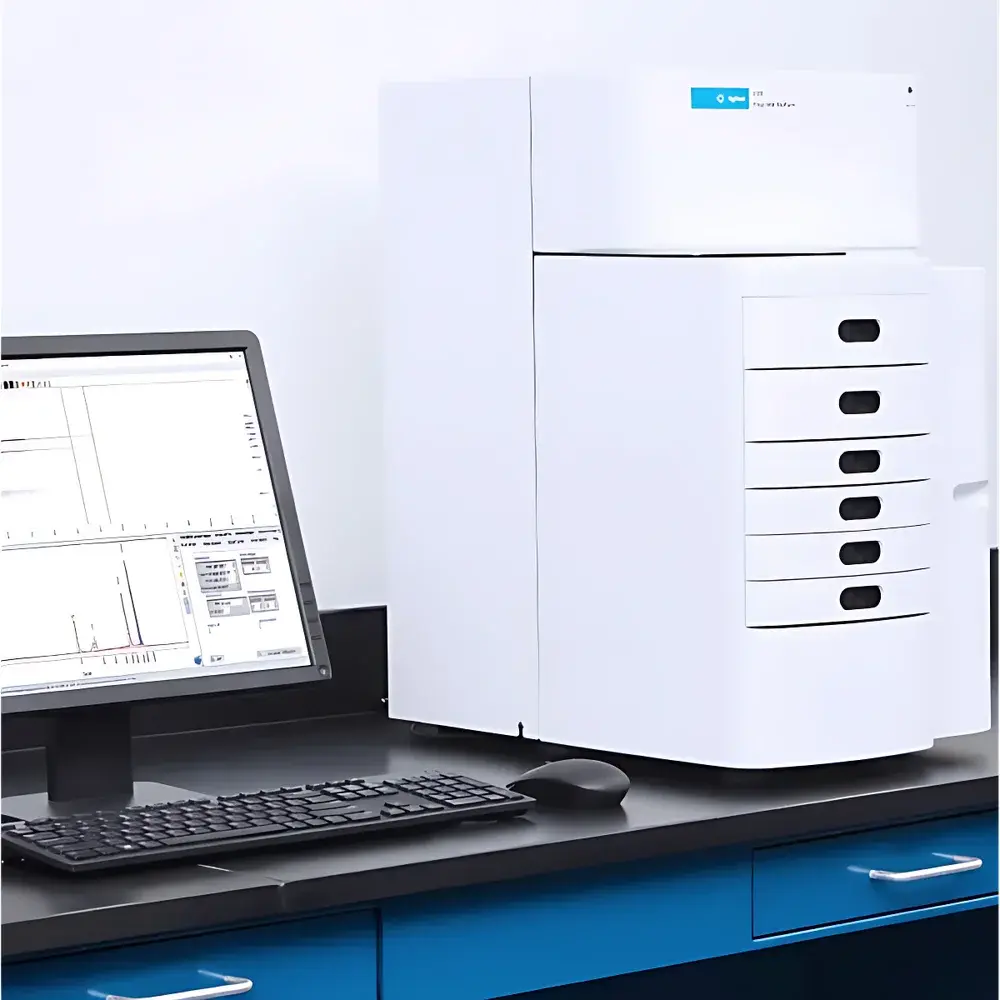
Agilent Fragment Analyzer 5300 Capillary Electrophoresis System
| Brand | Agilent Technologies |
|---|---|
| Origin | Malaysia |
| Manufacturer Type | Original Equipment Manufacturer (OEM) |
| Import Status | Imported |
| Model | Fragment Analyzer 5300 |
| Instrument Type | Capillary Electrophoresis (CE) System |
| Sample Type | Nucleic Acids (DNA, RNA, cDNA, cfDNA, gDNA, mRNA, small RNA) |
| Voltage | 100–240 VAC, 47–63 Hz |
| Power Consumption | 150 VA |
| Operating Temperature | 19–25 °C |
| Relative Humidity | 20–80 % RH |
| Dimensions (W × D × H) | 36 cm × 51 cm × 61 cm |
| Weight | 38.5 kg |
| Throughput | 48 or 96 samples per run (up to 288 samples unattended) |
| Resolution | ≤3 bp for fragments <300 bp |
| Quality Metrics | RNA Quality Number (RQN), Genomic Quality Number (GQN) |
Overview
The Agilent Fragment Analyzer 5300 Capillary Electrophoresis System is an automated, high-reproducibility platform engineered for parallel nucleic acid fragment analysis using capillary electrophoresis (CE) under controlled electrokinetic conditions. Unlike conventional slab-gel or single-capillary CE systems, the 5300 employs a multi-capillary array architecture—supporting simultaneous separation across 48 or 96 independent capillaries—to deliver scalable throughput without compromising resolution or analytical rigor. The system operates on the principle of differential electrophoretic mobility in polymer-based sieving matrices, enabling precise sizing, quantification, and integrity assessment of DNA and RNA molecules ranging from oligonucleotides (50 kbp). Designed for integration into regulated laboratory environments, it supports end-to-end QC workflows for next-generation sequencing (NGS) library preparation, mRNA vaccine development, cfDNA profiling, and total/small RNA quality control—all within a single instrument footprint and unified software interface.
Key Features
- Parallel capillary electrophoresis with configurable 48- or 96-sample capacity per run—enabling batch processing of up to 288 samples without manual intervention
- Pre-validated, room-temperature-stable reagent kits—including High Sensitivity (HS) NGS, HS Small Fragment, RNA, and gDNA assay modules—eliminating daily array conditioning and cold-chain dependency
- Automated capillary array handling and buffer replenishment; no user-initiated priming, rinsing, or gel polymerization required
- High-resolution separation down to 3 bp for fragments below 300 bp, validated against NIST-traceable DNA ladders and RNA standards
- Integrated quality scoring algorithms generating objective, numeric metrics: RNA Quality Number (RQN) and Genomic Quality Number (GQN), aligned with ISO/IEC 17025 and CLSI EP23-A guidelines
- Modular array design allowing rapid switching between separation chemistries (e.g., DNA vs. RNA matrices) without hardware modification or recalibration
- Compliance-ready architecture supporting audit trails, electronic signatures, and instrument qualification (IQ/OQ) documentation per FDA 21 CFR Part 11 and EU Annex 11 requirements
Sample Compatibility & Compliance
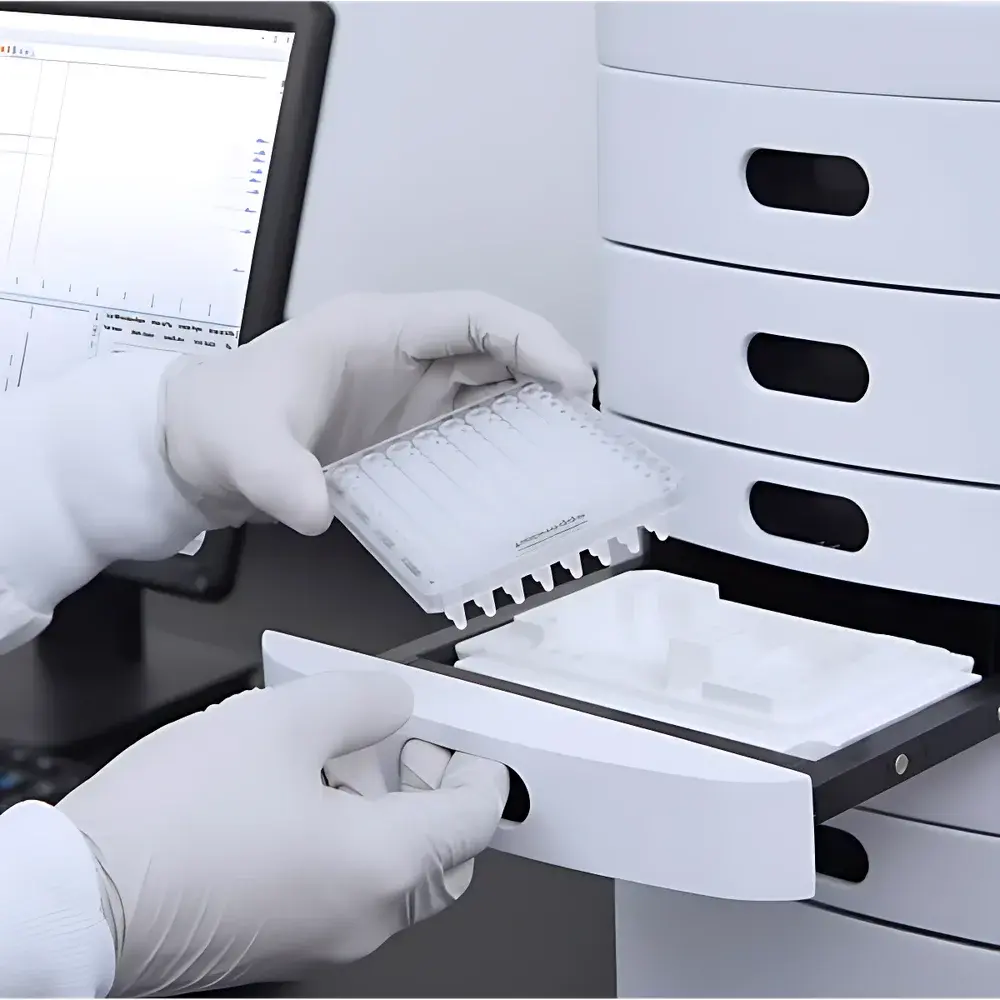
The Fragment Analyzer 5300 accepts native, denatured, or enzymatically processed nucleic acid samples in standard 96-well microplates. It is routinely employed for quality assessment of NGS libraries (including adapter dimer detection), intactness evaluation of in vitro transcribed (IVT) mRNA, integrity profiling of total RNA and small RNA species (e.g., miRNA), and sizing/quantification of fragmented gDNA, cfDNA, and large DNA constructs. All assay kits are manufactured under Agilent’s ISO 13485-certified quality management system and comply with relevant sections of USP , ASTM D7925, and ISO/IEC 17025 for method validation. The system meets electromagnetic compatibility (EMC) requirements per IEC 61326-1 and safety standards per IEC 61010-1, ensuring safe operation in shared laboratory environments.
Software & Data Management
Controlled by ProSize® 5 software, the system provides a secure, role-based interface for method setup, run scheduling, real-time monitoring, and post-run analysis. Data files are stored in vendor-neutral .fda format compliant with MIAME and MINSEQE metadata standards. The software includes built-in tools for lane normalization, peak detection, molecular weight calibration, and statistical reporting—including coefficient of variation (CV%) calculations for inter- and intra-run reproducibility. Audit trail functionality records all user actions, parameter changes, and result exports with timestamps and operator IDs. For GxP environments, optional ProSize® 5 GxP Edition enables full 21 CFR Part 11 compliance, including electronic signature enforcement, data integrity controls, and versioned method archiving.
Applications
- NGS library QC: Quantitative detection of adapter dimers, primer artifacts, and insert size distribution—critical for optimizing cluster density and reducing sequencing waste
- mRNA vaccine development: Assessment of IVT mRNA integrity, capping efficiency, and poly(A) tail length via RQN scoring and fragment mapping
- Single-cell and FFPE-derived nucleic acid analysis: Sensitive detection of degradation patterns in low-input, fragmented RNA/DNA samples
- CRISPR editing validation: Verification of on-target cleavage products and off-target fragment profiles
- Bioprocess monitoring: Real-time tracking of RNA stability during fermentation, purification, and fill-finish steps
- Reference material characterization: Certified sizing and purity profiling for NIST SRMs and ISO reference standards
FAQ
What sample types can be analyzed on the Fragment Analyzer 5300?
The system supports double-stranded DNA (dsDNA), single-stranded DNA (ssDNA), total RNA, small RNA, mRNA, cDNA, cfDNA, gDNA, and synthetic oligonucleotides—using application-specific, pre-formulated assay kits.
Does the system require daily maintenance or capillary conditioning?
No. The 5300 uses stable, ready-to-load polymer matrices and self-cleaning capillary arrays; routine maintenance is limited to weekly buffer replacement and monthly optical calibration.
Can the instrument be integrated into LIMS or ELN platforms?
Yes. ProSize® 5 supports export of structured data (CSV, XML, PDF) and offers RESTful API access for bidirectional integration with major LIMS and electronic lab notebook (ELN) systems.
Is IQ/OQ documentation available for GMP laboratories?
Agilent provides factory-verified IQ/OQ protocols and on-site qualification support, fully aligned with pharmaceutical GMP expectations and regulatory inspection readiness.
How does resolution compare between 48-well and 96-well configurations?
Resolution is identical across both throughput modes; separation performance is governed by capillary length, polymer matrix, and voltage gradient—not well count.



