
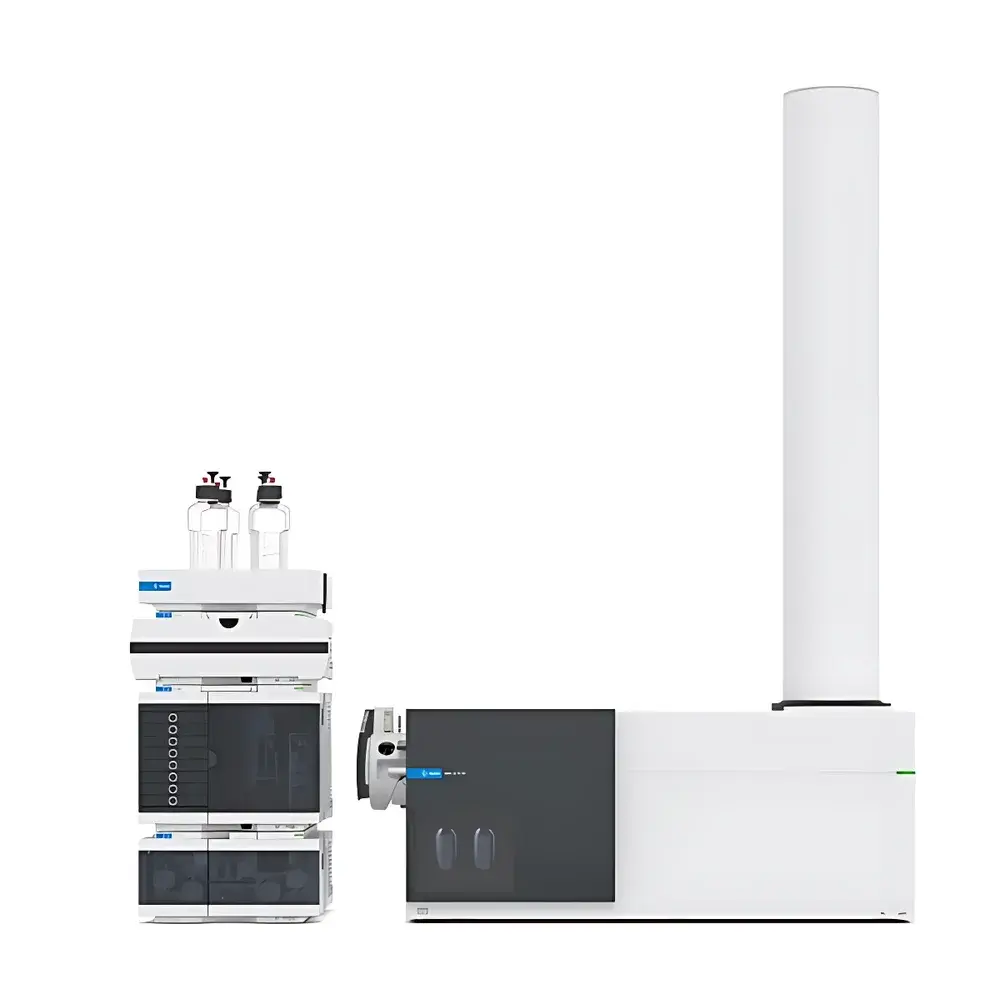
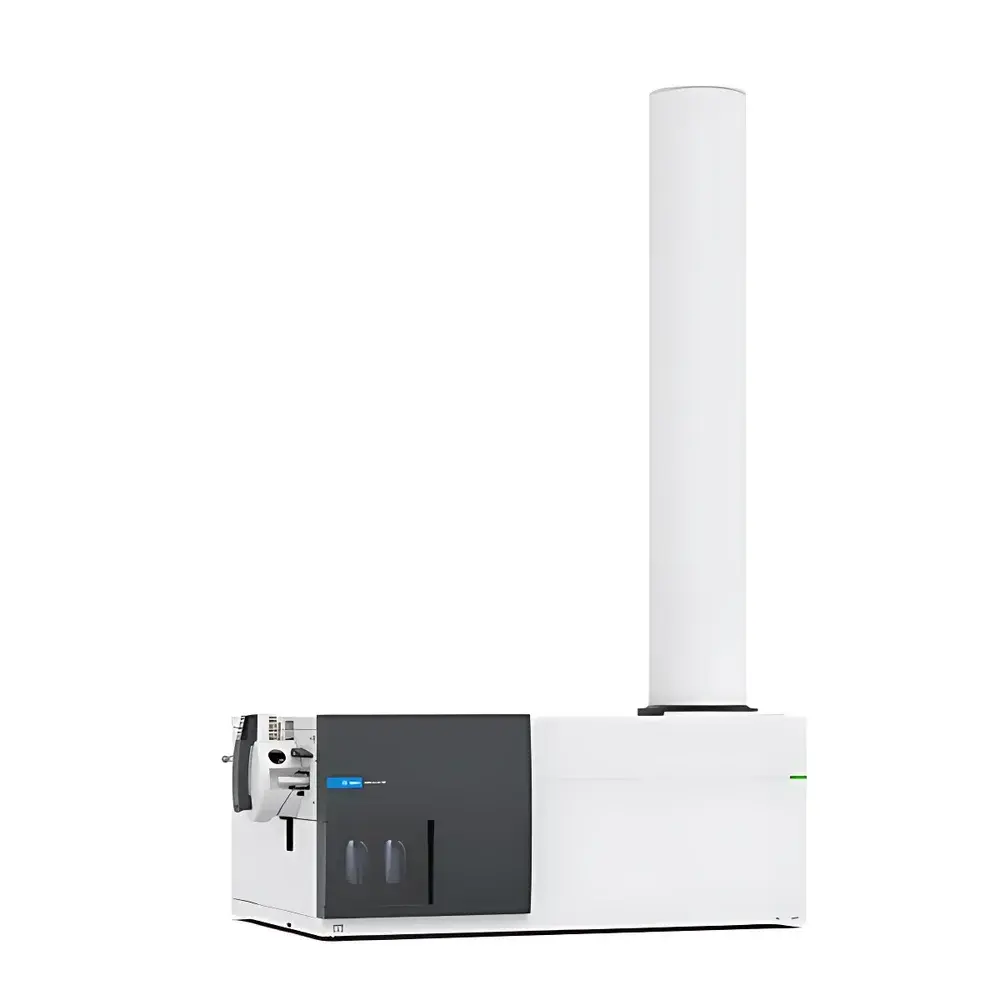
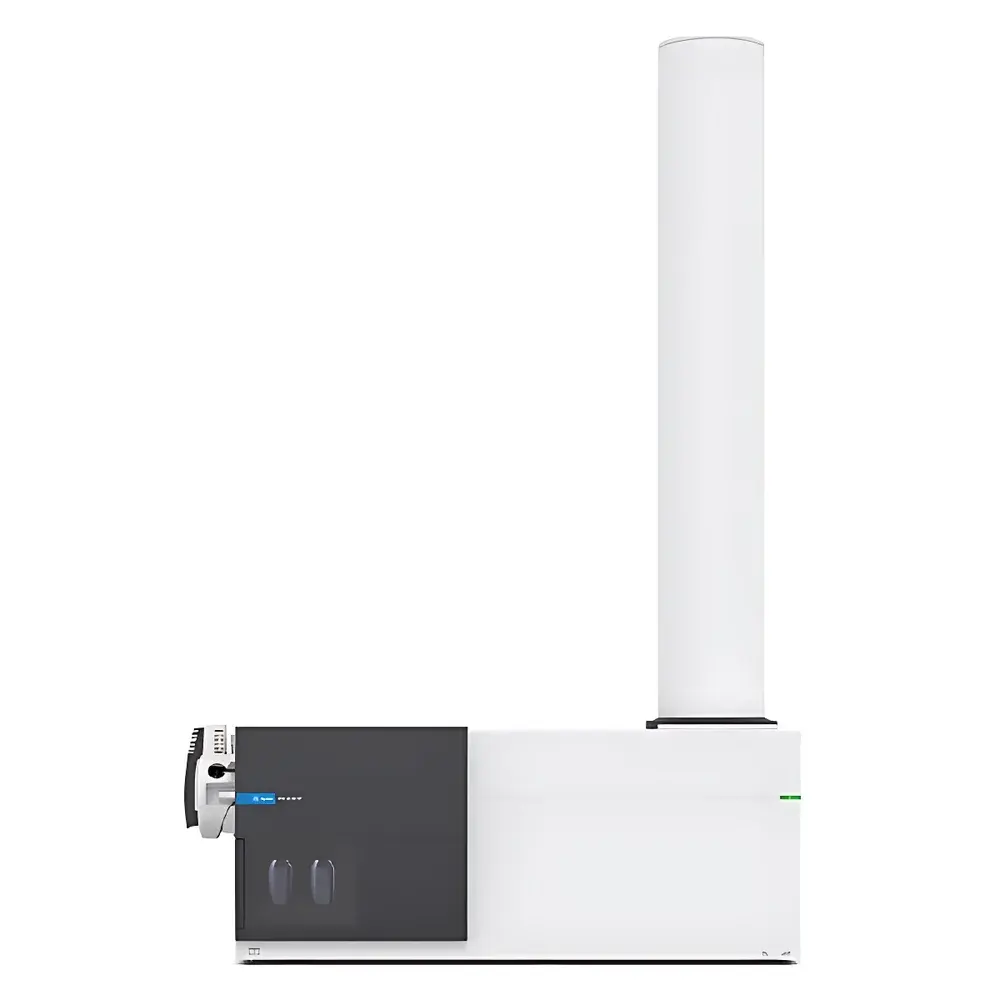
Agilent 6546 LC/Q-TOF Quadrupole Time-of-Flight Liquid Chromatography Mass Spectrometry System
| Brand | Agilent Technologies |
|---|---|
| Origin | Singapore |
| Manufacturer Type | Original Equipment Manufacturer (OEM) |
| Import Category | Imported Instrument |
| Model | 6546 LC/Q-TOF |
| Instrument Type | Quadrupole-Time-of-Flight (Q-TOF) |
| Application Field | Universal |
| Mass Range | m/z 20–10,000 |
| Sensitivity | S/N (RMS) > 500:1 (measured with 1 pg reserpine on-column) |
| Resolution | 30,000–60,000 FWHM (mass-dependent, acquisition-rate independent) |
| Quadrupole Resolution (FWHM) | 1.3 Da (auto-tuned) |
| Mass Accuracy | <0.8 ppm RMS (MS), <2 ppm RMS (MS/MS) |
| Isotopic Fidelity | <5% error |
| Dynamic Range | 5 orders of magnitude (intra-spectrum) |
| Polarity Switching Duty Cycle | 1.5 s |
| Ion Source Options | Dual AJS ESI, APCI, ESI/APCI multimode, GC/APCI, NanoESI |
Overview
The Agilent 6546 LC/Q-TOF Quadrupole Time-of-Flight Liquid Chromatography Mass Spectrometry System is an engineered platform for high-fidelity, untargeted and targeted qualitative and quantitative analysis in complex matrices. It integrates a high-transmission quadrupole mass filter with a high-resolution time-of-flight (TOF) mass analyzer, operating on the principle of orthogonal acceleration TOF detection with analog-to-digital conversion (ADC) signal processing. This architecture enables simultaneous acquisition of accurate mass, isotopic pattern fidelity, and fragment ion spectra without sacrificing duty cycle or dynamic range. The system delivers sub-ppm mass accuracy across both positive and negative ion modes, supported by real-time internal calibration and thermal stability compensation (<1 ppm/3 °C). Its design prioritizes reproducibility in regulated environments—meeting requirements for GLP-compliant metabolomics, FDA 21 CFR Part 11–ready data handling, and ISO/IEC 17025-aligned instrument qualification.
Key Features
- Quadrupole-resolved all-ion (Q-RAI) acquisition mode: Enables simultaneous molecular ion and fragment ion detection within user-defined m/z windows, eliminating off-window interferences while preserving retrospective data interrogation capability.
- Dual-gain ADC detection: Combines high- and low-gain acquisition channels to achieve 5-decade intra-spectrum dynamic range—critical for detecting trace analytes co-eluting with high-abundance species.
- Resolution performance: ≥30,000 FWHM at m/z 118 and ≥60,000 FWHM at m/z 2722, independent of acquisition rate—enabling baseline separation of 13C/2H isotopologues in biological extracts.
- Vacuum-free source maintenance: Capillary insertion valve allows rapid ion source and inlet servicing without venting the TOF vacuum chamber—reducing instrument downtime and contamination risk.
- Multi-mode ionization: Supports dual AJS ESI, APCI, ESI/APCI hybrid, GC/APCI, and NanoESI—ensuring compatibility with volatile, thermolabile, and polar compounds across diverse sample types.
- Robust polarity switching: 1.5-second duty cycle enables reliable dual-polarity profiling within single LC runs—essential for comprehensive metabolite coverage.
Sample Compatibility & Compliance
The 6546 LC/Q-TOF is validated for use with liquid chromatography effluents from reversed-phase, HILIC, and ion-pairing methods, as well as direct infusion and nanoLC workflows. It complies with key regulatory frameworks including USP , ASTM D7904 (petroleum screening), and ISO 17025 method validation guidelines. Its mass accuracy and isotopic fidelity support identification confidence levels per METLIN and HMDB spectral matching criteria (Level 1–2 identifications). For pharmaceutical extractables and leachables (E&L) analysis, the system meets PQRI and EMA CHMP/ICH Q5A recommendations for unknown compound characterization. Data integrity is ensured via MassHunter’s audit-trail-enabled workflow, supporting 21 CFR Part 11 compliance when deployed with appropriate IT controls.
Software & Data Management
The system operates natively within the Agilent MassHunter platform, with dedicated modules for targeted quantitation (Quantitative Analysis), untargeted discovery (Qualitative Analysis), and advanced interpretation (BioConfirm, Lipid Annotator, Mass Profiler Professional). VistaFlux enables stable-isotope-resolved metabolomics (SIRM) with integrated flux modeling. LC/Q-TOF Screener provides automated suspect screening against curated libraries—including pesticides, mycotoxins, PFAS, veterinary drugs, and water contaminants—with retention time alignment, isotope ratio filtering, and false-discovery-rate (FDR)-controlled annotation. All software modules generate FAIR-compliant (Findable, Accessible, Interoperable, Reusable) metadata, exportable in mzML and imzML formats for third-party tools such as XCMS Online and MS-DIAL.
Applications
- Metabolomics & Lipidomics: High-resolution, wide-dynamic-range profiling of endogenous metabolites in biofluids and tissues—paired with VistaFlux for 13C/15N tracer studies and Mass Profiler Professional for biomarker discovery.
- Food Authenticity & Adulteration: Discrimination of geographic origin and detection of economically motivated adulteration using exact-mass fingerprinting and multivariate statistical modeling.
- Environmental & Forensic Screening: Simultaneous quantification of regulated compounds and suspect screening of emerging contaminants (e.g., PFAS, microplastic additives) in wastewater, soil, and air particulates.
- Extractables & Leachables (E&L): Identification of unknown leachables from packaging and medical devices—leveraging high mass accuracy, isotopic fidelity, and MS/MS spectral libraries for structural elucidation.
- Biopharmaceutical Characterization: Optional integration with MOBIE® high-resolution ion mobility (HRIM) extends peak capacity and conformational resolution—supporting CQA assessment of mAbs, ADCs, and glycoproteins per ICH Q5B/Q5C.
FAQ
What is the maximum acquisition rate in full-scan MS mode?
The system acquires up to 50 spectra per second in MS mode and 30 spectra per second in MS/MS mode—maintaining full resolution and mass accuracy across the entire m/z 20–10,000 range.
Does the 6546 support real-time internal calibration during analysis?
Yes—via continuous infusion of reference masses or lock-mass correction using background ions, enabling long-duration runs with sustained sub-ppm mass accuracy.
Can Q-RAI mode be used for retrospective analysis after data acquisition?
Yes—Q-RAI stores all fragment ion data alongside precursor information, allowing post-acquisition extraction of MS/MS spectra for any m/z within the acquired window without re-injection.
Is the system compatible with non-Agilent LC systems?
It supports standard ESI/APCI interfaces and accepts analog/digital trigger signals from third-party UHPLC systems—including Waters, Thermo Fisher, and Shimadzu—via configurable I/O ports.
How does the dual-gain ADC improve quantitative reliability in complex samples?
By independently digitizing high- and low-intensity signals, it prevents saturation of abundant ions while retaining sensitivity for trace components—enabling linear response over five orders of magnitude without dilution or fractionation.





